
Exploring the Tradition: Why Do We Blow Out Birthday Candles?


Nobody decides to blow out candles. The lights go down, the room stops talking, and everyone does the same thing they did last year without being asked. It is the only piece of choreography at a party that needs no explaining.
We have been sending birthday cakes out of our Fortitude Valley kitchen since 2005, which means we have watched that moment go well and go badly several thousand times. The tradition behind it is older than the cake it sits on, and most of it was never about cake at all. Here is where it came from, and what twenty years of putting candles into buttercream in a Brisbane summer has taught us about the two minutes either side of it.
Key Takeaways
- Birthday cakes come down to us from the German Kinderfest and from far older honeyed offering cakes. The cake won the job because it divides: one object, forty portions, cut in front of everybody.
- Blowing the candles out is a Greek and German inheritance. Smoke carried prayers upward, an extra candle was added for luck, and the wish only counts if you keep it to yourself.
- The modern version exists because sugar and flour got cheap. What has not changed is the gap between lighting the candles and cutting the cake, which is the only part of the ritual worth actually planning.
The Birth of the Birthday Cake
Long before anyone sang about it, the birthday cake was doing quiet work at the German Kinderfest. A cake was set out for the child in the morning with a candle burning in the middle of it, and that candle was replaced through the day as it burned down, so the flame never went out. Only at dinner, with the family sitting around it, was it blown out and the cake cut.
Read that again and you can see why the cake was chosen and not, say, a roast. A cake keeps for a day without being touched, it survives being carried into a room, and it divides cleanly in front of an audience. It is the one food at a party that everybody eats at the same moment, which is a social trick nothing else on the table can do.
The older ancestors are honey cakes left as offerings, and there is a plain baker's reason those recipes lasted. Honey holds on to water. A cake sweetened with honey stays soft for days longer than one sweetened with sugar alone, so it was the cake that could be made in advance and still be worth eating when the day arrived.
The round shape gets talked about as a symbol of the year coming back around, and it may well be. It is also the shape of the tin. What matters to us is the top: a cake that has to carry candles needs a genuinely flat surface, so we build the top tier upside down and use the base of the tin as the top of the cake. A domed cake looks fine until a ring of candles goes into it and every one of them leans outward.

Candles and Ancient Greece
Birthday candles are usually traced to ancient Greece and to Artemis, goddess of the hunt and the moon. Her worshippers are said to have brought round cakes to the temple lit with candles, so the cake glowed the way the moon does. Whether or not the detail is exactly right, the instinct behind it is clear enough: put light on the food and the food stops being food.
They were also solving a problem we still solve every week, and it is a harder one than it looks. Wax runs at around forty degrees. Buttercream is comfortable up to about twenty-five. A lit candle is a small heat source standing on something that softens fast, which is why we never send a cake out with the candles already pushed in, and why the candles should go in at the table rather than in the kitchen.
The Greeks blew the candles out so the smoke would carry their prayers up to the gods. Smoke goes somewhere, though, and on a cake it goes onto the icing directly under the wicks. The slice from under the candles always tastes faintly of burnt wick. If the birthday person has a favourite side of the cake, cut it from the other one.
The German Influence on Blowing Out Candles
The Germans added the parts we would now call the rules. Make the wish silently. Tell nobody, or it will not come true. The candles on a cake came to stand for the light of life, one flame for each year lived, and a further candle was added on top of the count for good luck in the year ahead.

That extra candle is the most practical piece of folklore in the whole tradition, because it establishes that the number on the cake is not required to be the age. Past roughly twenty-five slim candles, a six-inch round has more wax on it than icing, and every one of them has to be pulled out by hand before the first cut. Any adult cake we decorate for a milestone gets a handful of candles or a single numeral, and nobody has ever counted.
Two things we tell people at the counter. If the cake is fondant, pierce the holes first with a bamboo skewer and then drop the candles in, because pushing a candle straight through fondant cracks the surface in a star shape that photographs badly. And do not take the cake out of the fridge and light it straight away. A cold cake beads with moisture within minutes in a Brisbane room, and a damp surface will not hold a candle upright.
The Power of Wishes and Smoke
Close your eyes, hold the wish, and take the lot out in one breath. That is the version almost everyone was taught, and the two conditions attached to it have survived unusually well: the wish stays unspoken, and one breath does better than three.
One breath is a harder standard than it used to be. Slim candles sit low, close to the icing, and go out easily. Numeral candles have a fat wick and a broad flame that will happily survive a serious blow from a four-year-old, so if the cake is for a small child, put a couple of ordinary candles alongside the numeral to give them something they can actually extinguish.
Outside, in Brisbane, the wind usually wins first. On a deck or a patio the candles are out before the second line of the song, so light them late, keep a lighter rather than matches in your pocket, and accept that the photo is the point and the flame is optional.
One modern habit is worth stealing. More and more of our customers order a single cupcake to carry the candles, blow that one out, and serve the cake untouched. Since 2020 the request has become common enough that we now suggest it for anything over about thirty guests. The ritual is identical and nobody has to think about whose breath went where.

Adapting the Tradition: Romans and Beyond
The Romans took the idea and made it theirs. They baked flat honeyed cakes leavened with yeast to mark the birthdays of prominent men, which moved the honour from gods and rulers a small step closer to ordinary people. Over the following centuries that step kept being taken until the birthday belonged to everyone.
A flat yeasted honey cake is, to a baker, much closer to a bread than to what we would send out today, and its flatness is not a stylistic choice. Honey browns far earlier than sugar does. Bake that dough deep and the crust is dark long before the middle has set, so the only workable version is a shallow one. Every old recipe you find for it is thin for exactly that reason.
The shift the Romans started is one we see the other end of. The cakes people fuss over most are almost never for the person who asked for a party. They are ordered quietly, a week out, for somebody who said they did not want anything made of it.
Modern Birthday Cakes and Celebrations
The cake still runs the room. What changed was access: once the Industrial Revolution made flour and sugar cheap, a decorated cake stopped being a thing only wealthy households could put on a table, and the ritual spread to everybody at once.
The Brisbane version has its own conditions attached. Buttercream is comfortable up to about twenty-five degrees, so a cake sitting in a car at midday in February is well past it and will arrive with its edges soft. Fondant hates the fridge, since cold makes it sweat and a cake carried back out into the afternoon beads with moisture within minutes. If the party is outdoors, keep the cake inside until the candles are going in.
Timing matters more than most people expect. Our decorated cakes and cupcakes need two to three business days, and the rest of the food is a 4pm cut-off for next-day delivery with no last-minute surcharge. On the day itself, cut earlier than you planned. At a kids' party families start leaving at around the ninety-minute mark, so a cake held back for the end is a cake half the room never sees.

Birthday Catering
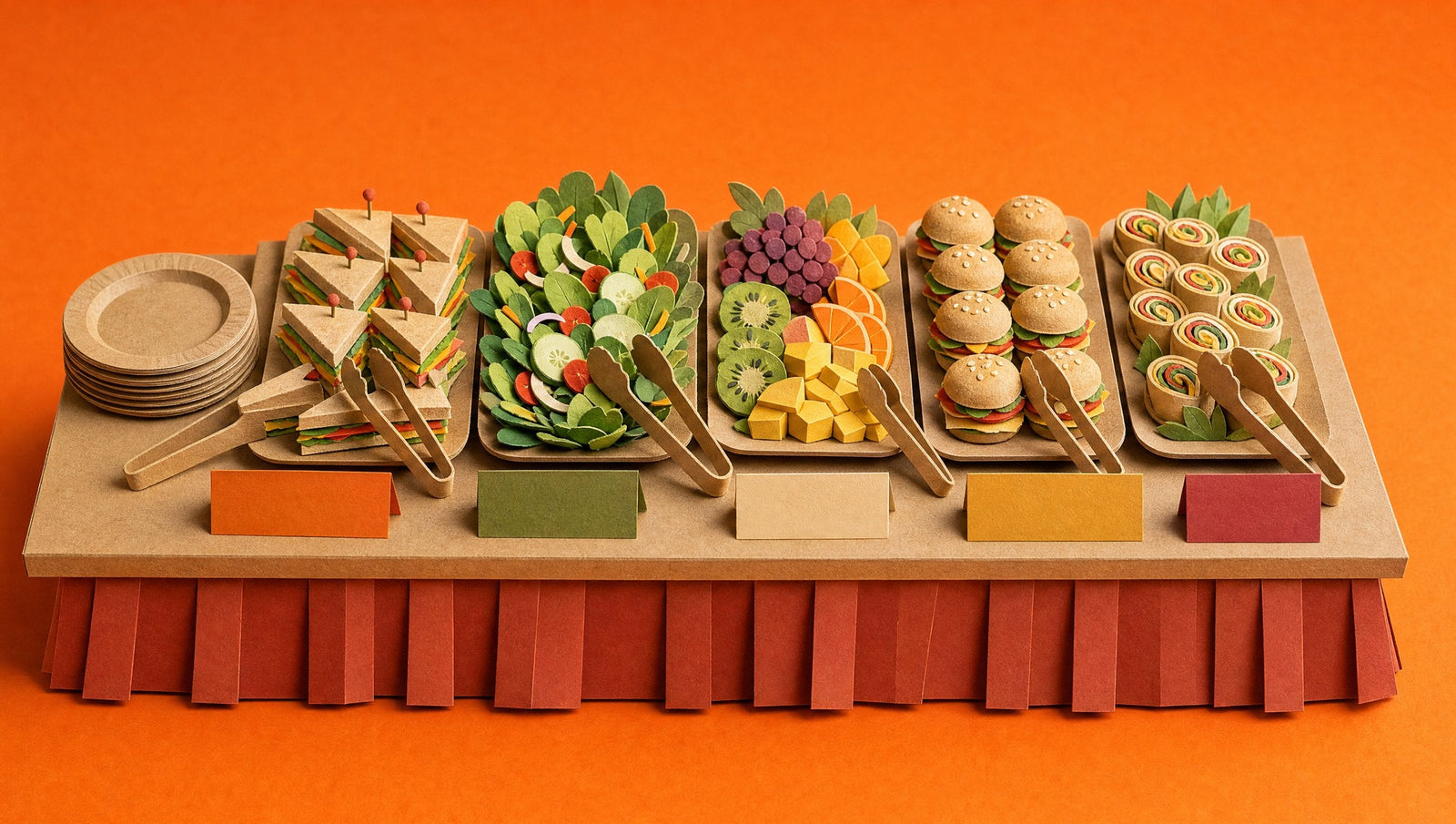
The cake is the ending. Everything before it is the part that decides whether people are still there for it. A working spread for a birthday usually comes down to five things:
- Sandwiches
- Fairy bread
- Finger food
- Mini pies
- Sausage rolls
The numbers are simple. Allow one and a half rounds of sandwiches a head if the party is over a mealtime and one if it is an afternoon with cake to follow, and order about a third more of the vegetarian than you think you need, because everyone eats it and not only the vegetarians. Hot items are at their best for roughly the first thirty minutes after they land, so put the pies and sausage rolls out when the room is full rather than when the first guest arrives.
Fairy bread is the one that catches people. Butter soaks through soft white within an hour or two and the sprinkles go dull, so it is made the day it is eaten and kept covered until the last moment. That is also why it is not something worth doing early to get it out of the way.
Ordering birthday catering from a local kitchen buys you the delivery window as much as the food. Everything is made by hand in Fortitude Valley, delivery starts at $19 on orders over $150 across more than 50 Brisbane suburbs, Saturday is the same rate, and pick-up runs from 7am at 159 Knapp St if you would rather collect it on the way. Tell us when the food is being eaten rather than when you want it dropped off. Those are two different problems and only one of them is ours to solve.

The Happy Birthday Song
Then the singing starts, and it is the same song in almost every English-speaking room on earth. It began in those countries and travelled everywhere, and for decades it sat under a copyright claim that made it genuinely expensive to sing on film. A 2015 federal court decision cleared that, and it is now sung freely.
For our purposes the song is a timer. It runs about fifteen seconds, and that is how long the candles are alight in most rooms. Slim candles lose close to a centimetre a minute, so lighting them while the cake is still in the kitchen means wax on the icing before anyone has seen it. Light them as the cake starts moving.
Two things save the photograph. Hand your phone to somebody before the cake comes out, because the person carrying a lit cake cannot also film it. And leave the room lights on. A dark room looks like the better idea and is not: a phone camera exposes for the brightest thing in the frame, so it chases the flames and leaves the face behind them in shadow.
Unique Candle Varieties and Their Purposes
Candles have multiplied into a small industry, and each type behaves differently once it is standing in icing.

- Trick candles relight themselves and are funny once. They also throw a fresh puff of smoke onto the icing with every relight and drop more wax than an ordinary candle, so use them on a cake you are not planning to photograph.
- Numeral candles are the steadiest thing you can put on a cake, and the heaviest. Push them down into the cake itself rather than seating them in the frosting, or they will slowly tilt while everyone is finding their phone.
- Floating candles belong on water rather than on cake, and are worth remembering for a pool party where the cake is indoors and the light needs to be somewhere.
- Personalised candles do the job a decorator would otherwise be paid for, which makes them a sensible way to lift a plain cake without adding days to the order.
- Sparkler candles burn hard for thirty to forty-five seconds and throw sparks the whole time. Keep them well clear of bunting, napkins and hair, never light them under a smoke alarm, and have somewhere to put them down when they are done.
Whatever the shape, they all run on wax, and wax is the thing that ends up in the cake. Pull the candles out before you cut, and count them out as they come. The ones that sank into soft buttercream are the ones somebody finds later in a slice.
Summary
From a temple in Greece to a kitchen bench in Brisbane, the ritual has been remarkably stable: light something, hope for something, put the light out in front of the people you like most. The cake changed, the wax changed, the song arrived and eventually became free to sing. The gesture has not moved.

Our contribution is unromantic. Order the decorated cake two to three business days out, keep it out of the car boot, put the candles in at the table, light them as the cake starts moving, and cut it before people begin leaving. Do that and the tradition takes care of itself, which is what a tradition is for.
Frequently Asked Questions
What is the significance of lighting candles on a birthday cake?
A lit candle stands for a year lived, and the flames together stand for the light of life. The practice reaches back to ancient Greece, where candles honoured the gods, and to Germany, where each flame marked a year and one more was added for luck. The modern meaning is simpler: it is the signal that everybody should stop and look at one person.
Why do we make a silent wish before blowing out birthday candles?
The rule that came down with the tradition is that a wish spoken aloud is spent. Keeping it to yourself is what preserves it, and taking the candles out in a single breath is supposed to improve the odds. It costs nothing to observe, which is probably why it has outlasted almost everything else attached to the custom.
What is the origin of the 'Happy Birthday' song?
It began in English-speaking countries and spread from there until it became the default in most of the world. It spent decades under a copyright claim, which is why it is rarely heard in older films, and a 2015 federal court decision put it beyond that claim. It is now sung freely at parties everywhere.
How have birthday candles changed over time?
A single candle relit through the day became one candle per year, which became numerals once the counts got unmanageable. Trick, floating, personalised and sparkler candles all followed. If you are planning a birthday party at home, the practical version of that history is short: numerals for adults, ordinary candles for small children who need something they can actually blow out.
Are there any superstitions associated with birthday candles?
Several, and they all point the same way. Lit candles were thought to keep dark spirits off a person on the one day they were considered vulnerable, and the smoke was believed to carry both the wish upward and the trouble away. The extra candle for luck is the last piece of that thinking still standing on a modern cake.

1 Response
Leave a comment
Comments will be approved before showing up.



Dhinesh
March 26, 2025
Happy Birthday