15+ Delicious Morning Tea Ideas for Work to Energize Your Team


A morning tea is the shortest catering job there is. The food goes on a table, a meeting lets out, and twenty minutes later it is over. We have been sending morning teas out of our Fortitude Valley kitchen since 2005 and the shape of it almost never varies. The platters are three-quarters empty inside the first ten minutes, then nothing moves again, and at half past eleven somebody carries the leftovers back to the kitchenette where they sit until they are thrown out at four.
That one observation should drive nearly every decision you make. It is why three small pieces a head is the right number and five is money on the floor. It is why hot food has to arrive when the people do rather than half an hour ahead of them. It is why the gluten free plate belongs at the front of the table and not at the far end, because in a twenty-minute window nobody walks the length of a table twice, and the person who most needs to find their food is the one least likely to push through a crowd to look for it.
What follows is a morning tea planned from the kitchen side. Which sweets survive an hour on a bench and which ones do not, what the savoury half is actually for, how to handle the dietary notes without building four separate menus, and where the money goes if you are trying to feed thirty people well without spending like it is a launch party.
Morning Tea Ideas - Key Takeaways
- Catering for a mixed room means ordering more vegetarian food than you have vegetarians. In a group of thirty the vegetarian platter empties first, mostly to people who eat meat, and then the vegetarians are left with fruit.
- Three small pieces a head, not five. A morning tea is eaten in about twenty minutes and leftovers are a cost, not a kindness.
- Split it roughly sixty sweet to forty savoury for a mid-morning tea, and reverse that if it runs past eleven. After eleven people are eating an early lunch whether the invitation says so or not.
- Hot items decide your delivery time. Pies and sausage rolls hold their heat about twenty to twenty-five minutes in a lidded foil tray. Everything else can wait; they cannot.
- Presentation is height and spacing, not decoration. The same food on two levels reads as more food than the same food laid flat, and a crowded platter looks like it has already been picked over.
- Label what a dish contains rather than what it is free of. “Contains egg and sesame” helps the whole room. “Gluten free” only helps the people already looking for it.
- Cross-contact almost never happens in a kitchen. It happens on your table, when one guest carries a pair of tongs from the sandwiches to the gluten free plate.
- Order by 4pm for next-day delivery. There is no last-minute surcharge, and delivery starts at $19 on orders over $150 across more than fifty Brisbane suburbs, Saturdays at the same rate.
Sweet Sensations for the Sweet Tooth in Every Team
The sweet half of a morning tea does the emotional work, which is why it is the half people remember and the half that gets ordered badly. The mistake is almost always the same: too many soft, creamy, filled things, and nothing that can sit on a bench for an hour without changing. A morning tea rarely starts on time. The meeting runs over, someone is on a call, and the food waits. So the useful question is not which sweet is nicest, it is which sweets are still themselves forty minutes after they were put out.
Here is the range we send out most often for office morning teas, with the honest note about how each one behaves.
Finger lamingtons

Bite-sized versions of the traditional Australian sponge, cut into fingers, dipped in chocolate and rolled in desiccated coconut. The finger shape is not a decorative choice. A cube of sponge has six faces and a finger has more coated surface for its volume, which means more of the outside is held together by set chocolate and less of it is loose crumb, and that is what lets a lamington survive being carried across an office on a napkin.
The coconut is doing the same kind of job. It is not there for flavour so much as to stop the chocolate transferring to fingers, which is why a lamington rolled thinly is a worse lamington in a practical sense as well as a culinary one. And the sponge itself is deliberately not fresh. Sponge baked that morning is too tender to dip; it tears apart the moment it meets the chocolate. It needs a day to firm up first. If you have ever wondered why home-made lamingtons collapse and bought ones do not, that is the reason, and it is the single most useful thing to know about them.
Lamingtons are at their best on the day they are dipped and are still good the next. They are one of the sweets we would put out at the start rather than hold back, because they do not suffer from sitting.
Cupcakes

Vanilla, chocolate and lemon, with buttercream and whatever decoration the occasion calls for. Cupcakes are the one item where morning tea has a genuine advantage over an afternoon function, because buttercream is comfortable up to about twenty-five degrees and starts to slump above it. A ten o’clock tea in a Brisbane office in February is fine. The same cupcakes at three in the afternoon in a room without air conditioning are a different proposition, and the ones nearest the window will tell you first.
The planning note that catches people out is lead time. Plain baking is a next-day job for us, but anything decorated — piped work, colours matched to a brand, a message across a set — needs two to three business days, because the baking and the decorating happen on different days and the decorating is done by hand. If a morning tea is being organised on Wednesday for Thursday, order the undecorated range and put the effort into the table instead.
Mini Danish pastries

An assortment of fruit, cheese and custard, and the closest thing on the table to a bakery item that has to be eaten as a bakery item. Danish pastry is laminated, which means it is built from layers of dough and butter, and every one of those layers is a place for moisture to move into. The custard ones soften from the inside and the fruit ones weep a little syrup into the pastry beneath them. Neither is a fault. It is what fruit and custard do to pastry, and it happens on a clock.
Practically, that gives Danish a window of about two hours from the kitchen before the base goes from crisp to pleasant-but-soft. That is a fine window for a morning tea and a bad one for a spread that has to be set up early and admired for an hour first. If your timing is uncertain, order fewer Danish and more of the dry sweets. If your timing is tight and reliable, Danish is the item that makes a table look like it came from a bakery rather than a supermarket.
Mini almond croissants
Flaky, filled with almond paste and finished with icing sugar. There is a small piece of stagecraft worth knowing here: the icing sugar disappears. Dusted sugar sitting under a lid or a sheet of film pulls moisture out of the air and out of the pastry and within about an hour it has dissolved into a faint damp sheen. The croissant tastes exactly the same and looks like nobody bothered.
So if the dusting matters to you, either take the cover off as soon as the tray lands or ask for a second dusting to be done at the table. This is one of the very few things about a catering order that a customer can improve at their end in ten seconds, and almost nobody knows to do it.
Viennese cookies

Short, buttery, piped biscuits, some flavoured with passionfruit, some dipped in chocolate or dusted with sugar. On any table we send out these are the most forgiving item there is. There is no cream, no custard and very little water in a Viennese biscuit, so there is nothing in it that can move anywhere. It is the same at half past nine and at midday.
That makes them the insurance policy. If you are catering a morning tea attached to a meeting that could finish any time in a forty-minute range, or an all-day training session where the food goes out once and gets eaten in two waves, weight the order towards biscuits and slices and away from anything filled. Nobody has ever complained that a biscuit was a biscuit.
Savoury Delights for a Balanced Morning Tea
The savoury half is not there for balance in a nutritional sense. It is there because a proportion of any office skipped breakfast, and those people will eat a sausage roll at ten in the morning without embarrassment and will not eat three cupcakes. On a purely sweet table you can watch it happen: the same four people hover, take one thing, and go back to their desks. Put out something savoury and they eat properly and stay in the room, which is usually the actual point of holding the morning tea.
Savoury is also where the catering gets technical, because most of it involves either heat or bread, and heat and bread are the two things that behave badly on a table.
Mini savoury quiches

Spinach and feta, or a bacon and cheese Lorraine, set in a short pastry case. Quiche is the most useful savoury item on a morning tea menu for one reason that has nothing to do with taste: it is genuinely good cold. Nearly everything else savoury is a compromise once it drops below warm. Quiche was always going to be eaten at whatever temperature the room is, so it never disappoints anyone.
The one thing to watch is that the pastry base absorbs moisture from the egg over several hours, so a quiche is at its best on the day. Overnight in a fridge and the base softens and the pastry loses its snap. If you have leftovers worth keeping, they are better on a bench under a cloth than in a fridge, which is true of far more baked goods than most people expect.

Baked egg cups with mushroom, vegetables and cheese folded through. Frittatas earn their place because they solve two problems with one item. They are crustless, so they are gluten free by construction rather than by substitution, and the vegetarian versions are vegetarian for the same reason — nothing had to be swapped out or replaced with an inferior stand-in. That matters more than it sounds. A gluten free item made by substituting a flour is always going to be judged against the original. A frittata is not standing in for anything.
They are also protein, which is the thing a morning tea table is usually short of. On an order where somebody has written “two gluten free, one vegetarian” in the notes, a tray of frittatas quietly handles all three of those people without any of them having to be served differently from everyone else, and that is worth more to the person concerned than a separately labelled box with their name on it.

Bite-sized meat pies and pastry-wrapped sausage, and the single item on the list that dictates your logistics. Hot food holds its heat about twenty to twenty-five minutes in a lidded foil tray once it leaves an oven, and after that it is warm pastry rather than hot pastry. It is still perfectly good food. It is just no longer the thing you paid for.
So the rule with hot items is to make the people and the pies arrive together. If the meeting finishes at ten thirty, do not have the food on the table at ten. If the timing genuinely cannot be pinned down, order quiche and frittata instead and skip the hot line altogether — you will get a better result than hot food eaten cold and everybody will assume that is what you meant to do.
The other thing worth saying: do not lid a tray of pies tightly to keep them warm. Trapped steam is what turns a crisp pastry base into a soft one, and it does it in about ten minutes. A loosely covered tray in a warm room stays crisper than a sealed one, even though the sealed one is technically hotter.
Finger sandwiches

Cucumber and cream cheese, smoked salmon with dill, roast beef with horseradish, egg and lettuce. Everything about a good finger sandwich is a moisture-management decision, and the butter is the clearest example. Butter on the bread is not a flavour choice in a catering kitchen. It is a waterproof layer between a wet filling and dry bread, and a sandwich made without it will be soggy in an hour while an identical buttered one is fine at three.
That single fact has a consequence people rarely connect: a dairy free sandwich is a structurally harder sandwich to make well, because you have removed the barrier. The fix is a fat that is not dairy — avocado, hummus, a good mayonnaise — rather than nothing at all. A dairy free sandwich with a dry filling and no spread is the one that comes back uneaten.
The other rule is that sandwiches are cut on the day and never the night before. Cut edges are exposed crumb, and exposed crumb dries out in hours. If somebody offers to make the sandwiches the evening before to save time in the morning, they are trading half an hour of their time for a noticeably worse sandwich.
Grilled chicken, roast vegetable and roast beef rolled in soft tortillas and cut into rounds. A wrap outlasts a sandwich on a table, and the reason is simply that a tortilla is drier than sliced bread and has less surface area exposed per serve. If your food has to sit — a long training day, a spread that goes out at nine for a tea at ten thirty, an event where you cannot control when people arrive — wraps are the more sensible choice and finger sandwiches are the riskier one.
Lay the cut rounds face up in a single layer so the filling shows. Stacked on their sides they read as beige cylinders and get left behind, which is a presentation problem masquerading as a taste problem.
A crackling roast pork filling in a crusty roll with pickled carrot, coriander and chilli. Banh mi is the shortest-lived item we make and it is worth ordering anyway, because when it is right it is the best thing on the table by some distance. The whole point of it is the contrast between a shattering crust and a wet filling, and the pickle attacks the crust from the moment the two meet. That is why the pickle goes in as late as we can manage it.
Order banh mi when the food and the people arrive at the same time. Order something else when they do not. There is no version of a banh mi platter that improves with waiting, and a caterer who tells you otherwise has not stood next to one for an hour.
Mini Ham and cheese croissants
Miniature croissants filled with ham and cheese and warmed through. Two practical notes. The first is that they want to be warm rather than hot, because cheese that has gone properly molten leaks into the pastry and then sets again as a hard patch. The second, and this is the one that ruins them in offices: do not reheat a croissant in a microwave. Microwaving works by moving water around inside the food, and moving water into laminated pastry turns a crisp layered thing into a chewy soft thing in about fifteen seconds. Oven or nothing.
If you have no oven at your venue — and most offices do not, whatever the kitchenette suggests — then plan to eat them at the temperature they arrive at. They are good at room temperature. They are not good after a microwave.
Must Known - Morning Tea Menus for Special Dietary Requirements
Every order that comes through our kitchen has a notes field, and the notes field is where the dietary requirements live. Two gluten free. One vegan. One dairy free but she can have butter. Please no nuts, it is serious. Those notes are the most useful part of an order and they are almost always written last, in a hurry, by someone who does not know how much depends on the wording.
The thing worth understanding is that different dietary requirements need different kinds of handling. An allergy changes how a kitchen works: a clean bench, clean equipment, the item made first in the morning before anything else has been near it. An intolerance changes the menu and nothing else, because the dose matters and a person who is lactose intolerant is generally fine with butter in a sandwich and in trouble after a milky coffee. A vegan or a vegetarian is not a medical requirement at all, and is still absolutely not going to eat around it. If you write “dairy free” when you mean “milk allergy”, you will get food that is fine for the first case and dangerous for the second.

The second thing is a numbers problem, and it is the one that actually goes wrong on the day. The old rule of thumb is that fifteen per cent of an order should be vegetarian and gluten free. Fifteen per cent is not enough, and the reason has nothing to do with how many people have the requirement. It is that in a mixed room the vegetarian and gluten free plates get eaten by everybody. They are usually the fresher-looking, lighter items on the table, they are nearer the front because you put them there deliberately, and by the time the two people they were ordered for get to the table there are three frittatas left. Order for roughly twice the number of people who need it and you will be about right.
The third thing is labelling, and here the whole convention is backwards. Almost everyone labels what a dish is free of. It is far more useful to label what it contains. “Contains egg, dairy and sesame” on a small card in front of a platter is readable by every person in the room with every requirement, including the ones you did not know about, and it does not turn a plate of food into a medical announcement about a colleague. Our product names carry dietary icons for exactly this reason — so the person ordering can see it at a glance and so it can be copied onto a card without anyone having to ring the kitchen.
Below, the three requirements that come up on almost every corporate morning tea order we take.
Gluten Free Goodness Without Compromise
The most useful gluten free items on a morning tea table are the ones that never contained gluten in the first place. Frittatas, fruit, cheese, meat, most slices built on nuts and dates. They do not read as substitutes because they are not substitutes, and nobody eating one feels like they are being catered to as an exception. Add gluten free sausage rolls, garlic chicken balls and gluten free wraps and sandwiches when you want the savoury line to look the same for everybody.

Where it gets genuinely difficult is bread. Gluten free bread stales in hours rather than days — the starch structure that keeps ordinary bread soft simply is not there — which means gluten free sandwiches are the last thing made in the kitchen and the first thing to suffer if food sits around. If your morning tea is going to be delayed, that is the item that gets hurt, and it is the item belonging to the person who has the fewest alternatives on the table. Which is another argument for weighting the gluten free part of the order towards frittatas and slices and away from sandwiches.
The rest of it is your table, not our kitchen. Cross-contact overwhelmingly happens at the serving end. One guest takes the tongs from the sandwich platter, uses them on the gluten free plate, and puts them back. A crumb of ordinary bread on that plate is a real exposure for someone with coeliac disease and no amount of care upstream fixes it. The two-minute solution is a separate plate, its own tongs, and a position at the front of the table rather than the end.
We should also say the honest thing that most bakeries will not. We are not a gluten free facility. There is flour in the air in this kitchen from about five in the morning. We can build a gluten free item without gluten in it, make it first on a clean bench with clean equipment, and tell you precisely what is in it. For most people that is more than enough. For someone with a severe reaction it is not, and they usually know that better than we do.
Dairy Free and Delicious
Dairy free is the requirement that turns up most often and gets planned for least, because dairy is invisible in more things than any other common allergen on a morning tea table. It is in the butter under the sandwich filling, in the cream cheese, in the buttercream, in the milk wash brushed over a bun before it went in the oven, in the pastry itself. A table that looks like it has six dairy free options frequently has one.

The sandwich problem is the practical one, and it is the same butter question from earlier turned around. Take butter out and you have taken out the moisture barrier, so a dairy free sandwich needs avocado, hummus or a good egg-free mayonnaise doing that job or it will be wet in an hour. Tuna, egg and chicken fillings all work without dairy. Dairy free almond cakes, coconut-based slices and a bowl of dips — hummus, baba ganoush, a sun-dried tomato spread — fill out the rest of the table without anything having to be labelled as the special option.
The one that surprises people is the drinks. If you put a jug of almond or coconut milk next to the urn it will separate in hot tea, because the proteins in most nut milks curdle in hot acidic liquid and tea is acidic. It looks like the milk has gone off, and the person who asked for it quietly pours it away. Soy behaves the same way if it is cold going into hot tea. Oat milk is far more stable, and a barista-grade version is more stable again. If oat is not available, serve the alternative milk at room temperature rather than straight from a fridge and it will hold together.
Vegetarian Varieties That Impress
Vegetarian is where a morning tea most often fails quietly, and the failure is arithmetic rather than culinary. Order for the number of vegetarians in the room and the vegetarians will not eat. The plates that look lightest and freshest are the plates everyone reaches for first.

Good vegetarian finger food for a corporate morning tea:
- Mix veggies frittatas
- Gourmet mini vegetarian burgers
- Spinach and feta sausage rolls
- Cherry tomatoes and bocconcini skewers
And sandwich fillings that hold up over a couple of hours:
- Grilled vegetables with hummus
- Avocado and tomato
- Caprese (mozzarella, tomato, and basil)
- Egg salad with vegan mayo
Two build notes from having made a great many of these. Grilled vegetables have to be drained and cooled properly before they go anywhere near bread, because warm roasted vegetables release liquid as they cool and they will do it inside the sandwich. And tomato in a sandwich that has to travel should be seeded, or laid against the cheese rather than against the bread. A slice of tomato sitting directly on white bread will soak through it in about ninety minutes, which is exactly the window between our kitchen and your table.
The traps that catch people out are the ones that are not obviously animal products at all. Parmesan is made with animal rennet. Worcestershire sauce and Caesar dressing both contain anchovy. Most commercial pesto contains parmesan. A vegetarian platter can fail on a dressing alone, and the person it fails for will not say anything.
For something a little more considered, ‘bread and butter’ cucumber sandwiches are still the most requested vegetarian item we make for high teas, and on the sweet side chocolate macadamia brownies, or scones served with blue cheese, pear and honey, give a vegetarian guest something that was clearly made for the occasion rather than left over from it.
The Art of Presentation: Serving Morning Tea with Style
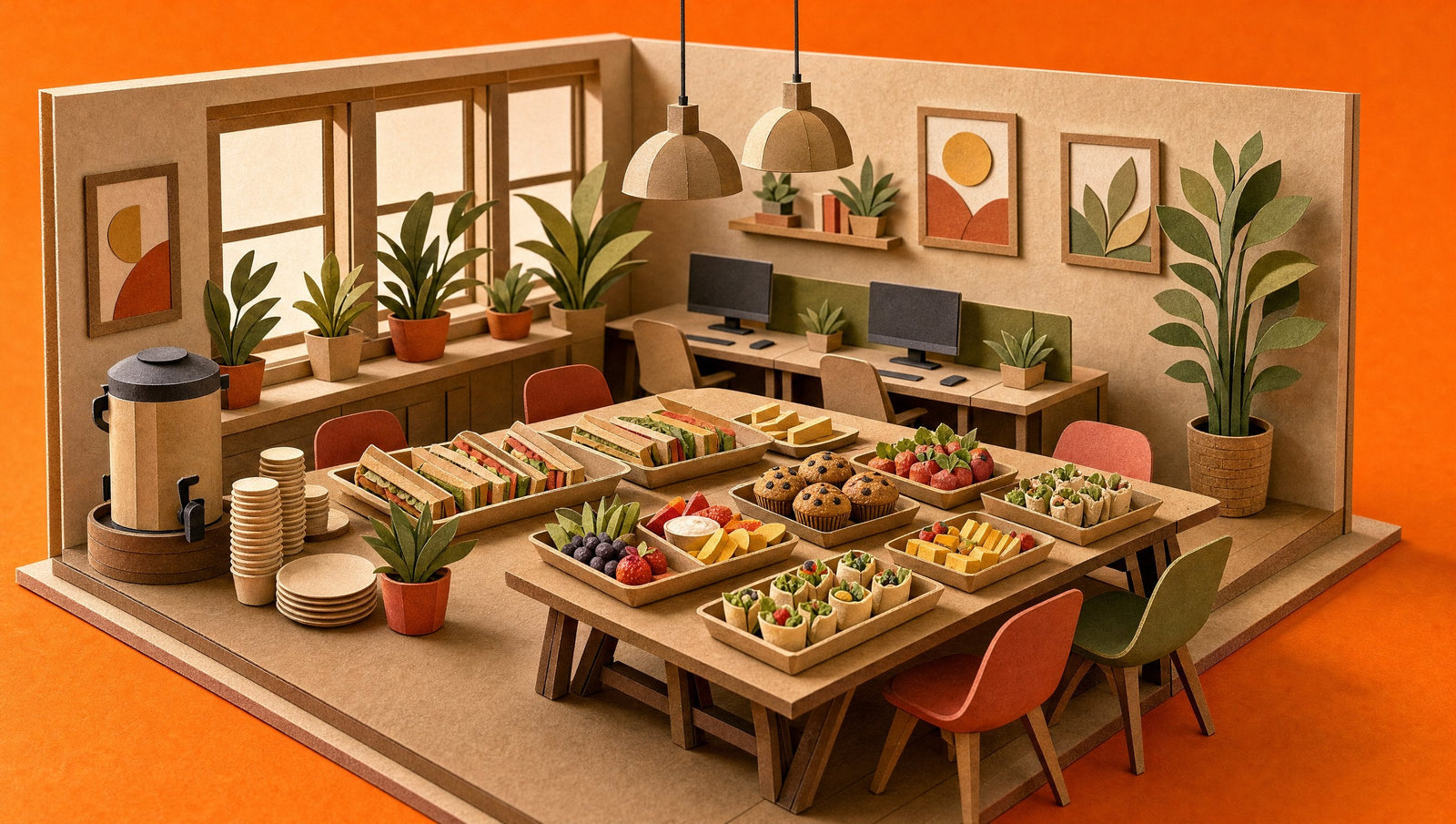
Presentation on a morning tea table is not decoration. It is height, spacing and access, in that order, and all three are about making thirty people able to serve themselves in ten minutes without a queue forming.

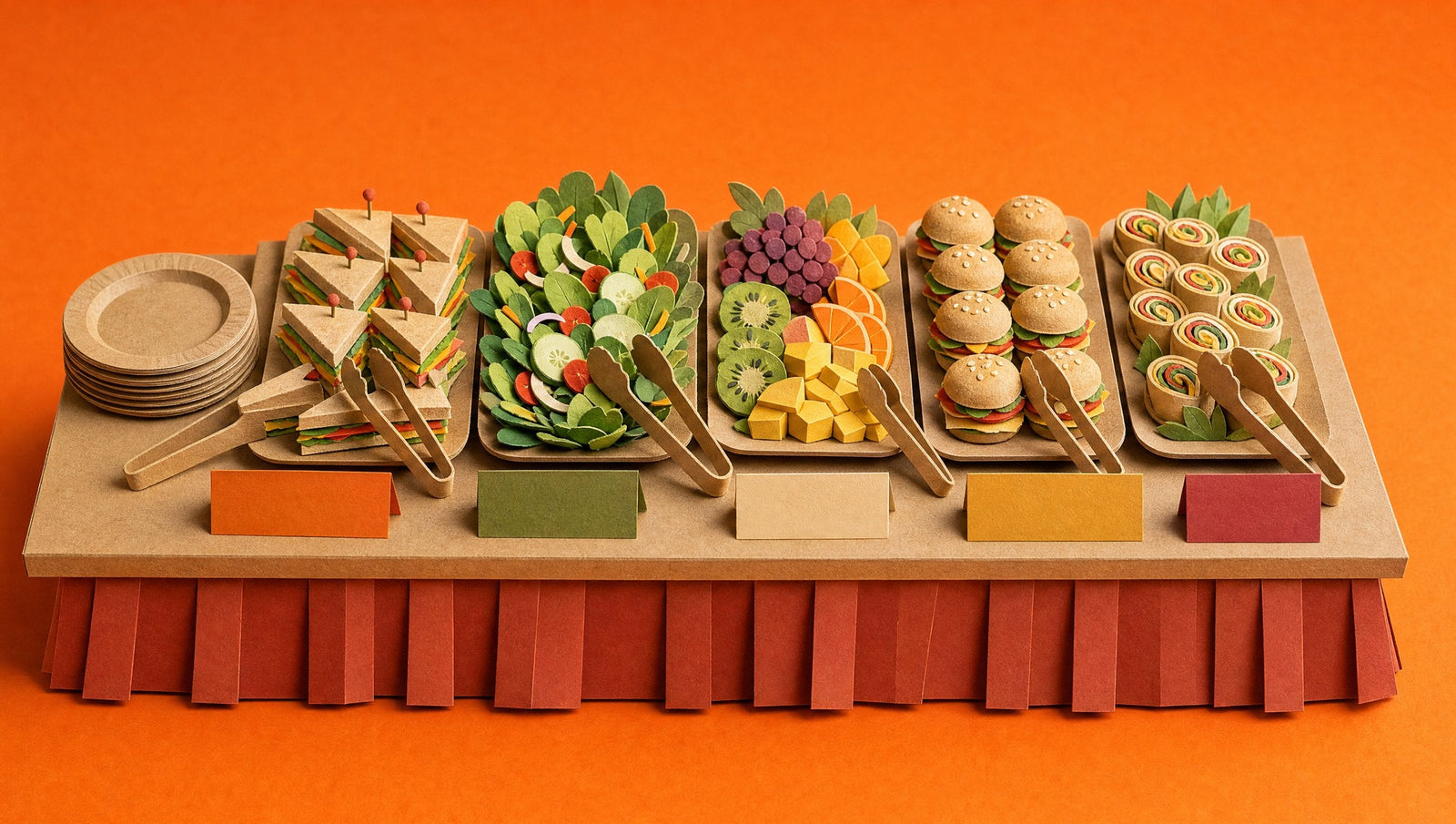
Height first. The same quantity of food reads as considerably more when it is on two or three levels than when it is laid flat, and it also reads as more deliberate. You do not need tiered stands to do it; a couple of upturned boxes under a tablecloth will lift the back row and cost nothing. Flat tables photograph badly and empty unevenly, because everything at the back is invisible until the front is gone.
Spacing second. A crowded platter looks picked-over before anyone has touched it. Leave a finger of space between items and the platter reads as arranged rather than dumped. This is also why a half-empty platter should be consolidated onto a smaller board halfway through rather than left spread out — the same food on the right-sized plate looks generous instead of finished.
Access last, and this is the one that gets ignored. A table pushed against a wall has one serving side and creates a queue. The same table pulled a metre out has two sides and halves the time it takes the room to eat. In a twenty-minute morning tea that is the difference between everybody eating and a third of the room giving up and going back to their desks.
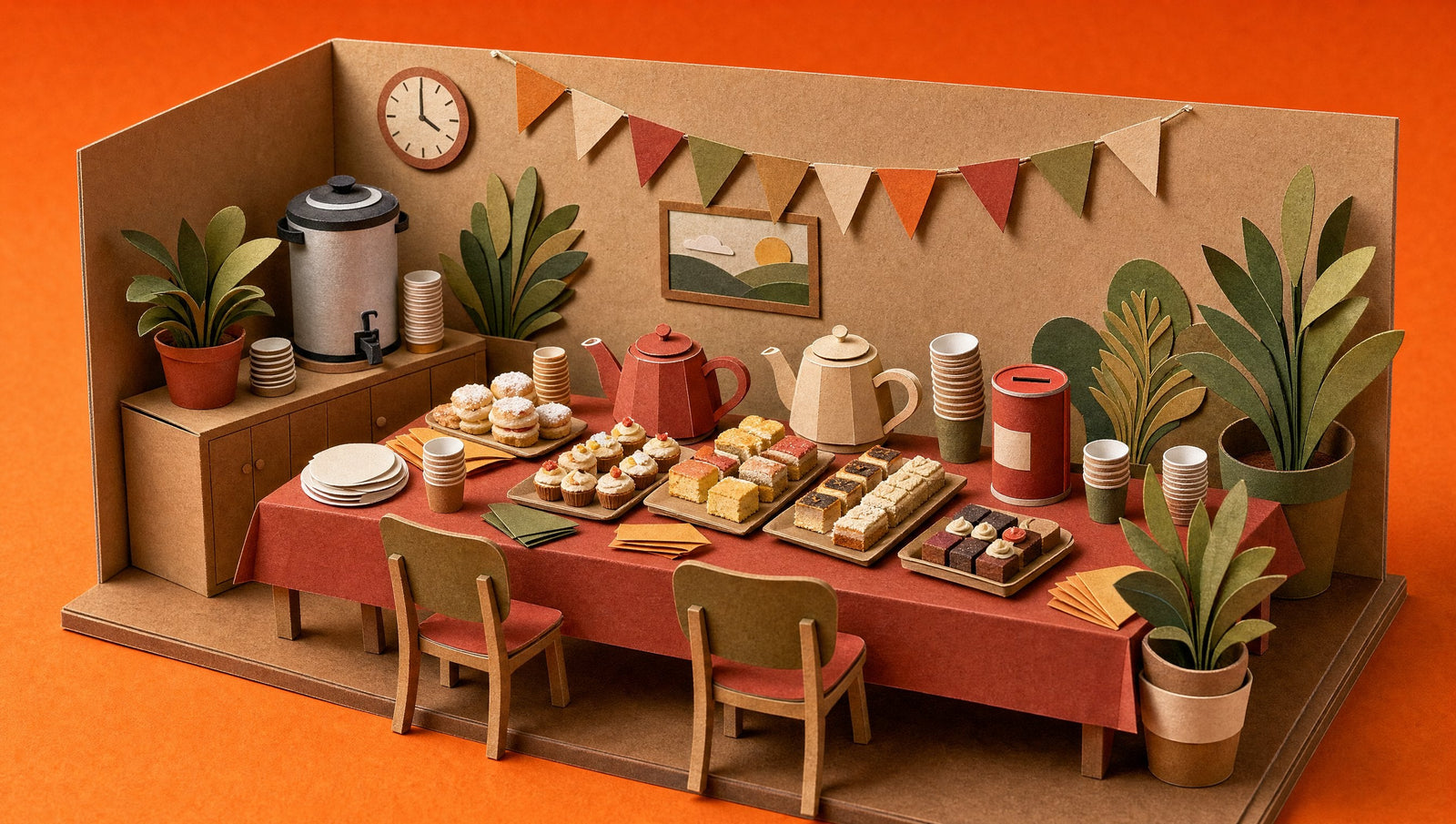
The rest is the easy part: a clean tablecloth, matching napkins, decent cups and saucers, plates and cutlery, and a small floral arrangement kept low enough that people can see over it. Edible flowers such as sugared pansies or lavender lift a plate of plain biscuits at almost no cost. Vintage teapots and cups from an op shop or a discount store do more for a morning tea than expensive matching crockery, and if you host these regularly they are worth collecting a few at a time.
Platter Perfection
A morning tea platter is built on contrast — colour, texture and shape — and on one hard rule about what is allowed to touch what. A good spread across a table of thirty looks something like:
- Fruit platter
- Flan tart collection
- High tea collection
- Savory quiches platter
- Gourmet sandwiches

The hard rule is that nothing wet goes next to anything pastry. Watermelon, pineapple and orange all release liquid onto a board as they sit, and that liquid travels. A fruit platter is a wonderful thing and it belongs on its own board, not sharing with the tarts. The same applies to anything dressed: a dressed salad or a bowl of dip needs its own plate and preferably its own corner of the table.
The other rule is single layer, never stacked. Anything stacked sticks to the thing above it and comes apart when the first person tries to take one. It is most dramatic with rice paper rolls, where the wrappers weld to each other within minutes, but it is true of sandwiches, wraps and slices as well. If you have more food than board, use another board.
On sequencing: fruit and anything cut from fresh produce goes out last, because it is the item that visibly ages. Baked goods can go out first without anyone being able to tell. If you are setting up thirty minutes early, set up everything except the fruit, then bring the fruit in when the room fills. The same logic works for an afternoon tea, where the wait is often longer and the room warmer.
Serve It Right
Temperature is where an otherwise well-planned morning tea comes apart, and there are only a handful of things to get right.

Croissants and other laminated pastries want to be warm, which brings out the butter and the flake. Party pies and sausage rolls want to be genuinely hot, and they are on a twenty-minute clock from the moment they leave heat. Quiche and frittata are honest at any temperature. Tea wants to be hot but not scalding, which in practice means letting a boiled urn stand for a minute before pouring, particularly for black tea drunk with milk — water straight off the boil pulls hard tannin out of tea leaves and the result tastes bitter no matter how good the tea is.
The lid question is the one people get exactly backwards. Covers keep food warm and they also trap steam, and trapped steam is water condensing back onto the food. Ten minutes under a sealed lid will take the crispness out of a pastry base that was perfect when it was covered. Take covers off as the room starts to fill rather than leaving everything sealed until the moment of serving, and if you must cover something for a long stretch, vent it — a corner of the film lifted is enough.
Anything sweet and wet goes on at the last second. Maple syrup drizzled over bacon rolls thirty minutes early is syrup soaking into bread; drizzled as the tray goes down it is a glaze. Icing sugar is the same. And a bread basket lined with a cloth napkin is better than a covered container for croissants and rolls, because the cloth absorbs the moisture that a hard lid would return to the pastry.
Morning Tea Ideas That Double as Conversation Starters
Most advice about making a morning tea social involves games or discussion prompts. In our experience the room is organised by the furniture long before anyone gets to a prompt, and the layout does more work than any activity.

One table with two open sides puts people shoulder to shoulder, moving slowly, in front of food they have to make a decision about. That is a conversation whether anyone intended one or not. Two tables at opposite ends of a room split it into two groups that never mix. Individual boxes handed out at desks produce no conversation at all, which is fine if the goal is feeding people quickly and a failure if the goal was to get the room talking.
Grazing tables and shared platters do the same thing more deliberately. Food that has to be served from a common board keeps people standing in one place for longer, and it is why grazing works so well for workshops and training days where the group does not know each other yet. Dairy free protein balls or an unusual slice will start a conversation on their own simply because somebody asks what is in them.
The one piece of scheduling that helps more than anything else: put the food out where people have to walk past it to get to the tea and coffee. Nobody attends a morning tea for the food, but everybody comes for the coffee, and the queue at the urn is where the talking happens.
Sweet and Savoury Pairings
Pairings that reliably work on a morning tea table:
- Bacon and maple syrup
- Cheese and fruit preserves
- Peanut butter and banana
- Prosciutto and melon
- Honey and goat cheese
A savoury croissant next to a strawberry jam and cream lamington is the version of this that shows up most often on our order forms, and it works for the same reason all of the above do: salt makes sweetness read as less sweet, so the pair together is more interesting than either on its own.
The catering caveat is a physical one. Keep them on separate boards. Sweet and savoury sharing a plate is a good idea in the mouth and a bad idea on a table, because pastry and bread pick up smells fast. A ham croissant sitting against a passionfruit biscuit for an hour gives you a biscuit that tastes faintly of ham, and there is no way back from that. Pair them across the table, not on the same board.
Effortless Morning Tea Catering for Corporate Events
The reason offices outsource a morning tea is not the cooking. It is that the person organising it has a job already, and a morning tea done properly is a two-hour errand at the exact time of day when the shops are busiest. Morning tea catering in Brisbane exists to turn that errand into a five-minute order that arrives ready to put on a table.
The practical detail that matters most for an office: our cut-off is 4pm for next-day delivery, and there is no last-minute surcharge for using it. A morning tea decided on at three in the afternoon for ten the next morning is an ordinary order, not an emergency one. Delivery starts at $19 on orders over $150 and we cover more than fifty Brisbane suburbs, with Saturdays at the same rate rather than a weekend loading. If you would rather collect, pick-up runs from 7am at 159 Knapp Street in Fortitude Valley, which suits an early meeting better than any delivery window can.
The other thing worth knowing is what “ready to serve” means in practice. It means the platters come arranged, and the only thing left to do at your end is take the covers off and find a space. It does not mean the food improves while it waits. Everything above about heat, moisture and cut edges still applies once the boxes are in your kitchenette, and the ten minutes of thought you put into when it lands is worth more than another fifty dollars of food.
Catering Options for Every Corporate Event
Catering services for corporate events fall into a handful of formats, and the format is usually a better decision than the menu:
- Finger foods
- High teas
- Grazing tables
- Buffets
- Sit-down meals
For a morning tea the honest answer is nearly always finger food, because it is the only format that works when people are standing, holding a coffee, and have one hand free. High tea suits a slower occasion — a farewell, a milestone, something where people are sitting down and the food is part of the event rather than an interruption to it. Grazing is for longer sessions where people graze across a couple of hours instead of eating in one go.

Individual boxes are the format worth knowing about for training days and workshops. A box per person costs a little more per head than a platter, and it buys back the fifteen minutes a room takes to serve itself from a table. If a facilitator has to restart a session on time, that is a good trade. It is also the right format when the group is spread over several rooms, or when the food has to be handed to people rather than laid out.
Whichever format you choose, it ends up marking time in the day. The morning tea is the point where a long session breaks, and people will start looking at the table five minutes before it is due. That is a reason to have it ready slightly early and a reason not to put the hot food out until the moment it is needed.
Ensuring Timely Delivery for Your Event

Delivery is where catering either disappears into the background or becomes the thing everybody remembers, and there are two or three things a customer can do that make a large difference to how it goes.
Ask for the food a little before you need it, not on the hour. A delivery run covers a lot of Brisbane in a morning and it arrives inside a window rather than on a minute. Half an hour of margin costs you nothing for cold items and gives the driver room to get through traffic without the whole thing hanging on one set of lights.
Give a mobile number for someone who is actually in the building and not in the meeting. This is the single most common cause of a late delivery in the CBD, and it is nothing to do with the kitchen. A city tower with a loading dock, a security desk and a lift that needs a pass adds ten to fifteen minutes over a ground-floor shopfront, and it adds thirty when the only contact number on the order rings out at an empty desk. If your building has a dock or after-hours access rules, put them in the order.
And keep the hot items separate in your head from everything else. Cold platters can arrive an hour early and be perfectly fine in a cool room. Hot food cannot, and if the two have to arrive together then the hot food sets the time. If a delivery window will not line up with your meeting, pick-up from 7am is the reliable alternative, because a ten-minute drive with the boxes on your own back seat is the shortest possible gap between an oven and a table.
Morning Tea on a Budget: Smart Choices for Cost-Effective Catering
A morning tea is the cheapest hospitality an office can offer, and it is still routinely over-ordered by half. The best saving available to anyone is not a cheaper supplier. It is ordering the right amount.

Three small pieces a head is the working number for a mid-morning tea of about half an hour. Five is what people order when they are anxious about running out, and five is where the leftovers come from. If the tea runs long, or it starts after eleven, or it is the only food at an all-morning session, then four to five is right — but that is a different event and it should be a deliberate decision rather than a nervous one.
Where else the money actually sits:
- Sweet is cheaper than savoury per piece, because savoury carries meat and more hands-on assembly. Shifting the ratio ten per cent towards sweet is a real saving and nobody notices at a morning tea.
- Mini items cost less per head than large items cut down, and they portion honestly. A large cake cut into thirty pieces looks mean at piece twenty-five.
- Seasonal fruit is dramatically cheaper than out-of-season fruit and always tastes better. In a Brisbane winter that means citrus and apples, not berries.
- One or two impressive items beat a table of adequate ones. A room notices the best thing on the table and forgets the rest.
- Use your own crockery. Disposable cups and plates for thirty people, bought in a hurry from a supermarket, cost more than most people expect and look worse than the mugs already in the cupboard.
Last tip - DIY Morning Tea Ideas
There is a sensible dividing line between what is worth making yourself and what is not, and it is drawn by equipment rather than skill. Make the things that need a knife and a board. Buy the things that need an oven, lamination, tempering or two days of lead time.

So: fruit skewers, dips, a good fruit platter, granola bars, scones, a banana bread, cheese and crackers laid out well. All of those are worth doing at home and all of them save real money. Pastry, laminated anything, decorated cakes and hot savoury items are not, because the ingredients cost about the same and you will spend three hours getting a worse result.
Two notes if you are making it yourself. Fruit skewers should be assembled the morning of, not the night before — cut fruit weeps overnight and a skewer that sat in a fridge arrives sitting in a puddle. And anything with apple, pear or banana on it needs a squeeze of lemon or lime over the cut faces or it will be brown by the time people see it.
If you are running a bring-a-plate morning tea, name the categories when you send the invitation. Ask for a plate and you will get six banana breads and no savoury; ask three people for savoury, three for sweet and one for fruit and you will get a table. That is the entire trick, and it costs nothing.
Summary
A morning tea is a twenty-minute event and it should be planned like one. Three pieces a head. Roughly sixty per cent sweet and forty per cent savoury, reversed if it runs past eleven. Hot food timed to the people rather than the clock, and dropped altogether if the timing is uncertain. Dry sweets when the schedule might slip, filled ones when it will not.
Order for twice as many vegetarian and gluten free guests as you have, put those plates at the front of the table with their own tongs, and label what the food contains instead of what it is free of. Build the table upwards, pull it away from the wall so it has two sides, and keep the wet things off the pastry.
None of that is expensive and none of it is difficult. It is just the handful of things that decide whether the food gets eaten properly or gets carried back to the kitchenette at half past eleven, and it is the part nobody tells you when you are handed the job.
Frequently Asked Questions
How can I cater to different dietary needs during morning tea?
Include gluten free, dairy free and vegetarian options, and order about twice as much of them as you think you need — in a mixed room those plates get eaten by everybody. Favour items that never contained the allergen rather than substitutes, so frittatas and fruit over gluten free bread. Give each of those plates its own serving tongs and put it at the front of the table, because cross-contact happens at the serving end, not in the kitchen. And label what each dish contains rather than what it is free of.
How can I make my morning tea spread visually appealing?
Height first: lift the back row on upturned boxes under the tablecloth so the whole spread is visible at once. Then spacing — leave a small gap between items, and consolidate a half-empty platter onto a smaller board rather than leaving it spread thin. Contrast colour and shape across the table, keep any flowers low enough to see over, and put the fruit out last so it is the freshest-looking thing on the table when the room walks in.
How can I ensure my morning tea is served at the right temperature?
Hot pastries hold about twenty to twenty-five minutes from the oven, so time them to the people rather than putting them out early. Do not seal them under a tight lid to keep them warm; trapped steam softens the base in ten minutes, so cover loosely or vent it. Let a boiled urn stand a minute before pouring so the tea is hot rather than scalding. Quiche and frittata are honest cold, which makes them the safe choice when the timing is uncertain.
How can I make my morning tea a conversation starter?
Arrange the room rather than the activity. One table pulled away from the wall so people can serve from both sides keeps everyone in the same place for longer, and putting the food between the door and the coffee means the whole room walks past it. Shared platters and grazing formats keep people standing together; individual boxes handed out at desks do the opposite. An unusual item or two gives people something to ask about without any prompting.
How can I organize a morning tea on a budget?
Order three pieces a head instead of five, which is the single biggest saving available. Shift the ratio slightly towards sweet, since savoury carries the meat and the labour. Choose mini items over a large item cut down, and seasonal fruit over out-of-season. Make the things that only need a knife and a board — fruit skewers, dips, granola bars — and buy the pastry. Use the mugs already in the office kitchen instead of buying disposables for thirty people.

Leave a comment
Comments will be approved before showing up.