
Understanding What is Catering: A Comprehensive Guide


The dictionary answer to what is catering is the provision of food and drink for an event. That is true and it is no help to anybody, because it describes two completely different businesses that happen to share a word.
One of them cooks somewhere else and delivers. Food is made in a commercial kitchen, packed, driven to an address and left on a table. Nobody stays. The other one brings the kitchen to you: chefs, waiters, hire equipment, a service plan and a bump-out at midnight. The first is a delivery business with cooking attached. The second is a labour business with cooking attached. They are quoted differently, they are priced differently, and most of the confusion people have about catering comes from ringing one and expecting the other.
We are the first kind. We have baked and delivered catering out of Fortitude Valley since 2005, mostly to offices, sites, schools, funerals and family gatherings around Brisbane, and the honest version of the job is that the cooking is the easy part. Anyone can make forty sandwiches. Making forty sandwiches that are still worth eating at one o'clock, after a forty-minute van run and an hour on a boardroom table, is the actual trade.
This guide walks through what catering is, what the different kinds of it do, and what a person ordering food for a room full of people needs to know before they order it. Where the honest answer is “that is not us, that is a different business,” we say so.
Catering - Key Takeaways
- Catering splits into drop-off and on-site. Drop-off is food delivered and left. On-site brings staff and equipment. The price gap between them is labour, not food.
- The most expensive part of a staffed event is the hours, and you pay for set-up and pack-down as well as the time guests are actually eating.
- Quantity beats variety. Ordering six kinds of thing and not enough of any of them is the most common mistake in event food, and it is the one guests notice.
- Order by the time of day, not just the head count. A room at eight in the morning eats about half of what the same room eats at noon.
- Food safety in catering is a clock, not a fridge. Between five and sixty degrees, two hours out is fine, four hours is the end of it, and a Brisbane afternoon runs that clock faster than the rule assumes.
- Presentation in delivered catering is mostly packing. Food laid in rows arrives in rows. Food piled up arrives as a heap.
- Dietary requirements belong in the order, not in a text message on the morning. Our cut-off is 4pm for next-day delivery, and there is no last-minute surcharge for using it.
- The most common delivery failure is not the food. It is a locked door, an unnamed room or a phone nobody answers.
- Ask a caterer for a delivery window rather than a time. Any honest one runs a route, not a teleporter.
Decoding Catering: The Essentials of Serving Food at Events
Strip the industry language away and catering is one problem repeated: food has to exist in a place that is not a kitchen, at a time somebody else chose, in a condition close enough to how it left. Everything a caterer does is arranged around that sentence.

It is why catering menus look conservative to people who cook at home. A restaurant plate is finished thirty seconds before it is eaten. A catering platter is finished hours before it is eaten, and in between it is stacked, wrapped, loaded, driven, carried up a lift and set down on a table in a room the kitchen has never seen. Dishes that survive that are a narrower list than dishes that taste good. Sandwiches, wraps, cold platters, slices, baked goods and fruit hold. Anything crumbed or fried has about fifteen good minutes and is ordinary after thirty. Anything dressed in advance has less than that, because salt draws water out of leaves inside a closed box and a rocket salad dressed at nine is soup at eleven.
The second half of the job is timing, and it runs backwards. A delivery run is not built forwards from when the kitchen finishes; it is built backwards from the earliest drop. If the first order is a 7:30am breakfast in the CBD, the driver leaves at 6:40, which means that food is packed by 6:20, which means it is made from about 4:30. Every later order on that run is then shaped by the first one. When a caterer says a delivery window is 10:00 to 10:30 rather than 10:15, that is not vagueness, it is arithmetic on a route with traffic in it.
The third part is the one nobody thinks of as catering at all, which is information. A caterer has to know what is in every item, be able to say it out loud, and label it so the host does not have to answer questions all lunch. On a forty-head office order it is now unusual to get no dietary notes at all. Two gluten free, one vegan and one dairy free is an ordinary Tuesday.
Serving food at an event, in other words, is a logistics job wearing an apron. The parts guests notice are flavour and the look of the table. The parts that decide whether it works are the packing, the route and the notes field.
The Spectrum of Catering Services
The useful way to sort catering is not by the type of event but by how much of the event the caterer owns. There are four steps and each one adds a cost line.

Food only. Platters arrive, someone in the room takes the lids off. This is drop-off catering and it is what most office lunches, morning teas, wakes and school functions actually are. You are buying food and a delivery, and the per-head number on the quote is close to the per-head number you pay.
Food plus equipment. The caterer also supplies chafing dishes, urns, platters that come back, sometimes tables. Somebody now has to be present at the end of the day to hand the equipment back, which sounds trivial and is the single most forgotten obligation in catering. A returnable platter means a person has to be in the building at three o'clock.
Food plus equipment plus staff. Waiters, a supervisor, sometimes a chef finishing food on site. This is where cost changes shape, because you stop paying per head and start paying per hour, including the hour before anyone arrives and the hour after everyone leaves.
The whole event. Full service with hire, styling, a bar and a run sheet. At this end the food is perhaps half the invoice.
Almost every argument about catering being expensive is really an argument about which of those four a person thought they were buying. A staffed dinner for eighty and a drop-off lunch for eighty are not the same product with different prices; they are different products. The right question at the start is not “what does catering cost” but “does this food need a person standing next to it.” If it has to be hot at a particular minute, or plated, or poured, the answer is yes and the budget follows. If it can sit on a table and be eaten over an hour, the answer is no, and paying for staff buys nothing a guest will notice.
Corporate Catering Services
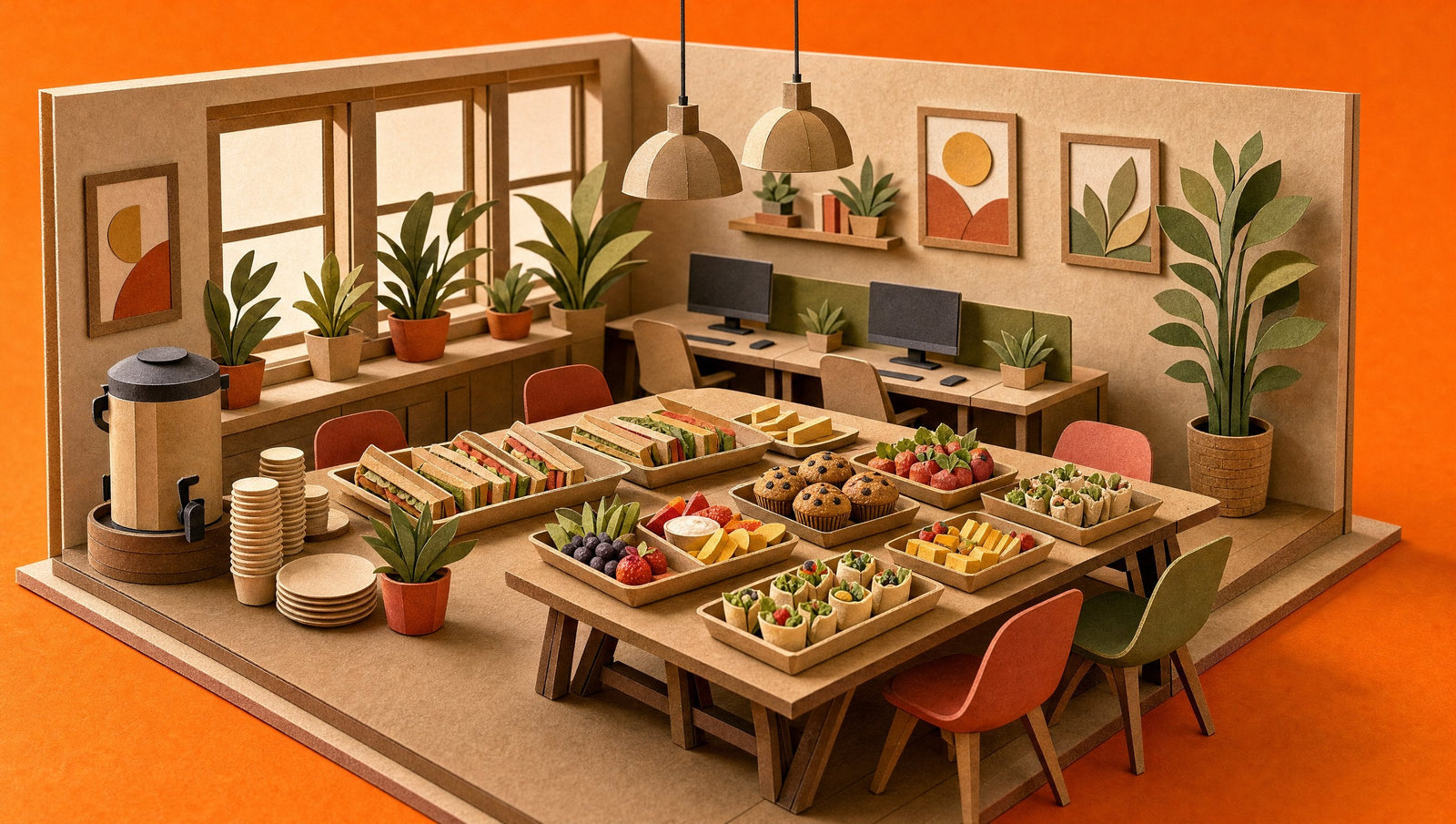
Corporate catering is the most predictable work there is, because offices run on a timetable and the timetable barely varies. Breakfast lands between 7:30 and 8:30. Morning tea is 10:00 to 10:30. Lunch is 12:00 to 12:30. Afternoon tea is 2:30 to 3:00. Those four windows account for the overwhelming majority of the corporate catering we send out, and a caterer who works in that market plans a whole day around them.

Quantities in the corporate world are steadier than people expect, which is why a caterer will give you numbers rather than opinions. For a morning tea, one and a half to two pieces a head. For sandwiches as a meal, one and a half rounds a head, which is six triangles. For finger food replacing lunch, eight to ten pieces a head; alongside a meal, four or five. A room of twenty at ten in the morning does not eat what a room of twenty at midday eats, and ordering a lunch quantity for a morning tea is how half a platter goes in the bin.
The constraint nobody puts on the order form is the room. Boardroom tables have laptops and papers on them. Training rooms have no spare surface at all. That is why corporate food is built to be eaten with one hand, standing, without cutlery, and why anything that needs a plate and a fork quietly turns a thirty-minute break into forty-five. If you are feeding a meeting that is still running, the food has to be silent and portable or the meeting stops.
Recurring orders behave differently to one-off ones. The person who orders every Tuesday is not looking for variety, they are looking for the absence of problems: same food, same time, same door. We would rather a client tells us the order is a standing one, because it changes how we roster it. Consistency is the product.
The other thing worth knowing about corporate ordering is that the person placing the order is usually not the person paying for it. An executive assistant orders, a finance system pays, and a purchase order number has to end up on the invoice or somebody chases it for a fortnight. Give a caterer two names: who signs for the food at the door, and who the invoice goes to. It saves everyone the follow-up.
Wedding Catering Services
Wedding catering in the full sense — a plated three-course dinner for a hundred and forty, waiters, a bar, a run sheet that starts at two in the afternoon and ends when the last chair is stacked — is a different business to ours, and we say that plainly rather than quoting on it and hoping. What a bakery does at a wedding is the food that arrives and is left: grazing, canapés, platters, the cake, and the breakfast for the people getting ready.

That last one is the order most often forgotten and the one that matters most on the day. Two hours of hair and makeup happen before anybody eats anything, and the people in that room have usually been awake since five. A tray of sandwiches and pastries delivered at nine in the morning does more for a wedding than most of what is spent on the reception, and it costs almost nothing. Book it at the same time as everything else, because on the morning itself nobody has a spare hand.
The cake has its own physics and it catches people out every summer. Buttercream is comfortable up to about twenty-five degrees. Above that it softens, and a cake that sits in a parked car at midday in a Brisbane February is well past it. Fondant has the opposite problem: it hates the fridge, because cold makes it sweat and a cake carried back out into a humid afternoon beads with moisture within minutes. The safe place for a decorated cake is a cool room indoors, out of the sun, sitting on something flat, and it should be the last thing moved rather than the first. Ours need two to three business days' notice to decorate, which is not a sales rule, it is how long the work takes.
Guest numbers on a wedding are the numbers that move latest and the ones a caterer has to lock earliest, because ingredients are ordered against them. A caterer asking for a final count a week out is not being difficult. And the timeline will slip, usually by twenty to forty minutes, usually because of photographs. Anything that has to be hot when it is eaten is the first casualty of that slip, which is another argument for food that is designed to be good at room temperature.
Social Event Catering
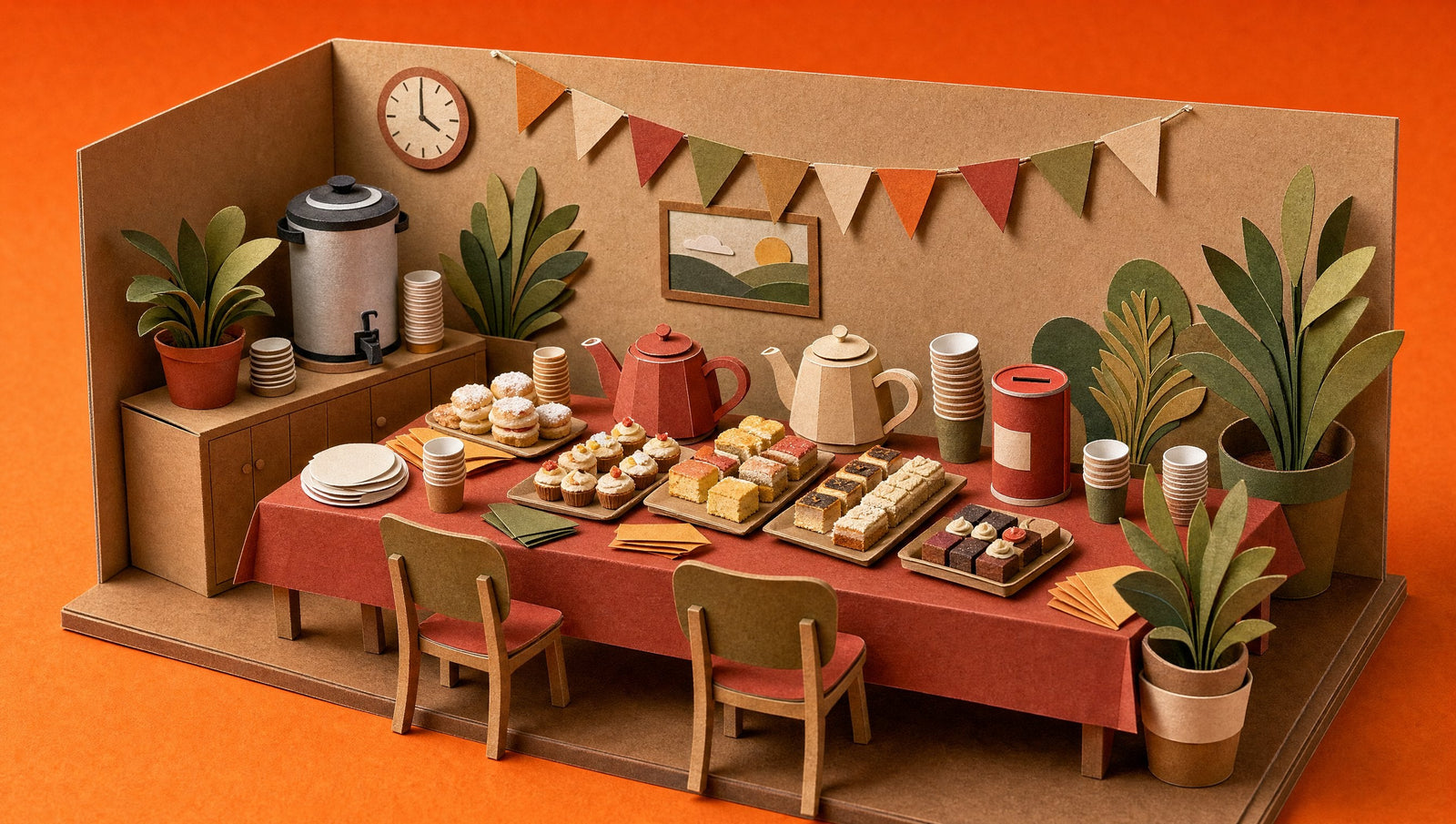
Social catering covers everything that is not work and not a wedding: birthdays, engagements, baby showers, christenings, retirements, club presentations, wakes. The food is easier than corporate food and the head count is much harder, because social guest lists are aspirational and social attendance is weather-dependent.

Two patterns hold across almost every social event we cater. The first is that people graze hard for the first twenty minutes and then stop. Whatever is on the table when guests walk in is what gets eaten; anything brought out an hour later is picked at politely. So front-load the table rather than staging it, unless there is somebody whose actual job is to keep it stocked.
The second is that children eat first, eat the sweet things, and take a full-sized portion in order to eat half of it. If a third of the room is under ten, order adult quantities and expect adult wastage, or order small versions of things so a half-eaten one is a small loss. That is one of the practical reasons a birthday party at home works better on small food than on big food.
Wakes deserve their own note because they are the hardest order to size and the least appropriate one to get wrong. Nobody RSVPs to a funeral. People come who were not expected and people leave before the food. Our rule of thumb is to cater for the number the family expects plus about twenty per cent, weighted toward sandwiches and slices rather than anything that needs attention. Families rarely want a menu conversation at that moment, and a caterer who offers one is misreading the call. Two or three options and a delivery time is the whole discussion.
Across all of it, the useful discipline is to write down the actual shape of the event before ordering: what time people arrive, whether they are sitting or standing, how long they will be there, and whether this is a meal or a fill-in. Those four answers decide the order far more than the theme does.
Home catering
Home catering means professional food in a house rather than a venue, and the thing that shapes it is not the menu, it is the building. A domestic kitchen is a small kitchen. One oven that fits one tray. A fridge that is already full. About a metre of usable bench once the kettle, the toaster and the fruit bowl are counted.

Everything that goes wrong with catering at home goes wrong for that reason. People order food that has to be finished in the oven and then discover the oven is busy with the thing they are already cooking. They order for thirty and then find there is nowhere to put it, because a grazing spread for twenty needs roughly a metre and a half of table and most homes do not have that free. They forget that thirty guests generate thirty plates and a bin that fills before the speeches.
The practical fixes are dull and they work. Choose food that is finished when it arrives, so the kitchen stays free for drinks and the one hot thing you actually want to make. Clear the surface you plan to use before the delivery arrives, not after. Decide where empty platters go, because they take up as much room as full ones. Put the drinks at the far end of the room from the food, so the two queues do not become one queue in a hallway.
Delivery at home also works differently to delivery at an office. An office has a reception desk and somebody who signs. A house has neither at half past seven in the morning. If food is being delivered to a home, somebody has to be there, and food should never be left on a doorstep in Brisbane weather. We time home drops close to when the food is wanted for that reason, and it is worth asking for a later window rather than an early one, even when an early one feels safer.
The good part of home catering is the part that cannot be bought at a venue. The house is already the right temperature, the seating is already where people want to sit, and nobody is watching the clock because the room is booked until eleven.
The Art of Preparing and Serving Food
Food safety in catering is a clock, not a fridge. That is the single most useful thing a person ordering catering can understand, and it is written into Australian food standards in a form worth memorising. Between five and sixty degrees is the range where bacteria multiply. Food that has been in that range for under two hours can be refrigerated again or used. Between two and four hours it must be used straight away and cannot go back in the fridge. Past four hours it is thrown out. Not tasted, not judged by smell. Thrown out.

That rule is why catering behaves the way it does. It is why a caterer asks what time you actually want to eat rather than what time you want it delivered, why we would rather come at 11:40 for a noon lunch than at nine because nine suited the driver, and why a platter that has sat out through a meeting that ran long is not something to put back in the office fridge for the afternoon. In a Brisbane summer the clock runs faster than the rule assumes, because a room at thirty-two degrees is not the twenty-two-degree room the standard imagines.
The other half of preparation is contamination, and the truthful version is not flattering to the way most people picture it. Commercial kitchens are the controlled part: separate boards, colour-coded equipment, food kept covered, hands washed constantly, temperature logs. The failures almost never happen there. They happen on the serving table, where one guest uses the tongs from the ham platter on the vegetarian one, or where a plate goes back onto a shared board. If you are hosting, the highest-value thing you can do is put a separate serving implement on every platter and keep the allergy-relevant items at the front of the table, before the crowd reaches them.

Allergen information is the third piece, and it is not optional. A caterer has to be able to tell you what is in each item, and the useful way to label food is by what it contains rather than what it is free from. “Contains egg and sesame” helps everyone in the room. “Gluten free” only helps the people already looking for it.
Worth saying about our own kitchen: we bake. There is flour in the air here from about five in the morning and there are nuts on the premises. We can build a dish without an allergen in it, make it first on a clean bench and tell you exactly what is in it. What we cannot honestly claim is that this is a nut-free or gluten-free facility, and a caterer running an ordinary bakery who tells you it is has told you something they cannot back up.
Venue and Event Coordination
Coordination sounds like a word for planners. In drop-off catering it means something much smaller and much more consequential: whether the food can physically get to the table. The overwhelming majority of catering deliveries that go wrong do not go wrong in the kitchen. They go wrong at a door.

The recurring failures are always the same handful. Reception is locked until eight and the order is for 7:30. The building has a loading dock on a different street to the address given. The lift needs a swipe card and the person with the card is in the meeting the food is for. The site has no street number, only a name on a fence. The contact number on the order goes to a desk phone in an empty office. None of these are exotic. Each of them turns a driver into a person standing in a corridor holding a hundred sandwiches.
What a caterer actually needs, and what is worth writing on the order rather than assuming, is four things: the exact address including which entrance, the room or floor, a mobile number belonging to somebody who will answer it while the delivery is happening, and any access rule that applies before nine in the morning. If there is a security desk, say so. If the food has to go to a bench rather than a table, say that too, because a driver who knows where it goes puts it there instead of leaving it at the front.

For staffed events the coordination is a bigger job and involves a site visit: where the kitchen or holding area is, whether there is power, how far the carry is from the vehicle to the room, what time the venue lets people in and what time it kicks them out. Bump-in and bump-out windows are contractual at most venues and they are the reason a caterer sometimes says no to a booking that looks easy.
Numbers move, and a good arrangement plans for it rather than pretending otherwise. Ours is simple: the order can change up to 4pm on the day before delivery, and using that window does not cost extra. There is no last-minute surcharge, because a customer who tells us at 3pm that four more people are coming is doing us a favour compared to a customer who says nothing.
Afterwards, the piece almost everybody skips is worth two minutes. Look at what came back. The platter that returned full is the one to drop next time, and the one that emptied in ten minutes is the one to double. Two or three events of paying attention to that gets an order right in a way no menu consultation can.
Crafting the Perfect Menu
A catering menu is built in an order, and most people build it in the wrong one. They start with what sounds good, then work out quantities at the end. A caterer starts with quantity, then decides what the food is.

Quantity first, because the failure people remember is running out, and the failure they do not notice is having eaten something slightly less exciting. Six kinds of thing and not enough of any of them looks generous on a quote and looks thin on a table, because guests take one of each and the platters empty in a pattern that reads as scarcity. Three things done in enough volume beats six things done in halves, every time.
The working numbers are worth having in front of you. Morning or afternoon tea: one and a half to two pieces a head. Sandwiches as a meal: one and a half rounds a head. Finger food as the meal: eight to ten pieces a head over two hours, and more if there is alcohol and no dinner afterwards. Finger food beside a meal: four to five. Cake: a six-inch round is about twelve party slices, an eight-inch about twenty-four. Adjust for the room rather than the number — a tradesperson crew at six in the morning and a boardroom at ten in the morning are not the same appetite even at identical head counts.
Then choose food that survives the journey. This is the constraint that decides whether a menu is any good in practice. Sauces and dressings travel separately and go on at the table. Anything crumbed goes out only when the food and the people arrive together. Bread that is cut early dries at the edges, so a caterer builds sandwiches as late as the run allows rather than as early as the roster allows. If a dish has to be assembled on site by somebody, name that somebody before you order it.

Dietary requirements come in at the design stage rather than as an add-on. In a mixed room the vegetarian platter empties first, taken by people who are not vegetarian, which is why ordering exactly as many vegetarian portions as you have vegetarians reliably leaves the vegetarians with nothing. Order more than the count suggests, and label things clearly enough that nobody has to interrogate a stranger to find lunch.
On tastings, the honest answer: a drop-off caterer does not run them the way a wedding caterer does, and a tasting would tell you about food thirty seconds out of a kitchen rather than food two hours into a day, which is not the thing you are buying. The better test is to order a small one first. A ten-head morning tea tells you everything a tasting would, and it tells you about the delivery as well.
Presentation and Aesthetics in Catering
Presentation in delivered catering is not garnish. It is packing. The only presentation that matters is what the platter looks like at the moment somebody in another building takes the lid off, and everything that happens between the bench and that moment is working against you.

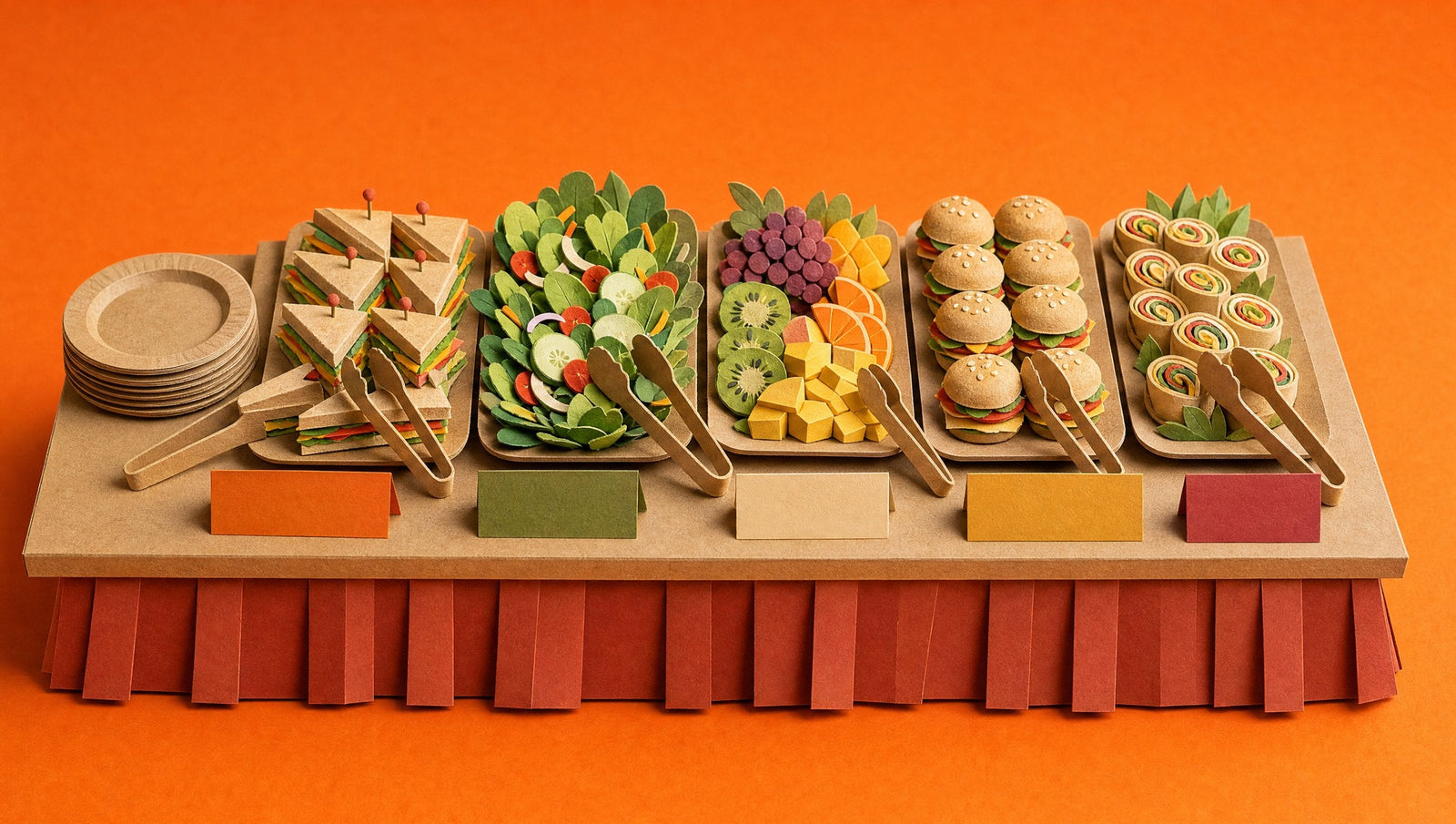
Food laid in rows arrives in rows. Food piled into a mound travels as a mound and arrives as a heap, because a van corner does to a platter exactly what you would expect. So catering food is built in lines, in blocks of the same item, with a small gap between the rows for fingers. It is less artful than a photograph of a restaurant plate and it is the reason the platter still looks deliberate three hours later.
Height does not travel either. Anything stacked, skewered upright or garnished on top gets flattened by the lid or the platter above it in the stack. Decoration on catering food goes flat and to the side, tucked between rows where the lid cannot reach it. Herbs are the cheapest thing on any platter and they do more visible work than anything else, because contrast is what the eye reads first: dark bread against pale filling, green against kraft brown, one red thing in a tray of beige.
The vessel matters more than the arrangement. Everything we send goes on kraft paper trays, paper plates or wooden boards, and never in clear plastic. Part of that is the packaging rule we hold ourselves to, and part of it is simply that food looks like food on paper and looks like a servo sandwich in a clear tub. Warm brown makes cream, red and green all look better than they do against white.
Labels are the last piece and the most underrated. A small card on each platter saying what the item is and what it contains means the host does not spend lunch as a menu service, and it means the person avoiding dairy does not have to ask a stranger. It takes a caterer thirty seconds. Ask for it if it is not offered.
One more thing, learned by watching: leave the covers on until people are actually ready to eat. A platter unwrapped forty minutes early looks tired by the time the room arrives, and the food dries at the edges for no reason at all.
Full-Service Catering: All-Inclusive Solutions
Full-service catering means the caterer takes the whole food operation off the host: menu, food, equipment hire, staff, service during the event, and the clean-up afterwards. Plates, cutlery, glassware, linen, sometimes tables and chairs, sometimes a bar. The host makes decisions in advance and then does nothing on the day. It is a genuinely good product and it is worth understanding what you are paying for.

You are paying for hours. That is the whole difference. Food cost per head is not wildly different between a drop-off platter and a staffed function; what changes is that a staffed event carries chef hours, waiter hours, a supervisor, travel time, and both bump-in and bump-out. A four-hour party is rarely a four-hour job for the crew — it is more like seven once set-up and pack-down are counted, and you pay for all of it. Hire has minimums attached as well, so a hundred plates and a hundred glasses do not cost half of two hundred.
The test for whether you need it is not the size of the event or how important it is. It is whether the food has to be hot at a specific minute, plated, poured, or continuously replenished. A seated dinner needs staff. A cocktail function running three hours with food coming out in waves needs staff. A meeting, a morning tea, an office lunch, a wake, a christening and most birthdays do not, and buying staff for them purchases nothing a guest will ever notice.
We are not a full-service caterer, and we would rather say it than quote for it. We are a bakery that delivers, so the room is yours to run. What we can do is remove most of the reasons a host ends up busy: food that needs no finishing, platters that need no arranging, packaging that does not have to be washed and returned, and a delivery timed to the eating rather than the roster. For the large majority of events people cater in Brisbane, that is the whole job.
If you do need full service, the questions that separate operators are unglamorous. How many staff for how many guests, and for how many hours. What is included in the hire and what is charged separately. Who clears, and to where. What happens to leftovers. And what the plan is if numbers move in the last week, because they will.
Specialty Catering Options
Beyond the two main shapes there is a long tail of specialty formats, and each of them is really a trade of one constraint for another. It is worth knowing what the trade is before booking one.

Food trucks. Excellent atmosphere, genuinely fresh food, and a serving rate that people consistently underestimate. A single truck serves somewhere in the range of sixty to a hundred people an hour depending on the menu, so two hundred guests means either a long queue or a second truck. A truck also needs level ground, a footprint of roughly four by eight metres, power or its own generator, and permission if it is standing on public land. It is a wonderful choice for a relaxed outdoor event with time in it, and a poor one for ninety minutes between a ceremony and a speech.
Grazing tables. Visually the strongest thing in catering and the most space-hungry. Roughly a metre of table for every twenty guests, and it needs to be built on site, which means somebody is there for an hour beforehand. It is also the format that runs the food-safety clock hardest, because everything sits out by design.
Cocktail service. Small food, circulated or on stations, eaten standing. Budget eight to ten pieces a head if it is replacing dinner, and remember that guests who are drinking eat earlier and more than guests who are not. Good finger foods for this are the ones that need one hand and no plate.
Plated service. The formal option, one course at a time, and the format with the least tolerance for a schedule slipping. If the speeches run twenty minutes long, the food is already made.
Dessert and cake tables, barista carts, spit roasts. Each solves one part of an event well and none of them feed a room by themselves. They work as the addition, not the plan.
Our own corner of that list is the delivered one: cold platters, sandwiches, mini quiches, slices, cakes and party catering that arrives ready to eat. It is not the most theatrical format. It is the one that reliably feeds a room on a Tuesday.
Hiring a Caterer: What to Consider
Recommendations are still the best filter, and reviews are worth reading for a specific thing rather than a score: look for whether the food arrived on time, not whether it was described as delicious. Anyone can cook once. Arriving at 10:15 on a Tuesday for the eleventh time is the harder achievement.

Beyond that, there are six questions that tell you more about a caterer than a menu does.
- What is the delivery window, and what happens if you are late? An honest caterer gives a window and a phone number. A promised exact minute usually means nobody has driven the route.
- When is the cut-off for changing numbers, and does a late change cost extra? Ours is 4pm the day before, and there is no last-minute surcharge. Ask, because a surcharge that appears on the invoice after the event is a bad surprise.
- What does the delivery fee cover — the kerb, the door, or the room? There is a real difference on the fourth floor of a building with one lift. Ours starts at $19 on orders over $150, across more than fifty Brisbane suburbs, and Saturday is the same rate as a weekday.
- What is included per head? Serviettes, tongs, plates. Small things, but if they are not included somebody has to buy them on the morning.
- Do the platters come back? If yes, somebody has to be present when they are collected. If no, check what the packaging is, because a room full of clear plastic is a different look and a different bin.
- Can you tell me what is in each item? The answer should be immediate. Hesitation here is the only real red flag on this list.
Budget is the constraint everyone starts with and it is better spent on quantity than on range. A larger amount of straightforward food feeds a room; a small amount of impressive food leaves people looking for a bakery afterwards. If money is tight, cut the number of items rather than the volume.
The last consideration is whether a caterer is the right shape for your event at all. If you want a staffed dinner, book a full-service caterer. If you want food that arrives ready and leaves you to run the room, book someone who does that all day. We fall into the second group and we would rather point a customer to the right business than take a booking we are the wrong fit for. Pick-up is also there for the people who would rather collect: from 7am at 159 Knapp St, Fortitude Valley.
Sustainable Practices in the Catering Industry
The sustainability conversation in catering usually starts with packaging, which is the smallest lever in the room. The largest one, by a distance, is ordering the right amount of food. Over-order by twenty per cent on a hundred-head event and you have thrown away twenty people's lunch along with everything it took to grow, bake, pack and drive it. No compostable box recovers that.

Which is why the least glamorous advice is the most effective: use real quantity numbers rather than fear, order to the room rather than to the guest list, and have a plan for leftovers before the event rather than at the end of it. The food-safety clock decides whether leftovers can go home with people — under two hours out and it is straightforward, past four hours it is not a decision anymore — so if you want people to take food away, say so at the start and get it into containers early rather than scraping platters at the end.
Inside a kitchen the levers are stock rotation, using the whole ingredient, and baking to order rather than to a forecast. For a bakery the biggest waste stream is bread, because bread is only itself for a day, and the only real answer to that is making the right amount rather than the comfortable amount. Surplus that is still good goes to food rescue rather than a bin wherever it can, which is now standard practice in the industry rather than a virtue.
Packaging still matters, and our rule is paper and kraft rather than clear plastic, on everything. It is worth being honest about the limits of that: compostable packaging composts in a commercial facility, and in a general waste bin it behaves much like anything else. So the real win is not only the box, it is whether the venue has a bin that goes anywhere useful. Ask the venue, not the caterer.

Energy and transport are the remaining pieces and they favour the boring solutions. Baking in one continuous run rather than heating an oven three times. Building a delivery route so a van does one loop rather than three. Buying from suppliers who are close enough that the ingredient does not arrive by air. None of this is a campaign; it is mostly just running a kitchen properly, which is what makes it durable.
Summary
Catering is food made in one place and eaten in another, and every difference between one catering business and the next comes down to how much of the gap between those two places the caterer covers. Drop-off covers the food and the delivery. Full service covers the food, the equipment, the people and the clean-up. Neither is better; they answer different questions, and the question is whether the food needs a person standing next to it.
Under that, the same handful of facts decide whether an event is fed properly. Quantity before variety. The clock, not the fridge. Food that is built to survive a van and an hour on a table. A delivery window instead of a promised minute. Dietary notes in the order rather than on the morning. Somebody at the door with a phone that rings.
None of it is complicated. It is just specific, and it is the specific parts that go wrong. If you are ordering food for a room in Brisbane and you get the quantities right, tell the caterer the truth about the timing and the access, and choose food that does not need rescuing on arrival, the rest of catering mostly takes care of itself.
Frequently Asked Questions
What roles do caterers play besides preparing and serving food?
Most of a caterer's day is not cooking. It is quantities, packing, routing and information. Working out how much food a particular room actually eats at a particular hour, building it so it survives being stacked and driven, planning a delivery run backwards from the earliest drop, and being able to say exactly what is in every item on the platter. On staffed events the list extends to hire equipment, rostering, venue access, set-up and pack-down. On delivered catering it extends to labelling, packaging choices and making sure the food reaches the right room rather than the front desk.

How do caterers ensure food safety at events?
By treating time as the control. Between five and sixty degrees, food is safe for two hours, must be used immediately between two and four hours, and is discarded past four. Everything else follows from that: deliveries timed to when people eat rather than when the van is free, cold food kept cold until the last possible moment, and nothing going back into a fridge once it has been out too long. Alongside the clock sit the ordinary controls — separate boards and equipment, food kept covered, constant hand washing, and allergen information written down. The weakest point at any event is not the kitchen, it is the serving table, so a separate implement on every platter does more real good than most other precautions combined.
Can caterers accommodate dietary restrictions and preferences in their menus?
Yes, and it is now the normal case rather than the exception — a forty-head office order with no dietary notes at all is unusual. The two things that make it work are telling the caterer in the order rather than on the morning, and being specific about what kind of requirement it is, because an allergy changes how the kitchen runs and an intolerance mostly changes the menu. Two practical notes: order more vegetarian food than you have vegetarians, because in a mixed room that platter empties first; and label food by what it contains rather than what it is free from. A bakery should also be honest about its limits. We can build a dish without an allergen and tell you exactly what is in it, but we bake with flour and nuts on the premises and cannot call this an allergen-free facility.
What is full-service catering, and what does it include?
Full-service catering hands the entire food operation to the caterer: menu design, cooking, hire of plates, cutlery, glassware and linen, staff to serve during the event, and the clean-up afterwards. What you are really buying is hours — chef and waiter time, plus set-up and pack-down, so a four-hour event is usually a seven-hour job on the invoice. It is the right choice when food has to be hot at a particular minute, plated, poured or continuously replenished. For meetings, morning teas, office lunches, wakes and most birthdays it buys nothing a guest notices, and delivered catering does the same job for less. We are a delivery caterer rather than a full-service one, and we say so rather than quoting on work that belongs to a different kind of business.
How are caterers contributing to sustainability in their industry?
The biggest contribution is ordering and producing the right amount, because food thrown away carries the cost of everything that went into it. After that comes stock rotation, using whole ingredients, and sending genuinely surplus food to rescue organisations rather than bins. Packaging matters too — kraft and paper rather than clear plastic on everything we send — with the honest caveat that compostable packaging only composts in a commercial facility, so the venue's bins decide the outcome as much as the caterer's choice does. The remaining gains are unremarkable operational ones: baking in a single continuous run instead of heating ovens repeatedly, building delivery routes as one loop rather than three, and buying from suppliers close enough that the ingredients do not travel further than the guests do.

2 Responses

Leave a comment
Comments will be approved before showing up.



Shree Caterers
January 21, 2026
Great explanation of different catering varieties. Easy to understand and helpful for beginners learning about catering services and event planning.