How To Create A Grazing Table That Hard To Forget


A grazing table is a long table covered end to end with food that needs no plate, no cutlery and no announcement. People walk past it, take what they want with one hand and keep talking. Built properly it is the least stressful way to feed a room, because all of the work happens before anyone arrives and almost none of it happens while they are there.
It is also the format we see misjudged most often. Everyone assumes the food is the hard part. The food is the easy part. What decides whether a grazing table still looks like the photograph two hours in is the order things go down, what is allowed to sit next to what, and how much of the spread is genuinely happy sitting in a Brisbane room at twenty-eight degrees. We have built these on a kitchen table for eight and across two-metre trestles for a hundred and twenty, and the mistakes are identical at both ends.
How much table and how much food
Two numbers before anything else, because they decide the shopping list. Work on about a metre of table for every ten people standing, and build to roughly five or six pieces a head when the table is a graze before a meal and closer to twelve when the table is the meal. Get those wrong and no amount of styling saves it: a table that is too long looks picked over from the first minute, and a table built as a graze but asked to be dinner leaves everyone politely still hungry.
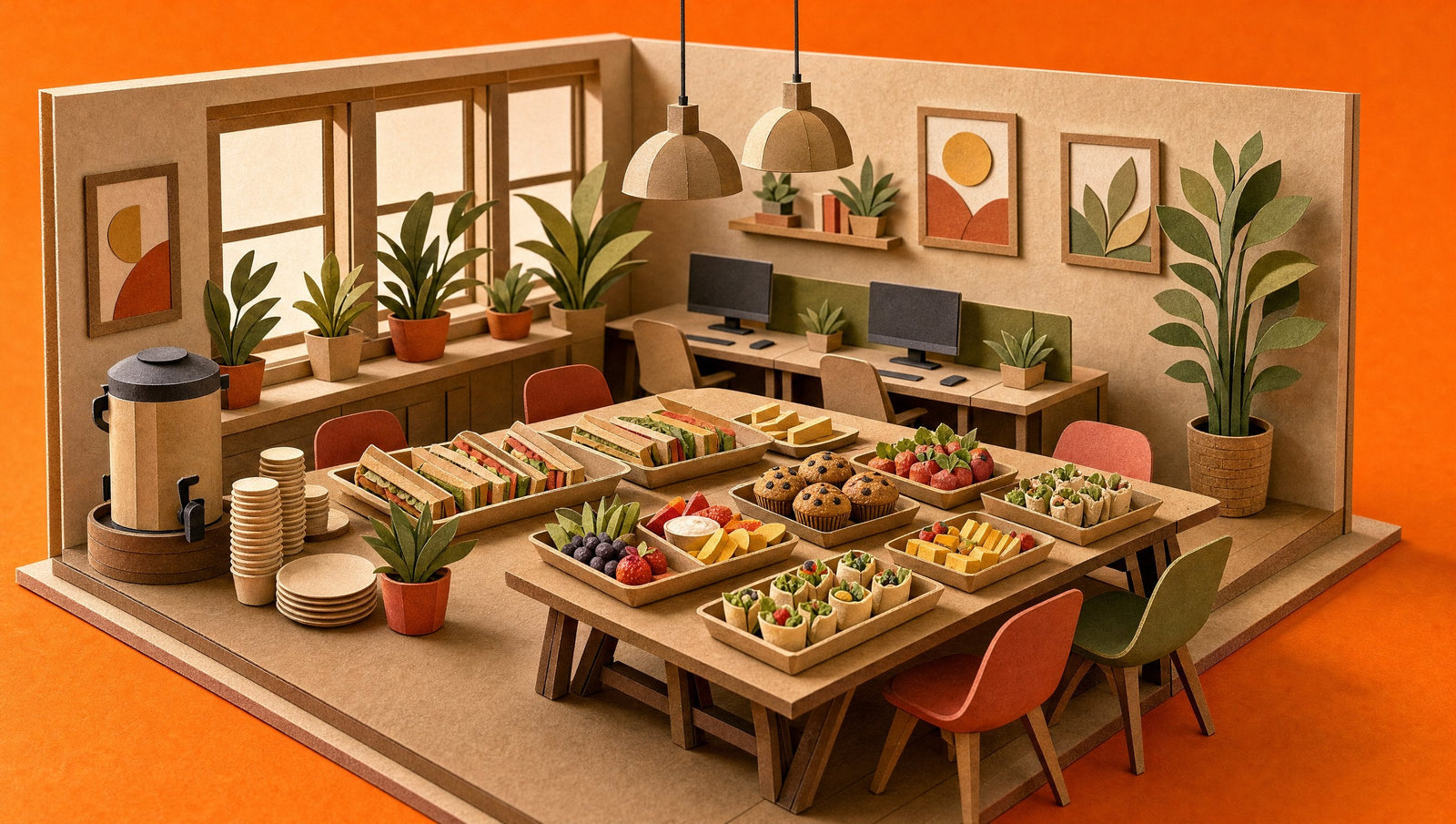
What follows is the whole method in the order you would actually do it. What to buy, how much of it, how to build the thing, and what happens to each part of it once it has been sitting out for a while, which is the part nobody tells you. It works the same for a few friends on a Sunday, for a family get-together, and for arranging a corporate catering event where forty people have fifty minutes and nowhere to sit down.
What a grazing table saves you

The first reason to like a grazing table is that nobody is in the kitchen while the party is happening. There is no service, no plating and no moment where the host disappears for twenty minutes. Everything is spread out in advance and then left alone, which is the opposite of how most home entertaining works.
The second reason is that it is honest about money in a way plated food is not. The food on a grazing table is not what makes it expensive. Boards, stands, greenery and the two people building it are where the cost sits, which is why a table works out at roughly the same per head as a platter menu and takes about three times as long to assemble. For a two-metre table, budget forty-five minutes of building for two people on the day, on top of the shopping and the cutting done the day before.
Because of that, a table built from pricey deli meats and cut cheese and a table built from seasonal fruit, supermarket crackers, popcorn and lollies look very similar from the doorway. What a room notices is coverage, colour and height. It does not notice the price of the cheese. If your budget is tight, spend it on the things that hold their shape and fill the surface, and buy the rest on special.
Why overlapping food looks like abundance
The third reason is the one people actually mean when they say a grazing table is a show stopper: it does not look like catering. It looks like abundance, and abundance is a visual effect produced by overlapping rather than by quantity. Food laid in overlapping rows with no gaps reads as full. The same amount of food spaced out in bowls reads as nearly finished.

The rest of this guide builds a grazing box step by step, because a box is the version most people can practise on. Nothing changes at scale. A single box for one person and a two-metre table for eighty are assembled in exactly the same order, with exactly the same rules about what goes down first and what goes down last. If you can build the box, you can build the table.
Why should you create a catering table over something else?
Grazing tables took hold in Australia harder than almost anywhere else, and most of the ideas circulating on Instagram and Pinterest still come from here. That is not an accident of taste. It is a format that suits the way Australians actually hold a party: standing, half outdoors, spread across an afternoon, with guests arriving over the better part of an hour.
That last point is the underrated one. A plated meal has a service time and everybody has to be in the room for it. A grazing table has no service time at all, so the person who arrives forty minutes late has exactly the same experience as the person who was early, and nobody has to be managed. For a Brisbane summer afternoon where half the guest list is coming from somewhere else first, that is worth more than any menu decision.
Dietary needs are visible without asking
The other quiet advantage is dietary. On a grazing table everything is visible and separate, so the guest who cannot eat dairy, or gluten, or meat, can see what is safe from two metres away and take it without asking a question in front of a room. Very few people will announce a dietary requirement to a host they do not know well, and a table that removes the need to ask feeds more of the room than one that does not. Our dietary icons live in the product names for the same reason: you should be able to see what something is before it arrives.

- Low cost to set up. There is no equipment to hire, no chafing dishes, no gas and nobody standing behind the table. Greenery is the cheapest volume you can buy and crackers are the cheapest way to make a table look full, so buy about twice as many crackers as looks sensible. They are the first thing to run out and the only thing you can top up without rebuilding the section.
- You can spend more time mingling with your guests instead of stressing about the food. The assembly windows are wider than people expect. Hard cheese and cured meat can go down two to three hours ahead if the room is cool. Cut fruit, soft cheese and anything with dairy in it go on last. Done in that order, the final hands-on stretch before guests arrive is about ten minutes.
- It provides a wide-range of eating experiences. The spread that works is a spread of textures, not a spread of names. Something creamy, something firm, something crunchy, something sweet and something sharp or pickled will carry a table further than five different cheeses nobody can tell apart.
- It offers your visitors the chance to taste just about everything. That only happens if everything is already in a portion. Cut small and people take four things; leave a whole wedge and one person carves it badly and everyone after them avoids it. Portion size is what controls variety, not the size of the shopping list.
- Permits you to be inventive and creative with your grazing table. Any theme survives as long as the structural food underneath it is right. Decorate all you like, but decide the load-bearing items on how they behave after two hours, not on how they photograph in the first five minutes.
What Is A Crazing Table?
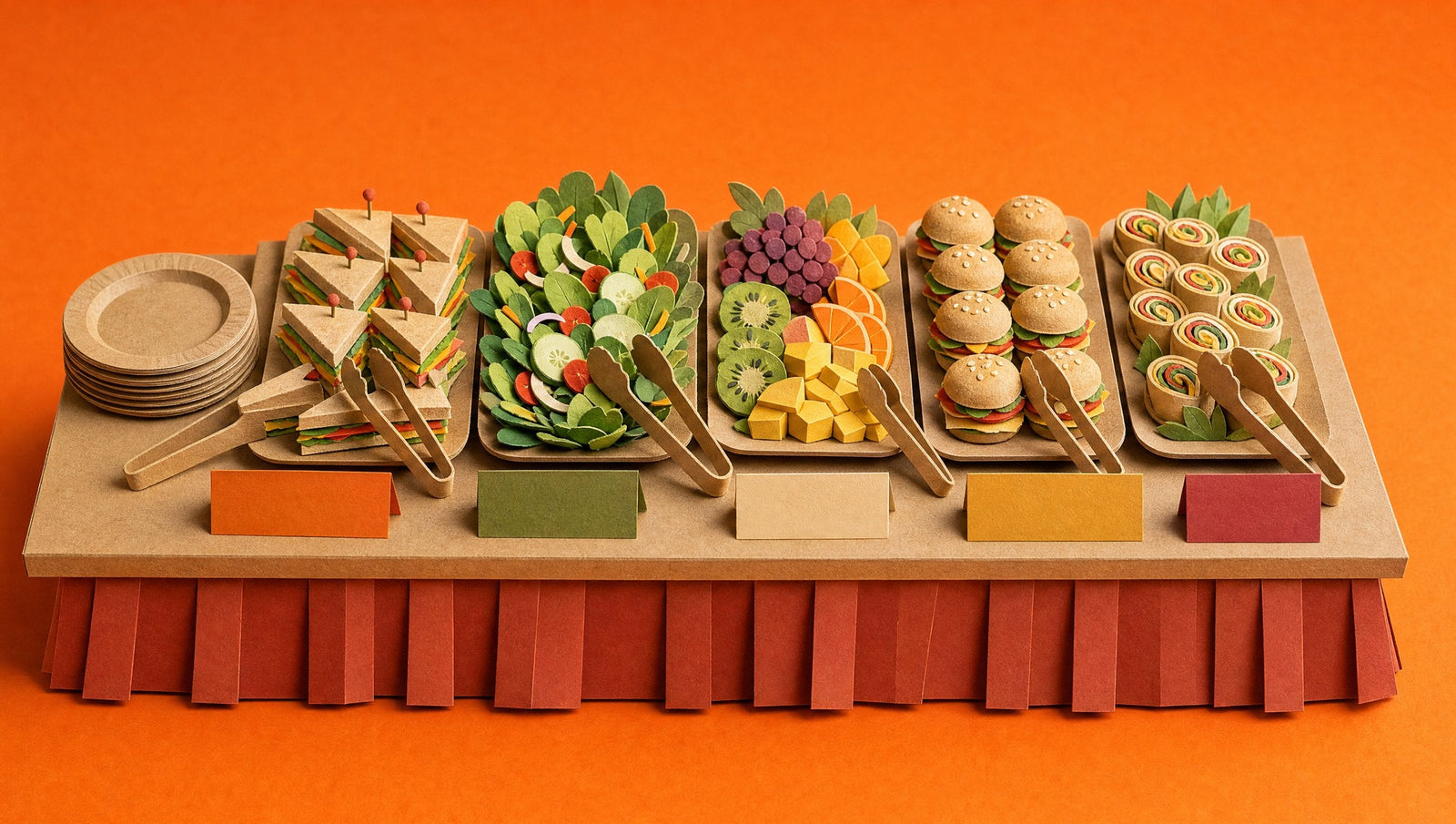
As the name implies, it is a table for grazing. Unlike a buffet, where guests queue and serve themselves onto a plate, a grazing table is laid out to be walked past. Everything is already in a portion, everything is designed for one hand, and people help themselves in passing rather than committing to a meal. The same set-up works on a large platter, a wooden board or any large clean flat surface, and the food does not have to sit in bowls or on plates at all. It can be piled so that it overflows, twists together and intersects, which is what makes it look like a table rather than a tray.
The defining rule is that everything on it is happy at room temperature. That is a deliberate constraint rather than a shortcut, and it writes the menu for you. Cured meats, hard cheese, crackers, bread, nuts, dried fruit and whole fruit do not care how long they sit there. Soft cheese, cooked chicken and anything bound with mayonnaise are on a clock, and in a Brisbane room that clock is about two hours, or one if the room is above thirty degrees. Build the table so that the things on the clock are the things you can pull off it without leaving a hole.
Where people actually take food from
The other thing worth knowing is that a grazing table is eaten unevenly. People take from the front edge and from anything raised, and they leave the back corners alone. If a section matters to you, put it where a hand naturally lands. If a section is there for volume, put it at the back where it will still be there at nine o'clock making the table look full.
It works for a wide array of corporate events, guests, themes and budgets for the same reason it works at home: it scales by adding length rather than by adding complexity.
A shopping list for a beautiful crazing table
A good table needs the shopping done properly, so save or print this list before you go. There are six groups to keep in mind: cheeses, fruits, crackers and bread, meat, dip veggies, and sweets and nuts. Here is what to buy in each and what each one does once it has been sitting out.
Cheeses. Three is plenty and five is showing off. Buy by texture rather than by name: one soft, one hard, one with something going on. Buy wedges whole and cut only a few pieces off each, because a cut face dries and forms a skin within about an hour while the rest of the wedge stays fine. Soft cheese is the first thing to lose its shape on a warm day. Brie is comfortable up to about twenty-five degrees and slumps past it, so give it its own small board or shallow pot rather than letting it run into the crackers.
Fruits. Grapes and strawberries do most of the work because they are already a portion and they hold for hours. Melon and pineapple are the opposite: they keep weeping, and the liquid runs to the lowest corner of the board and floods whatever is there. Apple and pear brown in about fifteen minutes once cut, so either brush them with lemon juice or leave them off. Keep grapes in small bunches with scissors nearby rather than loose in a pile, because loose grapes roll and people take a handful instead of a few.
What to cut ahead and what waits
Crackers and bread. Any bread works but the crunchy loaves earn their place: sourdough, ciabatta, a baguette. Slice them within an hour of serving, because cut bread stales at the cut face faster than anything else on the table, and never put bread in the fridge. Bread stales fastest at fridge temperature, which is the opposite of what most people assume. Crackers bend within about twenty minutes of sitting beside wet cheese, so put out half and keep the rest sealed under the table.
Meat. Sixty to eighty grams a head as a graze. Ask for it sliced thin at the deli on the day, because a thin slice drapes and folds while a thick one curls into a tube. Cured meat is the most forgiving thing on the whole table: salami, prosciutto and jerky were preserved for a reason and sit happily for hours. Cooked chicken and anything with mayonnaise through it are what set the clock.
Dip veggies. Carrot and celery survive being cut hours ahead and can be kept in water in the fridge, where they actually crisp up rather than soften. Cucumber does not behave the same way, it goes waterlogged, and capsicum sweats. Cut what you must ahead and keep the rest for the morning.
Sweets and nuts. Dried fruit is the one sweet thing that is happy all day. Chocolate is not: it blooms grey above about twenty-five degrees and the marks do not come back. Put nuts out last rather than first, because Brisbane air is wet enough to take the crunch out of a bowl of nuts across an afternoon.

What’s the difference between a grazing table and a buffet?
You will not see a chafing dish on a grazing table. A buffet is built around keeping food hot, which means equipment, gas or power, and somebody watching it. A grazing table is built around food that is meant to be eaten at room temperature, which means none of that. That is where the saving actually comes from, not from the food itself.
The eating is different too. A buffet needs a plate, a queue and somewhere to sit down afterwards. A grazing table is finger food that people carry around, so they can eat and keep talking at the same time. That is why the two formats fail in different ways. A buffet fails when the queue forms and half the room is standing in it. A grazing table fails when it is pushed against a wall, because then it can only be reached from one side and you have accidentally built a queue anyway. Pull the table off the wall and the same food serves twice as many people in the same time.
Buffet food is designed to survive being kept warm. Grazing food is designed to survive being ignored, which is a much harder brief and the reason the menu looks the way it does.
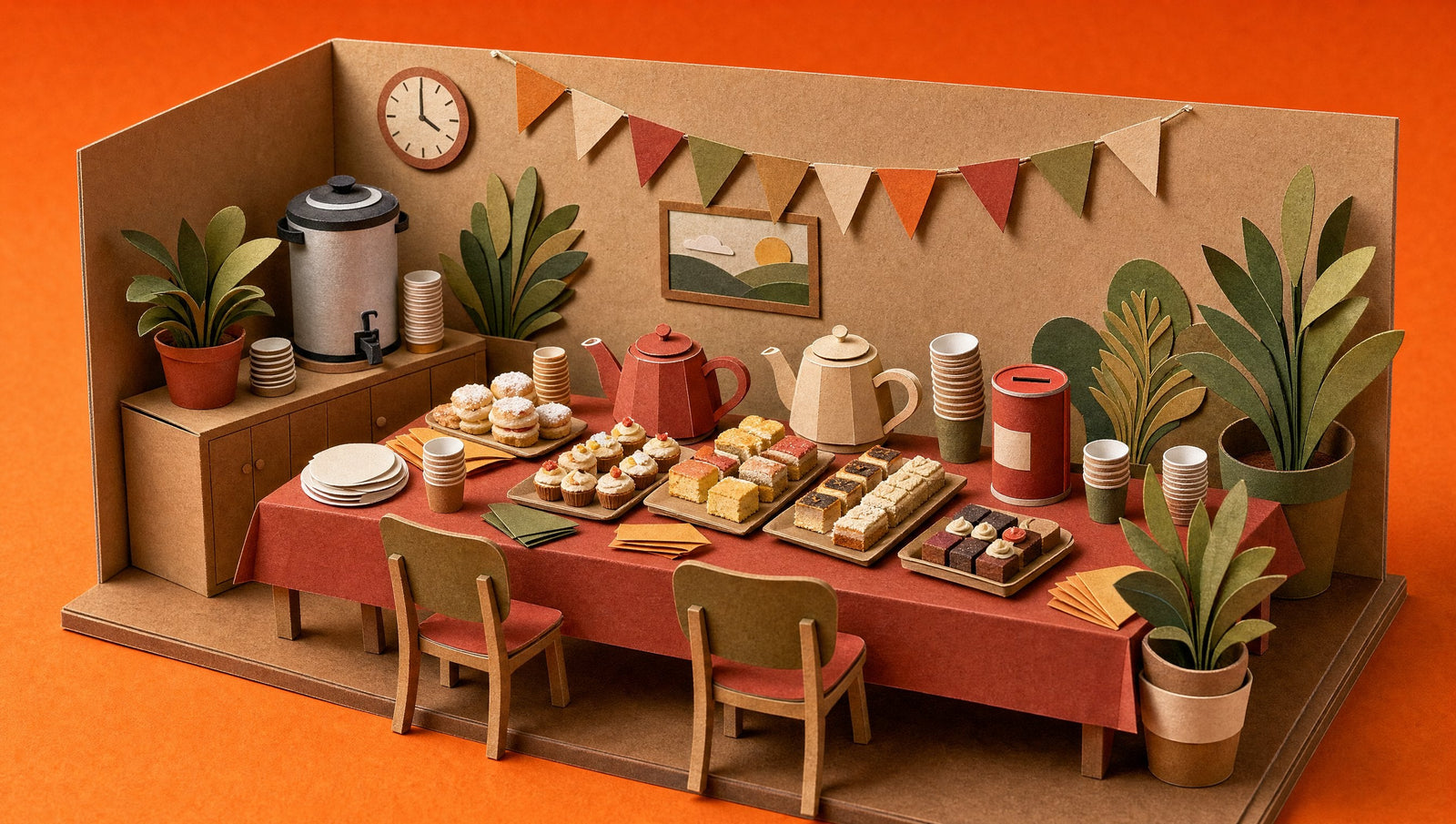
The food choices on a grazing table are also effectively endless, which is not true of a buffet. Depending on your budget you can go for cured meats, cheeses, fruits, bread, dips, nuts, sweet things, crackers or biscuits, bite-sized sandwiches, sushi, and just about any finger food you can think of, and they all sit on the same table without any of them needing to be hot.
Step by step how to put your grazing table together

- Pick a theme. As with any party, a theme sets the direction, and in practice what it really sets is the colour, which is the thing that reads from the doorway. A Halloween table wants its own foods, utensils, platters and accessories; a Christmas table can be arranged in red, gold and green. One practical constraint: pick a theme you can buy in the produce aisle. Red and green is easy, because grapes, capsicum, salami, olives and herbs all exist. Blue is not a food colour, so a blue theme has to live in the cloth, the napkins and the boards, and never in the food itself.
- The table or a serving container. The table should be proportionate to the amount of food. Make sure the surface can be covered by what you are serving. It should not be too big or too small, but the right size to look full and overflowing, which lets guests grab things easily. If in doubt go slightly short rather than slightly long, because food spread thin looks picked over before anybody has touched it. Leave about sixty centimetres clear at each end for plates and for people to put a drink down, or they will put the drink on the food.
- Create height. Height gives a three-dimensional look and the impression that there is more food than there is. Cake stands, wooden boards, boxes, woven baskets, tiered stands and crates all work, and most of them can go under the cloth so only the levels show. Two things we have learned doing this: the highest point is where hands go first and it empties first, so put your volume up there rather than the expensive thing, and anything raised has to be genuinely stable. A stand that rocks when someone reaches for it gets avoided, and it will still be full at the end of the night.
- Fresh flowers and greenery. Nothing fills a table more cheaply than herbs, flowers and greenery, and they add colour and character between the piles. Choose them for stamina. Rosemary, bay and olive branches look the same after a full day out of water. Basil and mint wilt within an hour of being cut and laid on a board, so keep those for a bowl of water or leave them out. Skip anything heavily scented, because the smell carries straight into the cheese, and keep flowers on their own leaf or in their own small vessel rather than lying directly on food.
- Foods, the primary star of your table. The food should suit the event, whether that is summer, Halloween, a Melbourne Cup lunch, an office birthday, an administration day morning tea or a wedding. Give people a variety they can appreciate and avoid gooey sauces that make a mess. Keep everything in a finger-food portion so nobody has to cut anything. That last rule is not about neatness. If one person has to stop and carve, everybody behind them waits, and the table stops being a graze and becomes a queue.

Now time to Assemble a Grazing Table/Box with images

Now we start with a list. Every ingredient here is easy to find at any local supermarket or grocery store, and none of it needs a specialist shop.
Do the shopping the day before rather than the morning of. Cheese and cured meat are no worse for a night in the fridge and the queue at the deli is shorter. Bread and cut fruit are the exceptions and belong to the day itself. The rule that keeps the whole build calm is simple: anything that goes into the box in its final form can be prepared the night before, and anything that has to be cut waits until the day.
Start with a base of leaves

Line the bottom with your choice of salads.
Leaves are structure, not garnish. They lift everything slightly off the base, they stop the wet items touching the box, and they fill the small gaps that no amount of arranging will close. Rocket and baby spinach hold their shape for hours. Butter lettuce collapses within about half an hour of having something heavy pressed on it, so keep that for the salad bowl. Lay the leaves dry. A leaf that goes in damp wicks straight into whatever crackers end up beside it, and you will not see it happen until the crackers bend.
Cheese first, then the ham rose

Varieties of cheeses, make a ham rose in the middle.
Cheese goes in first because it is the biggest and heaviest thing in the box and everything else gets built around it. Three textures, spaced apart rather than grouped, so the box reads as varied from any angle.
The ham rose is folded, not rolled. A folded slice stands up on its own creased edge and holds all night; a rolled one relaxes and flattens under its own weight inside an hour. Four or five slices folded around a centre is enough, and the same trick is what keeps a whole meat section looking alive at nine o'clock. It is not a garnish technique, it is surface area.
One more thing about cheese, and it is the difference between a board people talk about and one they walk past: cheese is stored cold and eaten warm. Straight from the fridge the fat is still set and the aroma has not opened, so an expensive cheese tastes of very little. Thirty to forty-five minutes out of the fridge fixes it.
Fill the gaps with dried fruit

Add sweets such as dried fruits, snacks and pickles, which are optional but worth it.
These are the gap fillers, and they go in while the gaps still exist rather than at the end. Dried apricots, figs and dates fill awkward corners better than anything else because they hold whatever shape you press them into.
Anything in brine goes in its own little cup, always. Olives, cornichons and marinated vegetables wet everything they touch, and twenty minutes of contact is enough to turn a crisp breadstick soft and a cracker bendy. If the room is above twenty-five degrees, think twice about chocolate here. It blooms grey in a warm box, and while it is perfectly fine to eat, it looks like it has been sitting out for a week.
Give every wet thing its own pot

Add sauce, condiments and some fruits.
Every wet thing gets its own pot, and the pots go in before the dry things rather than after, so nothing has to be moved once the crackers are in. Thick dips skin over: hummus and beetroot dull on the surface within about half an hour uncovered and stop looking like food, which is a presentation problem rather than a safety one, and a stir with the back of a spoon brings the whole pot straight back. Avocado is the real deadline and has roughly an hour of looking the way it did in the kitchen, so it goes in last and comes out of a covered pot.
For the fruit, grapes and berries first, then cut citrus for colour. Keep strawberries away from anything pale. They bleed into brie and cream cheese and the stain arrives faster than you would think.
Crackers go in last, on edge

Finish the grazing box or table with the rest of the meats and the crackers.
Crackers go in last and they go in on edge, overlapping like fallen dominoes, so only the bottom edge of each one touches anything. Crackers laid flat under cheese are soft in twenty minutes. Standing them up buys you the whole event.
Keep a reserve of crackers out of the box entirely. They are the first thing to run out, and they are the only element you can top up mid-party without disturbing anything around them. The same goes for a spare bunch of grapes and a few sprigs of herbs, which between them will close every hole that opens up in the first hour.
Veggies beside the dip, never in it

Now you have a grazing box or table, served with crunchy dip veggies.
The vegetables sit beside the dip, never standing in it. Cut vegetables wick, and a carrot left upright in hummus for twenty minutes goes soft exactly where it sits, which is the one part of the board people notice immediately.
Keep the whole thing covered until the room is actually in it. From the moment it is uncovered you are on the clock: about two hours for the soft cheese and anything cooked, and one if the room is above thirty. Everything else can stay out as long as the party lasts. When it is over, anything that has been handled does not go back in the fridge for tomorrow, so plan the quantity honestly rather than building for leftovers you are not going to keep.
To make more beautiful grazing platters, here are 7 practical tips you can follow.
- Advance preparation. The best thing about a grazing table is that most of it can be done ahead. Measure the board or table first so you buy the right amount rather than guessing, and write down the foods, utensils and materials so nothing is forgotten at the shop. Cut your vegetables the day before and keep the carrot and celery in containers of water, where they firm up rather than soften. Then split the job in two: everything that goes down in its final form the night before, everything that needs cutting on the day.
- Freshness and tastiness do matter. The whole point of a grazing table is food that is fresh and looks it. Buy fruit and vegetables that are in season, and go to a deli and ask for the meat sliced as thinly as they will do it, along with the prosciutto, salami and other cold cuts. Thin slices are not just about taste. A thick slice laid flat curls into a tube within half an hour while a thin one drapes and folds and still looks right hours later.
- Where to place the table. Depending on the theme you might set up in a bright garden or somewhere more relaxed inside. Either way, leave plenty of room for people to move around, and keep the table off the wall so it can be reached from both sides. Outdoors in a Brisbane summer, direct sun is the entire problem: a board in the sun runs well above the air temperature, and soft cheese and cooked meat will not give you an hour there. Put it in shade. If there is any wind, weight the napkins and the light greenery, because anything lighter than a coaster ends up in the garden.
- Level up your cutlery and utensils. Retire the plastic forks and paper cups and bring out proper cutlery, plates and glasses, or pick some up cheaply to suit the theme. One thing worth doing on purpose: use small plates rather than large ones. A large plate makes people load up once and sit down, while a small plate brings them back to the table, which is the entire point of grazing. Put out one serving utensil for each wet item and none for the things people can pick up.
- Fill out white spaces. The table should be covered properly, with the gaps filled by greenery, sprigs of herbs or low-scent flowers so nothing overpowers the smell of the food. The part people miss is that the gaps that matter appear while the table is being eaten, not while it is being built. Keep a small reserve of grapes, crackers and herbs under the table and spend five minutes closing holes at the halfway point. That is worth more than any amount of arranging at the start.
- Always keep the food in small bite-sized pieces. Everything should be a bite or two at most so guests can taste a bit of everything, and nothing should be messy or hard to bite through. The practical test is simple: if it needs a knife, it needs a plate, and if it needs a plate it needs somewhere to sit down. Anything that fails that test belongs on a different menu.
- Consider the season and time. Most food is season and time sensitive. On a hot day lean towards fruit and vegetables that freshen the palate and cut back on the things that suffer in the heat, like soft cheese, cooked meats and seafood. Seafood is the one item we would talk you out of on an open table. Prawns get about two hours out of the fridge and one above thirty degrees, and a grazing table is designed to sit for three. If you want them, bring them out on a small tray in waves and take the tray back.
A grazing table is an array of flavours, textures and tastes, built from good ingredients that complement each other rather than compete. It is an extensive piece of work, and it is worth doing properly.
It is also, underneath the styling, an order of operations. Leaves, then cheese, then meat, then the gap fillers, then the wet things in their own pots, then the crackers on edge at the very end, and a small reserve kept back for the halfway mark. Follow that order and a table built at two o'clock still looks like a table at six.
If you would rather not build it yourself, we have been making this kind of food by hand in Fortitude Valley since 2005. Orders placed before 4pm are delivered the next day with no last-minute surcharge, delivery starts at $19 on orders over $150 across more than fifty Brisbane suburbs, Saturday is the same rate as a weekday, and you can collect from 159 Knapp St from 7am if you would rather build the table yourself and let us do the making.

Leave a comment
Comments will be approved before showing up.