How To Eat Healthier And Save The Planet


Health is wealth is the version of this that ends up printed on an office wall. The version we see is smaller and a great deal more specific. A tray comes back from a Brisbane office at two in the afternoon with a third of the food still sitting on it, that food goes in the bin, and nobody ate better for it and no carbon was saved by it. Somebody paid for a paddock, a truck and a kitchen, and then paid again to throw the result away.
Eating healthier and saving the planet get discussed as two separate projects with two separate sets of instructions. From inside a catering kitchen they look like one problem with one cause, which is food ordered without much thought about who is actually going to eat it and when. Fix the ordering and both problems get smaller at once. That is not a moral position. It is what the empty trays tell us every week.
How food drives emissions and disease

The mechanism behind the environmental half is not complicated. Somewhere between twenty and thirty per cent of total global greenhouse gas emissions come from food: growing crops, raising livestock, and moving the result to a plate. Current farming methods carry most of that, because meat and dairy production keeps pushing agricultural land outward. Changing what sits on the plate changes what has to be grown to fill it. If you want the detailed version of how food choices and food needs interact, our guide to catering for special diets covers the same ground from the other direction.

The health half has been measured just as thoroughly. Diabetes, heart disease, chronic respiratory illness and several cancers remain leading causes of death, and all of them track back to diet. Australia eats a great deal of discretionary food: high in kilojoules, low in anything the body needed. Those same foods are the ones that put the most pressure on the system that produced them. Food accounts for an estimated nineteen to twenty-six per cent of global greenhouse emissions and around seventy per cent of global freshwater use. Eating fewer of the foods that do nothing for you reduces both numbers at the same time, which is a rare thing in this argument.
What follows is the practical version, written by people who load the vans. Six habits, each one small enough to start on Monday. None of them requires giving anything up permanently, and every one of them saves somebody money, which is usually what makes a habit stick when good intentions do not.
1. Know your serving size

The bigger the serving, the higher the emissions behind it. That is true at a table and it is true at scale, and it is the single biggest lever in this entire article. Everything grown, raised, chilled and driven to produce a portion nobody finishes was produced for nothing.
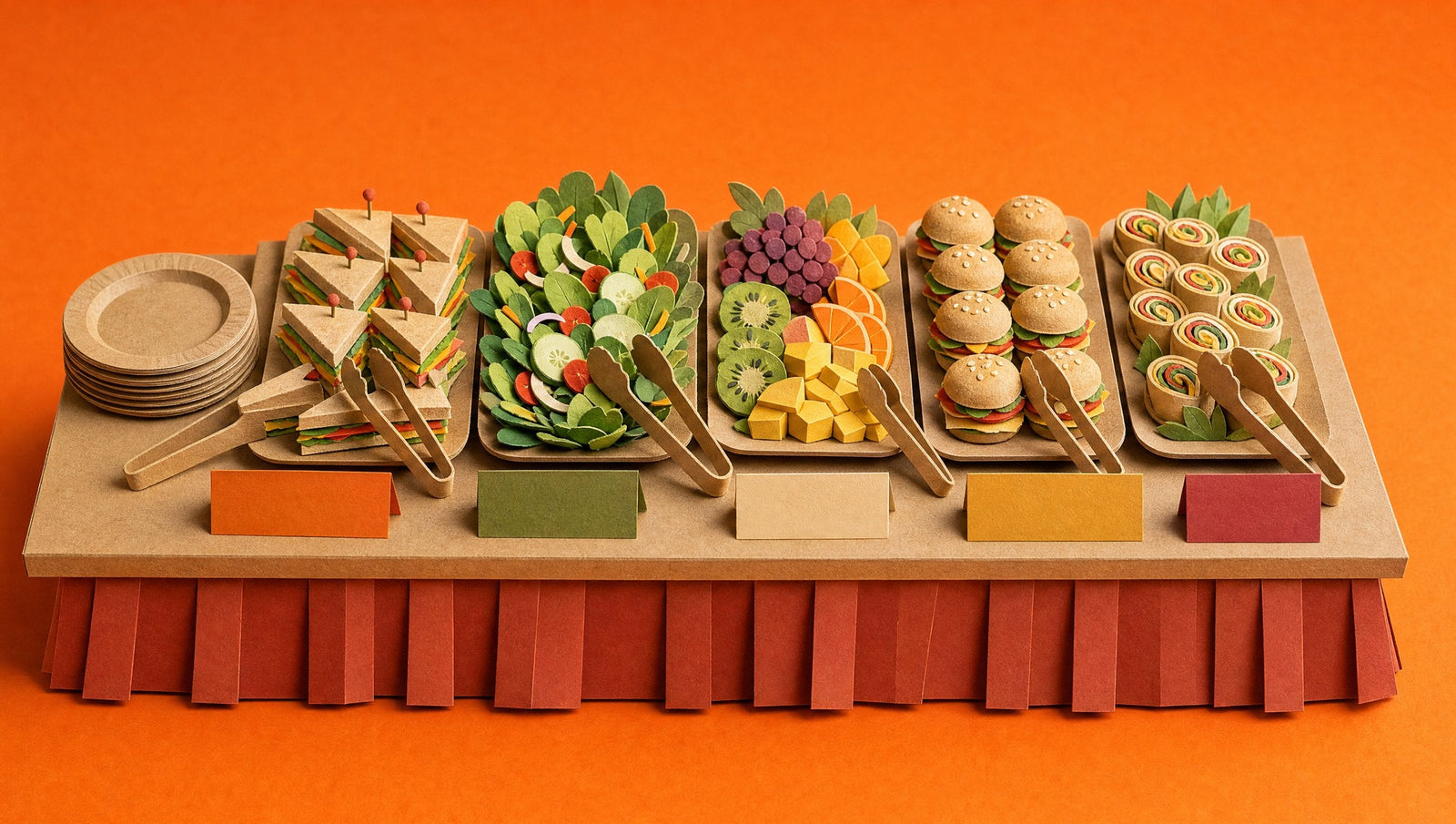
Here is how we count, because the numbers are more useful than the principle. A round of sandwiches is two slices of bread cut into four points. For people eating at their desks, three points a head is the honest number. For a standing event where people graze and talk, four to five, because standing eating is slower and lasts longer. One and a half rounds a head has been right for us more often than any other figure we have used. For morning tea, two pieces a head is generous if lunch is coming within a couple of hours, and one and a half is closer to what actually gets eaten.
The over-ordering almost never comes from the caterer. It comes from ordering to the invitation list rather than the reply list. Forty invitations produce something closer to thirty people in the room, and then someone adds ten per cent on top to be safe, which on a group that size is four full serves manufactured specifically to be thrown out.
Why the leftovers get thrown out
People assume the surplus gets eaten later. Mostly it does not, and the reason is food safety rather than appetite. Cold food that has been out of refrigeration for under two hours can go back in the fridge. Between two and four hours it has to be used straight away. Past four hours it is thrown out, and a platter that landed at eleven for a lunch that started at one is already halfway through that budget before anyone touched it. Timing the delivery to the eating matters as much as the quantity.
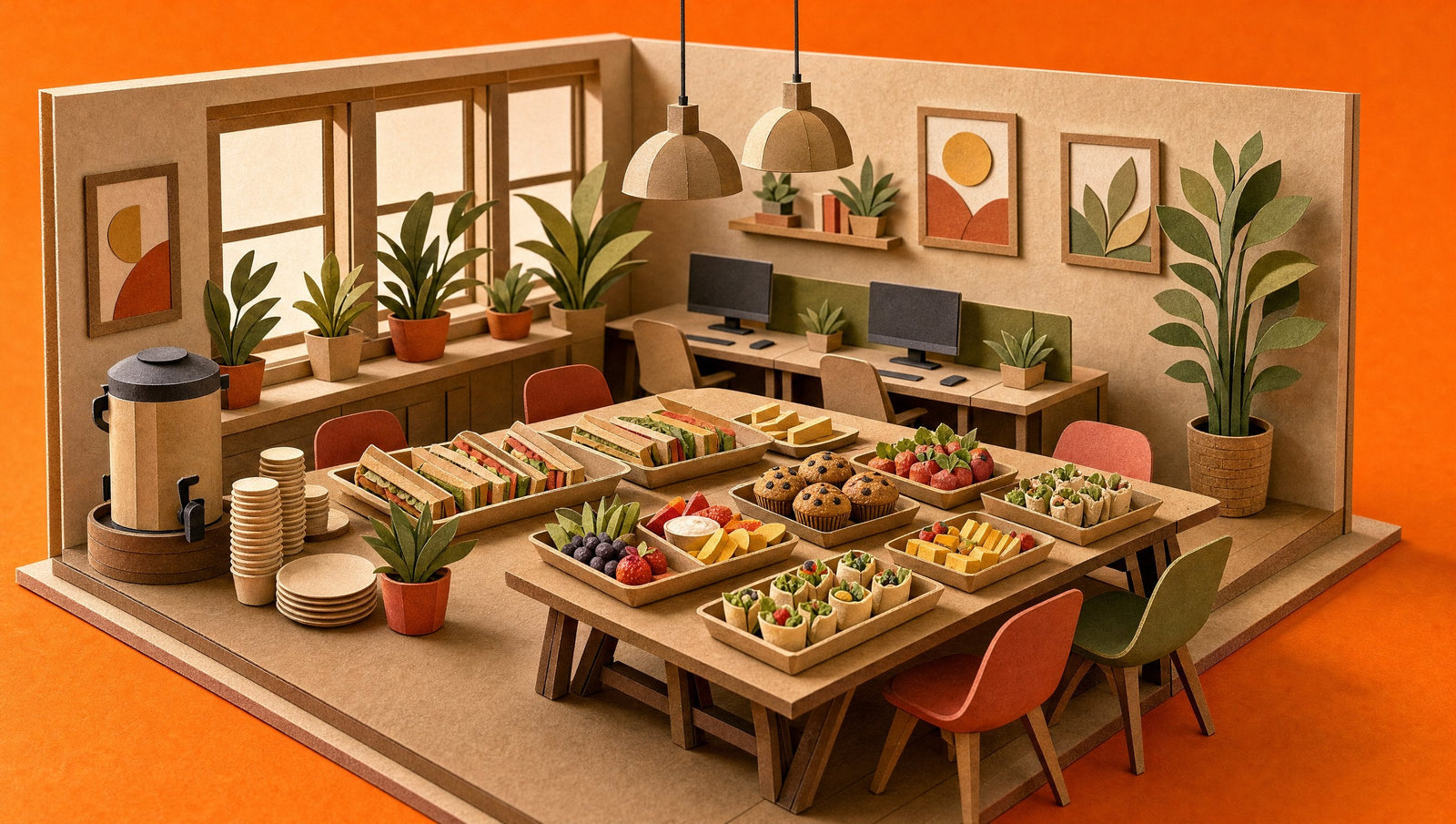
Ordering late helps here, which surprises people. Our cut-off is 4pm for next-day delivery and there is no last-minute surcharge, so a number confirmed at a quarter to four the day before is a truer number than one guessed on Monday for a Thursday. If you are arranging corporate catering, work out how much food the room genuinely needs rather than how much would look impressive on arrival. The room does not remember the tray that was too full. It remembers being fed.
One observation from years of collecting empties: fruit platters come back closer to bare than anything else we send, and the last thing standing is almost always the heaviest item on the table. Order accordingly.
2. Eat less meat

Cattle production is the main driver of methane emissions and of deforestation for grazing land, and Australia is one of the biggest meat-eating countries on earth. Halving your meat intake would make a genuine difference, and halving is the instruction worth giving because it is the one people can keep. Cutting meat out entirely does not mean going vegan or vegetarian is wrong, only that it is a bigger ask than most offices will accept, and an instruction nobody follows saves nothing.
The alternatives are not a compromise. Legumes, nuts, seeds, whole grains, eggs and roast vegetables all carry protein, and on a platter they carry it at a lower cost per head than chicken or beef. That difference is not trivial across a year of Friday lunches. Spend it on better bread and you will get more credit for the lunch than the meat was earning you.
Test a fifty-fifty platter split
Here is the part worth testing rather than believing. The assumption behind most meat-heavy orders is that the vegetarian points will be the ones left over. On our mixed sandwich platters, roast vegetable and falafel disappear at about the same rate as the chicken, and on a hot day they go faster. Order a fifty-fifty split for a month and count what comes back on the trays. If we are wrong, you will know in four weeks. Nobody has asked us to reverse it yet.
There is a Brisbane-specific argument on top of the environmental one. Mayonnaise-bound fillings are the first things to suffer in a warm room, and a chicken or egg mayo point that has been sitting out in February is the item we would pull first. Roast vegetable, haloumi and falafel hold their condition far longer in the same conditions. In a climate like ours, a lighter platter is also the safer platter.
One rule if you take nothing else from this section: do not let the vegetarian option be the punishment option. A cheese and lettuce sandwich is not a vegetarian choice, it is a sandwich somebody forgot to finish. If the meat-free half of the platter is as considered as the rest, people eat it without noticing they have made a decision, which is the whole point.
3. Know where your meat comes from

Not all meat carries the same footprint. Conventionally farmed animals and animals raised under regenerative practices produce very different emissions for the same weight of product, and the gap is large enough to matter. Meat labelled grass-fed or certified organic has generally been through a slower, more natural process, with fewer chemical inputs along the way.
The labels are worth reading properly rather than trusting as a group. Grass-fed describes the diet. Organic describes the inputs and the certification behind them. Free-range on chicken describes the bird's living conditions and says almost nothing about emissions. They are all reasonable things to want and they are not interchangeable, so decide which one you actually care about before you pay for it.
If you are buying catering rather than shopping, the useful question is not whether a caterer's meat is organic. It is who their supplier is and how often that supplier delivers. A kitchen that can answer both in one sentence is buying from a person it knows. A kitchen that cannot is buying from whoever was cheapest that week, and next week it will be somebody else. Everything we make is made by hand in our own kitchen, which means somebody looks at the ingredients before they go anywhere near a platter, and that is a different relationship to food from opening a box.
The honest limit on all of this: no caterer in Australia can hand you a reliable carbon figure per platter, and anyone who offers one is estimating. What is real and checkable is the volume. Buying less meat and better meat is the version of this that survives contact with a catering budget, because you cannot do both at the same quantity. Reduce first, upgrade second, in that order.
4. Choose seeds, nuts and vegetables wisely

Plant food is not automatically light on the environment. Harvesting releases carbon too, and a crop grown in the same ground season after season, as corn, soy and wheat commonly are, strips the soil of what the next crop needs. Foods that grow above ground and are not dug up each season sit at the better end of that scale. Macadamias and avocados are both Australian-grown examples that hold their ground for years rather than being replanted annually.
Two things a caterer learns about nuts very quickly. The first is that any office of forty contains at least one person with a nut allergy, and usually more than one. Nuts scattered through a shared salad turn a healthy tray into a tray that one person cannot touch. Keep them in their own bowl and say which item has them in it. The second is that seeds do the same job with almost none of the risk. Pepitas and sunflower seeds give you the crunch and the fats without making the platter a problem.
Avocado has one behaviour worth knowing before you build a menu around it. Cut avocado browns within twenty to thirty minutes. Lime juice and a covered container buys you closer to an hour, and that is the ceiling, not a starting point. Guacamole and anything else wet should always travel separately from the bread it is going on, or you will be serving a soft sandwich to people who ordered a fresh one.
Price tells you what is in season
The easiest sustainability signal available to a home cook is one we watch for commercial reasons: price. When a vegetable gets noticeably cheaper, it is in season and it was grown somewhere close. Build the salad around whatever has dropped this month and you have accidentally ordered the low-footprint version without reading a single label.
In Brisbane that has a seasonal shape. Winter is the good salad season here, with leaves that survive the trip and hold their condition on a table. Through the worst of summer, leaves wilt between the kitchen and the office no matter how they are packed, so slaws, roasted root vegetables and grain-based salads are the ones that arrive looking like they did when they left. Ordering to the season is the same discipline as ordering to the headcount, and it produces less waste for the same reason.
5. Support sustainable corporate caterers and food suppliers

Food is a weekly line item in almost every workplace, so the supplier you choose for it does more environmental work over a year than any single decision you make at home. Looking for eco-positive caterers and suppliers for events, office lunches and the pantry is one of the few changes a company can make once and then benefit from indefinitely.
Packaging is the part you can inspect without asking anyone anything. Everything we send goes out on kraft paper trays, in paper boxes and paper bowls. There are no clear plastic containers anywhere in it. A paper tray goes into the office paper recycling the moment it is empty. A black plastic platter has to be washed and returned, or it goes in the general bin, and in practice it almost always goes in the bin. Choosing an office caterer whose packaging is recyclable removes an entire weekly waste stream that nobody in the office has to think about again.
Delivery is the other half and it gets ignored. One van doing a suburb run replaces a dozen people driving out separately for lunch, and that comparison is not close. Our delivery starts at $19 on orders over $150, covers more than fifty Brisbane suburbs, and stays at the same rate on Saturdays. If you are already driving past, pick-up runs from 7am at 159 Knapp St in Fortitude Valley and adds no trip at all.
Questions to ask before you commit
Three questions are worth asking any caterer before you commit. What is the packaging made of. Is the food made on site or bought in and re-trayed. Will they take a headcount change the day before without adding a surcharge. That last one is a waste question disguised as a pricing question: a caterer who penalises you for correcting a number is a caterer who profits from you over-ordering. We do not charge one, which is why we can tell you to order the smaller platter without it costing us the argument.
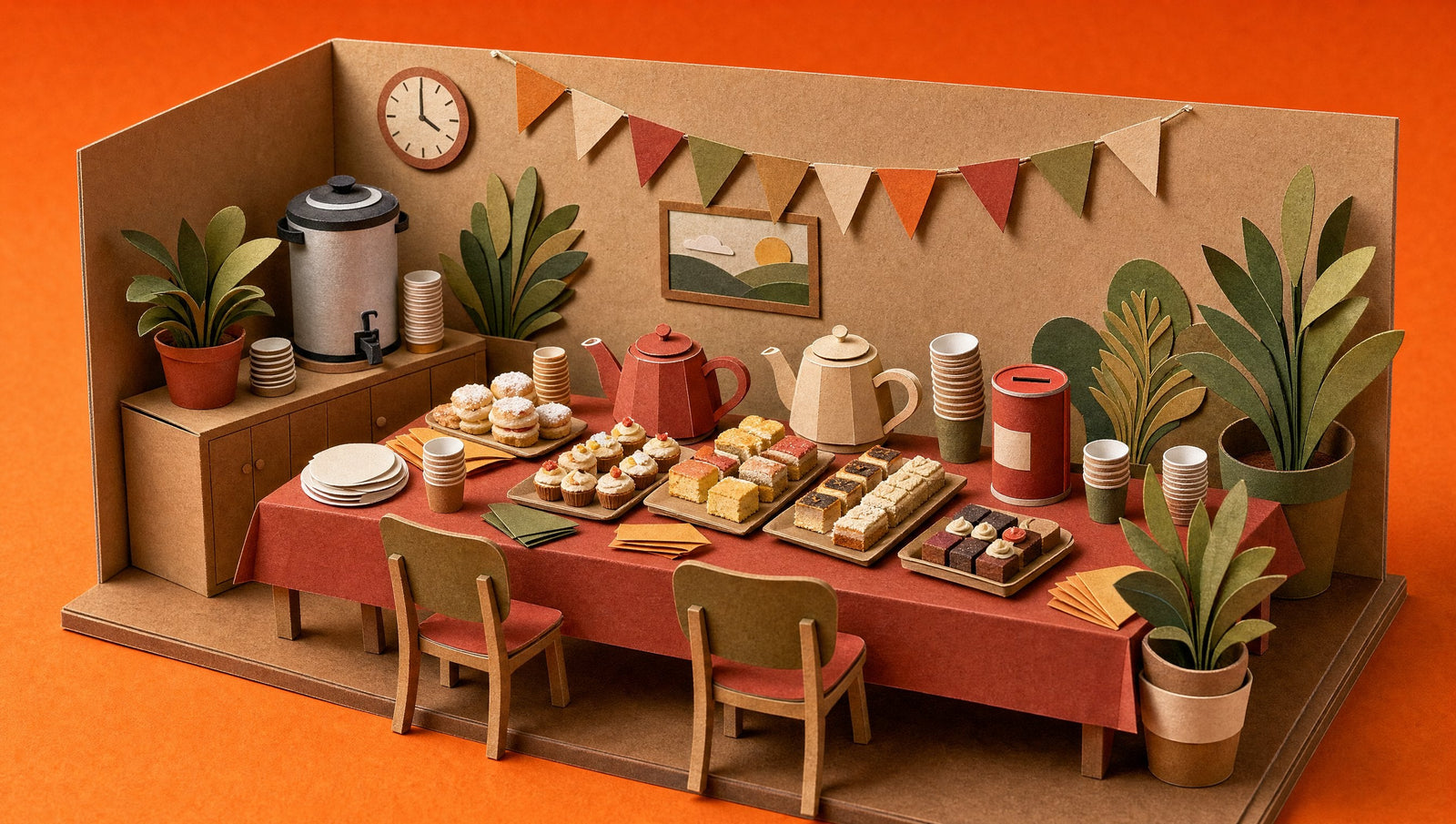
Dietary requirements belong in the same conversation. Our dietary icons sit in the product names so you can order six specific vegan serves rather than an entire extra tray on the off-chance. That precision is where most of the waste at a catered event hides. Cakes and cupcakes that need decorating want two to three business days, and the planning that requires is the same planning that stops the panic order for double what the room needs.
6. Lastly, growing your own food

Growing some of your own food is the most direct version of everything above. Nothing is transported, nothing is packaged, and you choose what goes on the plate at the point where it is planted rather than at the point where it is sold to you.
Herbs are where we would tell anyone to start, and the reason is waste rather than flavour. Herbs are bought by the bunch and used by the sprig. A commercial kitchen gets through a bunch of parsley or mint fast enough to justify it. A household does not, and half of every bunch bought for one recipe dies in the crisper drawer before anyone opens it again. A pot of parsley, mint or basil on a windowsill is the only crop we know of that removes waste instead of adding to it, and it survives a Brisbane summer without any attention worth mentioning.
The office version is smaller than people imagine and works better than people expect. A couple of herb pots on the kitchen windowsill, maybe a tomato plant on the balcony. Not a farm and not a project. Enough that the garnish on a catered platter came from ten metres away, and enough that the people in that office watch something edible take its time.
That last part is the real return. Anybody who has grown a lettuce over eight weeks and then watched somebody scrape half a salad into a bin understands the arithmetic of food waste in a way no statistic delivers. Growing food teaches you how long food takes. Once you know that, ordering the right amount stops feeling like restraint and starts feeling obvious.
None of this is dramatic. Order to the number of people who said yes rather than the number you invited. Split the platter half and half and count what comes back. Ask what the tray is made of. Buy less meat and better meat. Grow the garnish. Six small habits, repeated weekly by an office of forty, move more than one heroic gesture ever will, and the food is better on the way through.

Leave a comment
Comments will be approved before showing up.