Melbourne Cup Sweep - Everything You Need


The Melbourne Cup is run on the first Tuesday of November over two miles at Flemington, with the field capped at twenty-four horses. That is roughly all anyone in an office needs to know about the race itself. The part that takes organising is the sweep, and the lunch that goes with it.
One detail catches Brisbane offices out every year. The race jumps at three o'clock Melbourne time, and Melbourne is on daylight saving in November while Queensland is not. In Brisbane that is two o'clock. We have taken that phone call more than once — someone books delivery for half past twelve on the assumption they have until three, and the room eats the entire platter a full hour before the horses load.
So plan the day backwards from two. Draw the sweep at morning tea, put the food out at one, and let people stand with a plate in one hand while the race is run. What follows is how a sweep works, what the rules actually say, and the handful of things we have learned delivering into rooms like yours on the first Tuesday of November.

What Is A Sweep
A sweep is a pooled lucky draw. Everyone puts in the same small amount, each person draws a horse at random, and the money that comes in is paid back out to whoever holds the horses that place. There is no skill in it and no form guide to read, which is precisely why it works in an office where half the room could not name a single runner.
Tickets are usually a set price, most often somewhere between two and twenty dollars, and the pool is split across first, second and third. The organiser decides the split. Raise the ticket price and you raise the prize, but the number of people willing to join falls at about the same rate, which is why five dollars has survived as the default for so long.
It is popular with people who have never had a bet in their lives. No bookmaker, no account, no odds to understand — you hand over a note, you take a folded piece of paper, and for three minutes you have a horse.
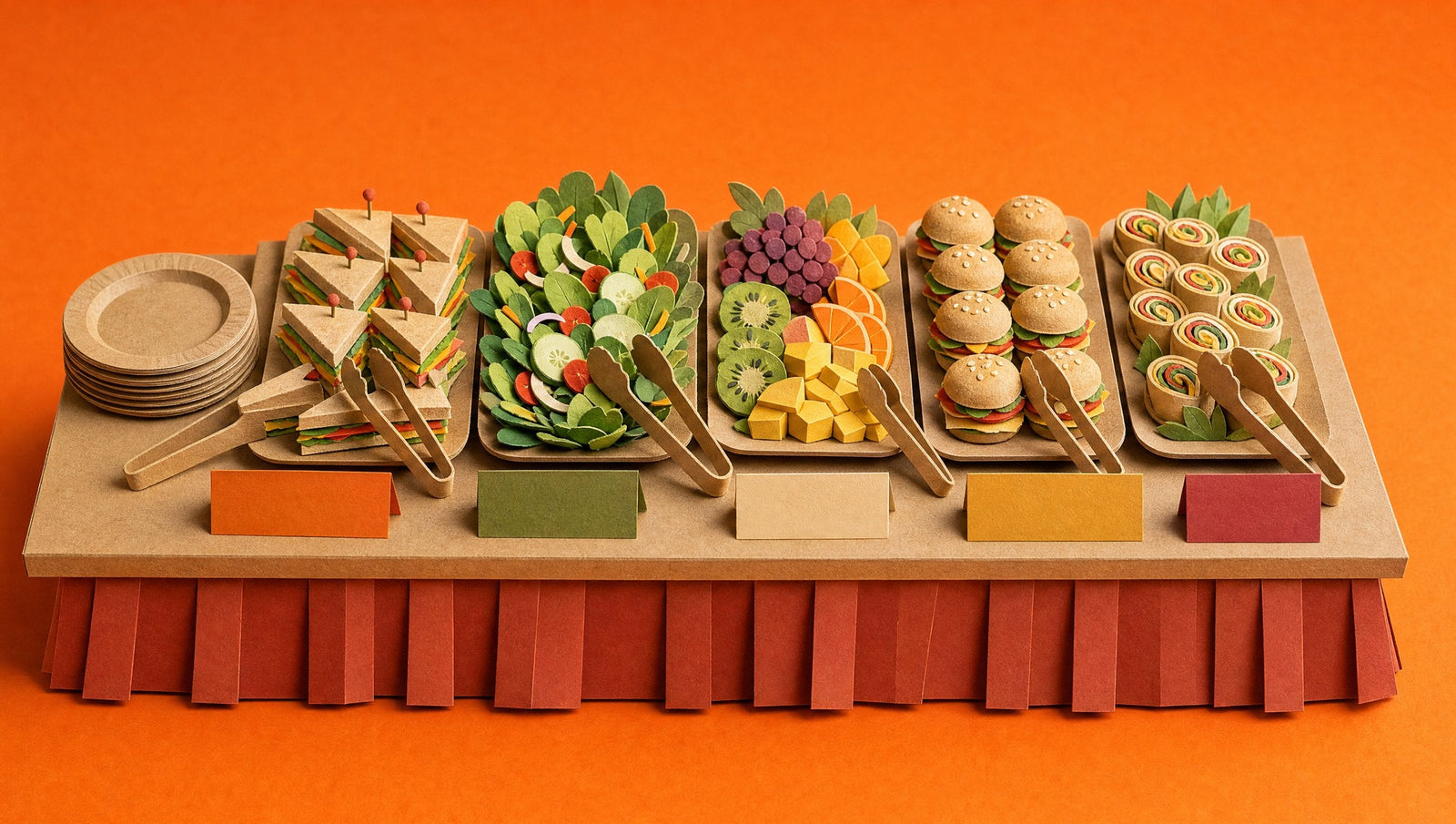
What a sweep really does is put a whole office in one room at a fixed minute, which no morning tea invitation ever manages on its own. From a catering point of view that is a very specific problem. Everybody eats inside about a twenty-minute window, standing up, watching a screen, with one hand already holding a cup. Food that needs a fork and a flat surface does not get eaten at a sweep no matter how good it is, and that is the single most common ordering mistake we see on Cup day.
Is The Melbourne Cup Office Sweep Legal?
Yes, with conditions, and the conditions differ by state. There are two kinds of sweep. A common sweep is the one described above — a fixed ticket price, horses drawn at random, and a prize pool made up only of the ticket money, with the person holding the winner usually taking the largest share. A Calcutta is a different animal: participants bid against each other for the horse they want, auction style, and it is far more tightly controlled. In Victoria a Calcutta can only be run under a permit issued by the Minister for Racing.
Prizes may be money, goods or gift vouchers. Tobacco, firearms, ammunition, weapons and cosmetic surgery are not permitted as prizes. In New South Wales liquor prizes are capped at twenty litres and total ticket sales must not exceed twenty thousand dollars. In Victoria the prize itself must not exceed five thousand dollars. Limits like these get reviewed from time to time, so check your own state regulator before you start taking money. A twenty-person office sweep at five dollars a ticket is nowhere near any of these thresholds; a building-wide one might be.
Those rules are quietly why food and vouchers turn up as prizes so often. Nobody has to work out what category a tray of something falls into, and unlike a bottle it does not sit in a drawer until Christmas. One warning if you go that way. A box of chocolates left on a desk from nine in the morning until two in the afternoon in November is a soft box of chocolates by the time it is won, and anything held together with buttercream is comfortable up to about twenty-five degrees and no further. Keep an edible prize out of the room, and out of the sun, until the moment it is handed over.

Instructions On How To Play The Melbourne Cup Sweep
The mechanics take about ten minutes and have not changed in decades. Print the template, cut it up, put it in a bowl, take the money, let people draw. The pool is then split among the winners — commonly half to first and the rest shared across second, third and sometimes fourth, though the organiser sets that before a single ticket is sold, not after.
- Download and print a Melbourne Cup sweep template.
- On the morning of the race, check the scratchings — the horses withdrawn before the start — and take those tickets out. Scratchings are announced on the day, so this is a morning-of job and cannot be done the week before.
- Cut out the tickets for the horses still running and put them in a bowl. If more than twenty-four people want in, print a second set so there are enough to go around.
- Invite everyone to pay and draw.
- Write down who drew what, as they draw it, not afterwards from memory.
- Once the race is run, work out who has won.
- Announce the winners and hand over the prizes.
- Spend the rest of the afternoon on good foods and drinks.
Two pieces of timing advice, both learned the hard way. Run the draw at morning tea rather than at five to two, because a bowl going around a room takes far longer than anyone expects and the last three people will still be counting out coins while the race is being called. And put the food out after the draw, not before. A platter uncovered at half past eleven is picked over by one o'clock, and the room has lost interest in it by the time it actually matters.
Whoever runs the sweep should also be the person who does not have to do anything else at two o'clock. Collecting money, tracking twenty-four names and putting lunch out are three jobs, and on Cup day they all fall due in the same fifteen minutes.
What Are The Prize Options?
Cash is the usual answer. For an average office sweep people pay somewhere between one and twenty dollars a horse, and the pool is split three or four ways. That last-place prize is not a joke, incidentally — it is the reason people keep watching a race their horse stopped mattering in somewhere around the first turn.

If you would rather give something than hand over notes, match the value of the gift to what the winner would otherwise have collected. Beyond that the standard choices are a decent bottle, good chocolates or a gift certificate, and all three work because none of them needs to be the right size or the right colour.
A few notes on the edible ones, since we make them. Decorated cakes and cupcakes need two to three business days, so a race-day prize has to be ordered by the Friday before at the latest. Everything else here goes out next day on a 4pm cut-off with no last-minute surcharge, but decorated work is not a queue that can be jumped — the icing needs the time it needs.
If the prize will sit somewhere warm before it is handed over, choose something that does not mind sitting: biscuits, a jar of something, a voucher. And the most popular prize we deliver is not really a prize for one person at all. It is a platter for the winner's team the following week, which is how an office gets two occasions out of one sweep and how the person who won stays popular past Wednesday.
Can You Still Hold Office Sweep Virtually?
It works, and for a lot of offices it is now the only version that happens. An online sweep generator does the drawing for you, which removes the bowl, the queue and the person who cannot find a pen. It is also the answer for anyone who cannot get to the office on the day, or who is joining from another state.
- Enter the number of participants. Depending on scratchings and how many people join, some may end up with more than one horse and some with none, so agree how you are handling that before you generate anything.
- Click generate.
- Share the sweep with everyone, printed or on screen.
- Wait for the race.
- Announce the winners on whatever platform the office already uses.
- Pay out. Most generators default to sixty per cent of the pool for first, twenty-five for second, ten for third, and five for the horse that comes home last.
The catering problem changes shape when the sweep goes online. One delivery becomes six addresses, or none at all. What most hybrid offices land on is sending a single platter to whichever house has the most people in it and letting everyone else join from their own kitchen. We deliver to more than fifty Brisbane suburbs, delivery from $19 on orders over $150, Saturdays at the same rate, and pick-up from the Fortitude Valley kitchen opens at 7am if somebody would rather collect on the way through.
How To Run Melbourne Cup Office Sweep For People Working From Home?

A remote draw needs three things: a video call, a shared screen and a random number generator. The shared screen is the entire point. A draw nobody could watch is a draw somebody will quietly wonder about, and the wondering lasts longer than the race.
- Make an alphabetical list of everyone joining the sweep.
- Get them all onto a video call — Zoom, Google Meet, whichever app the office already lives in.
- Share your screen so the draw happens in front of everybody.
- Have the random number generator open before you begin, not while twenty people watch you search for it.
- Generate a number for the first name on the list. The number is the horse.
- Record it beside that name and cross the horse off your list.
- Work down the list, one name at a time, until everyone has a horse.
- If the generator returns a number already taken, generate again until it gives one that is not.
- If people are getting more than one horse each, go back to the top of the alphabetical list and run through it a second time.
Allow about ten minutes for a room of twenty. It is slower than a bowl, because every number has to be read out, written down and confirmed, and it is worth starting well before one o'clock so the call is not still going when the gates open.
None of this is complicated. The sweep takes ten minutes to set up and earns its keep in the number of people who stand in the same room voluntarily on a Tuesday afternoon. The food is the part that decides whether the hour feels like an occasion or like a meeting that ran over.
Order it for one o'clock, keep it one-handed, and remember that in Brisbane the race is at two. Everything on Mr T's Melbourne Cup Menu is made by hand in our Fortitude Valley kitchen the morning it goes out, and the first Tuesday in November is one of the busiest days of our year, so the earlier the order lands the better.

Leave a comment
Comments will be approved before showing up.