Melbourne Cup Catering Food Ideas


The Melbourne Cup runs on the first Tuesday in November, and in Brisbane that matters more than most people allow for. Queensland does not run daylight saving, so the race Melbourne calls three o'clock jumps here at two. Every Cup day order we send out is built around that one number.
What it means in practice is that the eating window is narrow and it closes early. The room fills at about half past eleven, the sweep goes up on the wall, the food gets forty solid minutes, and then nobody touches anything between twenty to two and ten past. Afterwards a third of the room goes back to work. Food that arrives at half past one has missed the party it was ordered for.
Order for eleven, not for three

The Cup is more than a race. It is the one day of the year an ordinary Tuesday office turns into a social event, with hats, a sweep on the wall and a table of gourmet finger foods that has to feed people standing up. Victoria gets the public holiday. Everywhere else simply stops working at about a quarter to two and pretends otherwise.
Most of what leaves our kitchen on Cup day is either a late morning tea that runs long or a stand-up lunch that has to be finished before the race. The afternoon teas we deliver that day are ordered for eleven rather than three, because by three the room has emptied. That single scheduling detail is the most common Cup day ordering mistake we see, and it is the easiest one to avoid once somebody says it out loud.
The rules that keep the food good

Whether it is eight people around a meeting table or a hundred and fifty in a warehouse, the shape of the day is the same and so are the rules that keep the food good. Here is what fifteen-odd Cup days have taught us about hosting one.
- Cocktail finger food is the right call, and for a reason that has nothing to do with elegance. People are standing, holding a drink and half watching a screen. Anything that needs a second hand does not get eaten.
- Skip the cutlery and skip the plates, but do not skip the serviettes. Napkins are the thing every host under-orders. Count two a head and you will still run out by one o'clock.
- Put the food out all at once rather than in waves. A staggered service means somebody is standing in the kitchen at ten to two, which on Cup day is the worst place in the building to be.
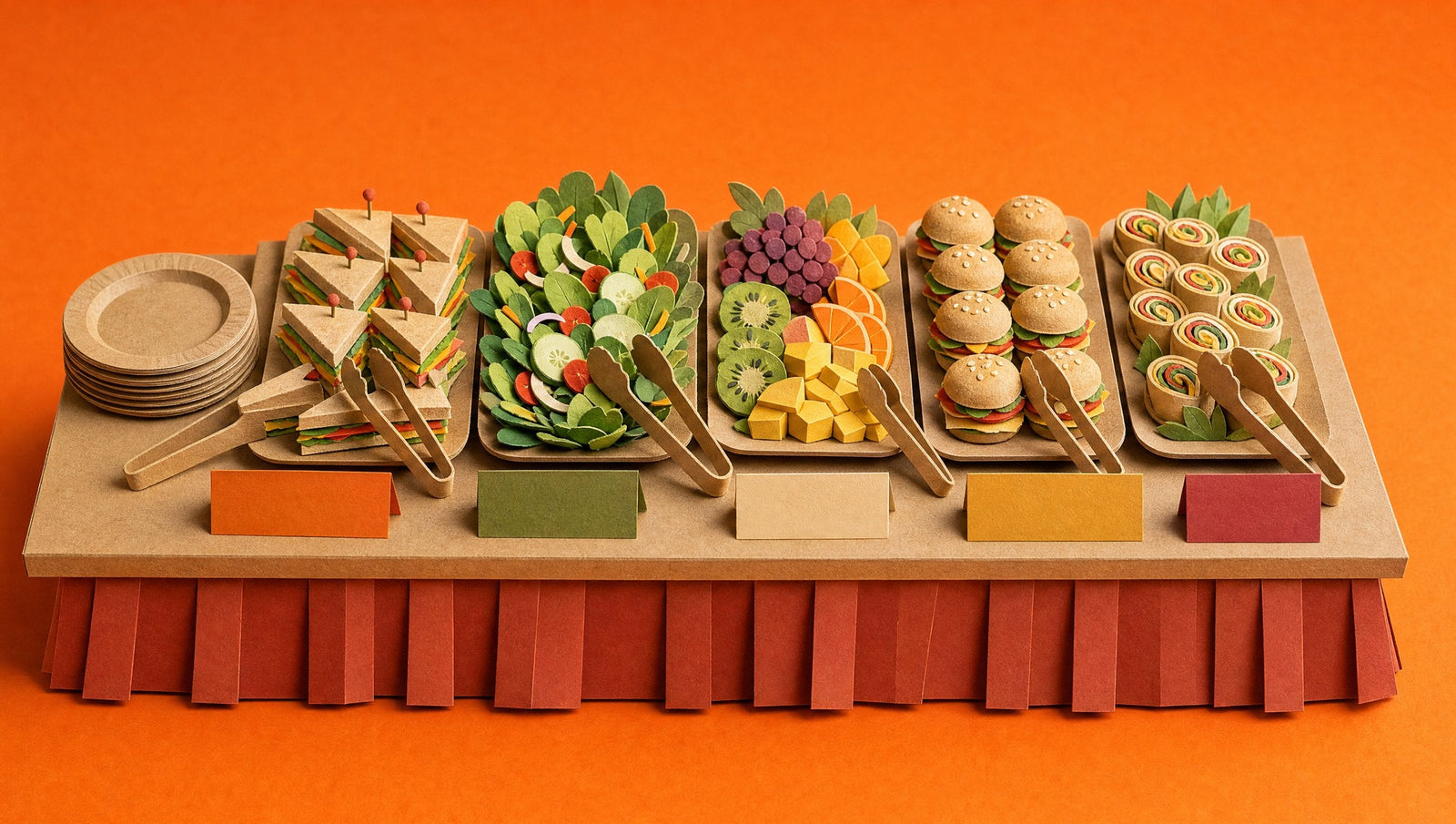
- Serve on wooden boards, kraft trays and wide shallow bowls that can be picked up and carried around the room. Deep bowls hide the bottom third of what is in them and it comes back untouched.
- Give the drinks their own table, on the other side of the room from the food. One table for both makes a queue, and a queue at a stand-up party is the difference between a room that mingles and a room that shuffles.
How many pieces to order per head
Quantities are the next thing to settle, and they are simpler than people fear. For a party that runs from half past eleven to two, count eight to ten pieces a head across everything on the table if the food is the meal, and five or six if people are eating properly afterwards. What catches hosts out is not the total but the spread. Six kinds of food at eight pieces a head is a better party than three kinds at sixteen, because variety keeps people walking back to the table, while three things get picked over in twenty minutes and then ignored for an hour.
The last thing to know before you order is the weather. November in Brisbane is warm and already humid. Late morning is fine. By two the room is full, the air conditioning is losing, and everything on the table has been sitting out for two hours. That is not an argument for serving less. It is an argument for choosing food that survives it, and knowing which items do not.
What follows are the ten things we send out most for Cup day, and what each one actually does once it has been standing on a table since half past eleven.

1. Fresh Fruit Platter
Fruit is the first platter to empty on Cup day and the one nobody plans for properly. It brings colour to a table of beige food, it suits every diet in the room without anyone having to announce anything, and after an hour of champagne it is the thing people actually want. Order more of it than feels sensible.
The catch is that cut fruit is a clock. It has about four hours before it stops looking fresh, and that is well before it stops being good to eat. The clock starts when the knife goes through it, not when the box lands on your bench. Melon and pineapple are the worst offenders: they keep weeping, the juice runs to the low corner of the tray, and by two o'clock the last pieces are sitting in a shallow puddle. Grapes, strawberries and citrus segments hold far better and are worth weighting the platter towards if the day is hot.
Two habits fix most of it. Leave the platter covered until people are actually in the room, because an uncovered tray dries at the cut faces within half an hour and the colour goes flat and chalky. And keep it at the far end of the table from anything dry, since fruit wets whatever it stands next to. Crackers beside a fruit platter go soft and nobody ever works out why.
A couple of fruits are worth leaving off entirely. Banana browns within about fifteen minutes of being cut and there is nothing you can do about it. Kiwi and passionfruit are wet enough to soak everything they touch. Pineapple, for all that people love it, turns anything dairy that sits beside it, so it belongs on the fruit platter and nowhere near the cheese board.
Our seasonal platters are cut by hand the morning they go out, which is the only honest way to buy yourself the whole four hours rather than the tail end of somebody else's.

2. Cheese Platters
Cheese is the platter that rewards a bit of range. Something aged and hard, something soft and white, something blue if the room is game, and a firm one in the middle to keep the peace. Cow, goat and sheep milk taste different enough that four cheeses can carry a whole table on their own.
Cheese also has the sharpest temperature rules of anything here, in both directions. Straight out of the fridge it tastes of nothing, because the fat is too cold to release its flavour and an expensive cheese eats like a cheap one. Thirty to forty minutes out of the cold is the sweet spot. Past about an hour and a half in a warm November room the soft cheeses start to bead at the surface and go greasy, and a brie will slump out of its shape and keep going.
Crackers are the other half of the problem. Crackers laid against a cut cheese bend within about twenty minutes, and a bent cracker breaks in the dip instead of scooping it. Keep them in their own bowl beside the board rather than fanned decoratively around the edge of it, top that bowl up twice during the party, and the last person at the table gets the same snap as the first.
One small thing makes a cheese board work harder than anything else you can do to it: cut two or three pieces off every wedge before you put it down. An untouched wheel sits there all afternoon because nobody wants to be the person who ruins the arrangement. A wedge that has already been started gets eaten.

3. Dips Platters
Dips are the cheapest way to make a table look full and they hold better than almost anything else standing on it. Thick dips built on cream cheese or chickpea keep their shape for hours. Yoghurt-based dips are the ones to watch, because they separate in the heat, and a thin film of water sitting on top of a tzatziki at half past one looks exactly as appetising as that sounds.
The mistake everybody makes is standing the vegetables up in the dip. It looks good for ten minutes. What happens next is that the batons wick moisture up through the cut end, go limp from the bottom, and then have to be pulled out and thrown away in front of everyone. Lay the carrot, celery and green beans flat around the outside of the dip instead and they stay crisp for the whole party.
Serve dips in several small bowls rather than one large one. A half-empty bowl with tracks dragged through it stops being used, whereas a small bowl can be swapped for a fresh one without anybody noticing there was a problem. Add the crackers and flatbread at the last possible moment, for the same reason as the cheese board.
Dips are also the one item on this list that genuinely improves if you make it the day before, because the garlic and the acid need a few hours to settle into the base. Make them on the Monday, keep them cold overnight, and take them out about twenty minutes before people arrive so they are soft enough to scoop. A fridge-cold dip is stiff, and a stiff dip tears the cracker in half.

4. Sandwiches
A sandwich platter is the least exciting order on a Cup day menu and the one that stops the party going sideways at one o'clock. Champagne on an empty stomach at a lunchtime event is how a good office day becomes a story that gets retold for years, and sandwiches are the only thing on this list substantial enough to prevent it.
Numbers first. Allow one and a half rounds a head if the sandwiches are the meal, and about one a head if they are sitting alongside platters. Order roughly a third more of the vegetarian than you think you need, because everybody eats it, not only the vegetarians. This is true at every event we cater and it is still the most under-ordered item on any menu.
Whether a platter is still good at two o'clock is decided in the build, not in the fridge. The spread has to go right to the edges to seal the bread, the wet ingredients such as tomato, beetroot and anything pickled belong in the middle away from the crust, and the leaves have to be dry when they go in. Built that way, a platter is as good at two as it was at eleven. Built the other way it is soggy before midday and no amount of cold storage will save it.
Do not park them in a fridge for hours in the name of safety, either. Bread stales fastest at fridge temperature, which is the opposite of what almost everyone assumes. Somewhere cool and out of the sun, still wrapped, is better than cold. Click to see the sandwich platters that go out most often on race day.

5. Baked Oyster With Cheese Bacon
Oysters are at their best through spring, and a baked oyster with cheese and bacon is genuinely one of the better things you can put in front of a crowd. It is also the one item on this list we will talk you out of if the timing is wrong, which on Cup day it usually is.
Anything hot has a fifteen-minute window. A baked oyster is excellent for about fifteen minutes and ordinary after thirty. The cheese sets, the bacon goes from crisp to leathery, and the shell holds enough heat to keep cooking the topping while it waits for somebody to notice it. Order them only when the food and the people arrive at the same time, which on Cup day means once the room is already standing rather than at eleven with everything else.
If you are serving them, sit the shells in rock salt or crumpled paper rather than straight onto a flat tray. An oyster shell is round underneath. On a flat surface it tips, and the topping you paid for ends up on the table instead of in the shell.
The other reason we say all this out loud is that seafood is the item people order emotionally. Somebody remembers a very good oyster and adds three dozen to a menu that is otherwise designed to sit quietly on a table for two hours. If the room is standing around a screen from half past eleven, put that money into more finger food and save the oysters for a dinner where everyone sits down at once.

6. Viennese Cookies
Viennese biscuits are piped butter shortbread, half dipped in chocolate, sometimes rolled in chopped pistachio or almond and sometimes sandwiched with jam. They are the item that carries the back half of the afternoon, when nobody wants anything savoury any more but the room has not gone home yet.
They are also the most weather-sensitive thing on the table, and the reason is the chocolate rather than the biscuit. Above about twenty-five degrees a chocolate coating softens enough to take a fingerprint, and if it has been warm and then cooled again it blooms into dull grey-white streaks across the surface. It is harmless and it tastes exactly the same, but it does not look like the biscuit you ordered, and on a table people are photographing that matters.
Keep them somewhere cool and dry, in their box, out of the sun, and do not put them in the fridge. Cold pulls condensation onto the chocolate the moment they come back out, and a damp biscuit loses its snap within twenty minutes. In Brisbane humidity an open plate of shortbread softens in about two hours anyway, so put half out and hold the rest back for the second wave after the race.

7. Sushi Platters
Sushi works on Cup day for the same reason sandwiches do. It is already portioned, it takes one hand, and each piece is a complete thing rather than a component that needs assembling on a plate. Vinegared rice, seaweed, something from the sea or the garden, cut into bites nobody has to negotiate while holding a drink.
Rice is the part that decides how good it still is by lunchtime. Sushi rice goes hard and chalky at fridge temperature, and under an hour of proper cold is enough to do it, so sushi is not something you make the day before and hold. It is a two-hour food out of the fridge on a mild day and about one on a hot one, which puts it firmly in the half-eleven-to-one window rather than anywhere near the afternoon.
Handling matters more than people expect. Lay the pieces in a single layer and never stack them, because the nori sticks to whatever is put on top of it and tears when the two are pulled apart. Keep the platter covered until service, since the cut faces dry out and darken within half an hour. And keep the soy in its own small dish rather than poured over the top, because sauce on nori softens it in minutes and a soft roll falls apart between the platter and the mouth.

8. Gluten-free Frittata
Frittata is the quiet answer to almost everything difficult about a Cup day menu. It is egg, vegetables, herbs and cheese, it is naturally gluten free with no pastry anywhere near it, and, most usefully, it is just as good at room temperature as it is hot. Nothing else on this list is both a proper savoury item and completely indifferent to how long it has been standing there.
Cut it cold and it cuts clean. Cut it hot and it crumbles at the edges and the pieces stop looking like squares, so if you want neat portions on a board, let it come back to room temperature before the knife goes anywhere near it. What you should not do is reheat it twice. Egg goes rubbery and weeps water the second time around, and a twice-warmed frittata at two o'clock is worse than a cool one straight from the box.
It is also the item that solves the dietary problem without a conversation. Our dietary requirements are marked in the product names themselves, so a gluten free guest can look at the menu and know, rather than having to interrupt a host who is currently trying to get a sweep drawn before the horses go into the barriers.

9. Cupcakes
Cupcakes suit a standing party better than a cake does, because there is no cutting, no plates, no serving spoon and no queue. Vanilla, chocolate, strawberry and red velvet between them cover almost any room you are likely to be feeding.
Buttercream is comfortable up to about twenty-five degrees. A November afternoon in Brisbane is past that, and a tray of cupcakes left on a sunny window ledge will be leaning inside an hour. Keep them in the box, in the shade, and bring them out as the savoury food is being cleared rather than at the start. Cream cheese frosting is stricter again, with roughly two hours out of the fridge before it starts to go.
If you want them decorated in racing colours or topped with fondant, they need two to three business days. That is not a queue, it is drying time. Fondant work has to firm up before it can be handled without marking, and a topper made this morning will not hold its shape this afternoon.
10. Melbourne Cakes
A Melbourne Cup cake is usually vanilla with buttercream under fondant, decorated in racing colours with a horse and jockey topper on top. It is the centrepiece of the table, and the whole point of a centrepiece is that everybody sees it before it gets cut.
Which means cutting it before the race rather than after. The room empties within fifteen minutes of the finish, because people go back to work or move on somewhere else, and a cake cut at half past two gets eaten by six people and thrown out by four. Bring it out at about one, cut it then, and let people take a piece away with them.
Sizing is simple enough once you know the convention. A six-inch round is about twelve party slices and an eight-inch is about twenty-four, and a party slice is considerably smaller than the wedge you would cut at home. Order to the number of people who will still be in the room at one o'clock, not to the number on the invitation.
Two things ruin a decorated cake on its way to a party and both are avoidable. Fondant hates the fridge: cold makes it sweat, and a cake taken out of the cold into a Brisbane November afternoon will bead with moisture within minutes and stay that way. And a car is not a cool room. A boot at midday in November is well past what buttercream tolerates, so the cake travels on a flat floor with the air conditioning running, not in the back with the shopping. Decorated cakes need the same two to three business days' notice as the cupcakes, for the same drying reason.
Office party or party at home

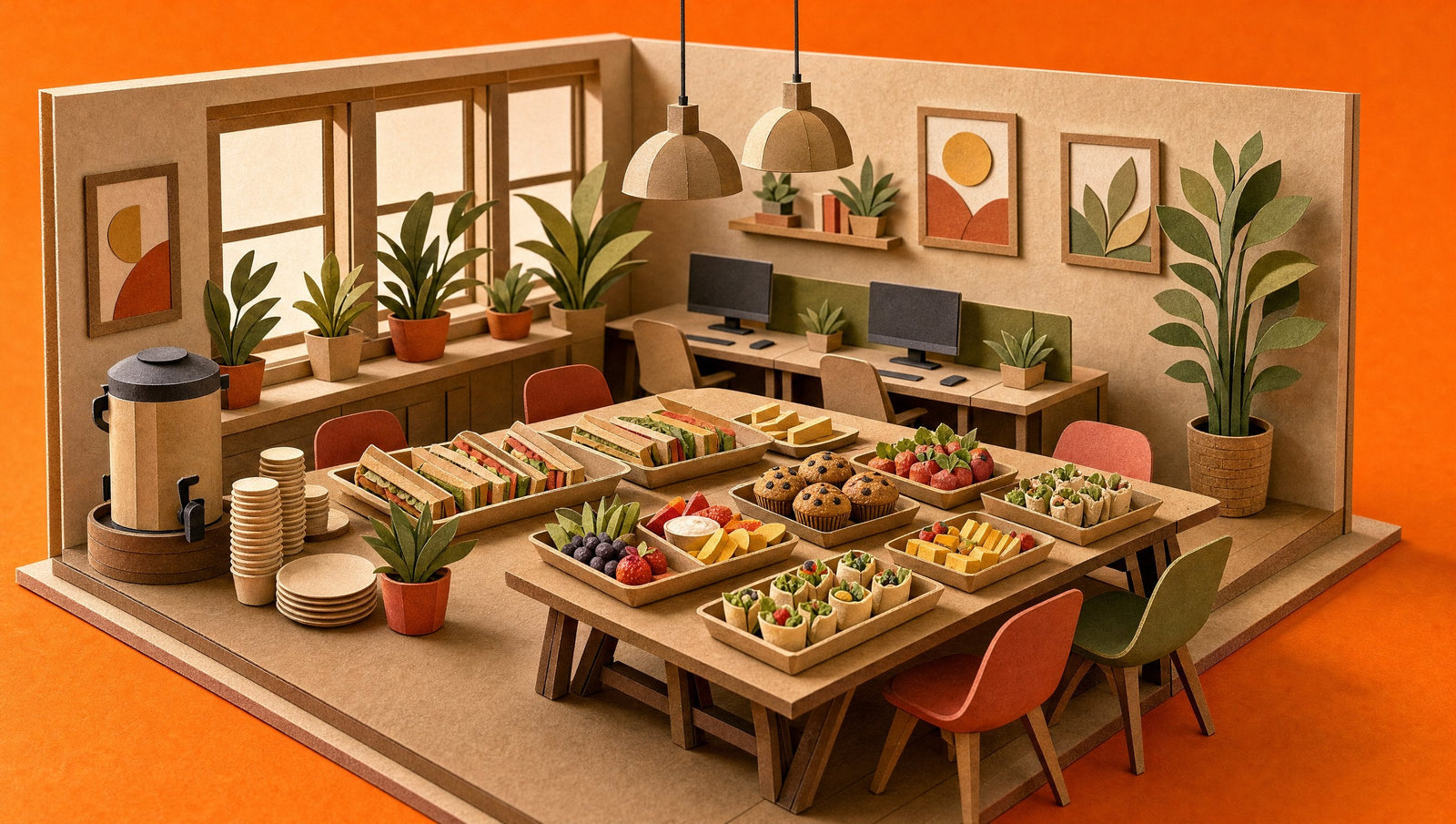
Two shapes of Cup party come through this kitchen and they want different food. The office one is short, runs on standing room and finishes at three, so it wants finger food, sandwiches and something sweet, six or seven small things with no cutlery anywhere in sight. The one at home runs for six hours, people sit down at some point, and the table needs a couple of substantial items held back for the middle of the afternoon or the whole thing peaks at one o'clock and dies quietly by three. If you are hosting at home, keep a platter in reserve and put it out after the race.
Cut-off times, delivery and pick-up
The ordering itself is the easy part. We take orders until 4pm for next-day delivery with no last-minute surcharge, so a Monday afternoon phone call still puts food on the table on Cup day. Delivery starts at $19 on orders over $150 across more than fifty Brisbane suburbs, Saturday at the same rate, and pick-up runs from 7am at 159 Knapp St in Fortitude Valley if you would rather collect on your way in. Everything goes out of that kitchen made by hand that morning. The only items that need more notice are the decorated cakes and cupcakes, at two to three business days.
One last piece of advice, and it saves more trouble than everything above it put together: tell us what time the food is being eaten, not what time you want it delivered. Those are two different problems and only one of them is ours to solve. On a day where the entire room stops at two o'clock Brisbane time, getting that one detail right is most of the job.
If you want a hand putting a menu together for eight people or a hundred and fifty, we are your caterer in Brisbane.

Leave a comment
Comments will be approved before showing up.