Food Platter Varieties For Catering


Feeding a hundred people is not a cooking problem. It is a timing problem, a counting problem and a transport problem, and the cooking is the part least likely to go wrong. That is the whole difference between hosting a dinner for eight and catering a wedding, a milestone birthday or one of the corporate functions that fill a Brisbane function room on a Thursday afternoon.
A caterer is a logistics business with a kitchen attached. The menu is the easy half. The other half is a production order that has to be built backwards from the moment the food is eaten, a packing list, a delivery run, a loading dock, a lift that may or may not be working, and somebody at the other end who knows the food is coming. Order enough of them and you learn that the meals that go wrong almost never go wrong in the kitchen.
Where the word catering came from

The word is older than the trade. To cater once meant simply to buy provisions, and the person doing it was shopping for a household rather than cooking for a crowd. Catering as something you could hire came later and from several directions at once: ships that carried a catering officer whose job was to feed a crew for the length of a voyage, monastery kitchens that fed whoever turned up at the door, and the run of restaurants that opened in France after the revolution when the cooks of large private houses suddenly had to find new customers. After the second world war the companies that had been feeding troops needed somewhere else to sell food, and catering stopped being something only the wealthy bought.
What has actually changed since is mostly the ordering. The menu is on a screen, the quote is instant, and the cut-off for next-day delivery is 4pm the day before rather than a phone call and a fortnight of notice. The food, if it is any good, is still made by hand in a kitchen by people who started early.
The three kinds of catering

There are broadly three things sold under the word catering, and knowing which one you are buying matters more than the menu does.
In-house event catering is the full production for a corporate event. Menu design and preparation, the flowers, the decorations, staff placed in the venue, and somebody whose entire job on the day is to watch the room. You are paying for hours of labour standing in your building, and it is priced accordingly.
Full private catering is the same thing pointed at a wedding, an anniversary, a milestone birthday or a party at home. It covers menu planning, a tasting, the dishes themselves, decorations, hired cutlery and crockery, service through the night and the clean-up afterwards. The clean-up is the part people forget to ask about and the part they are most grateful for at eleven o'clock.
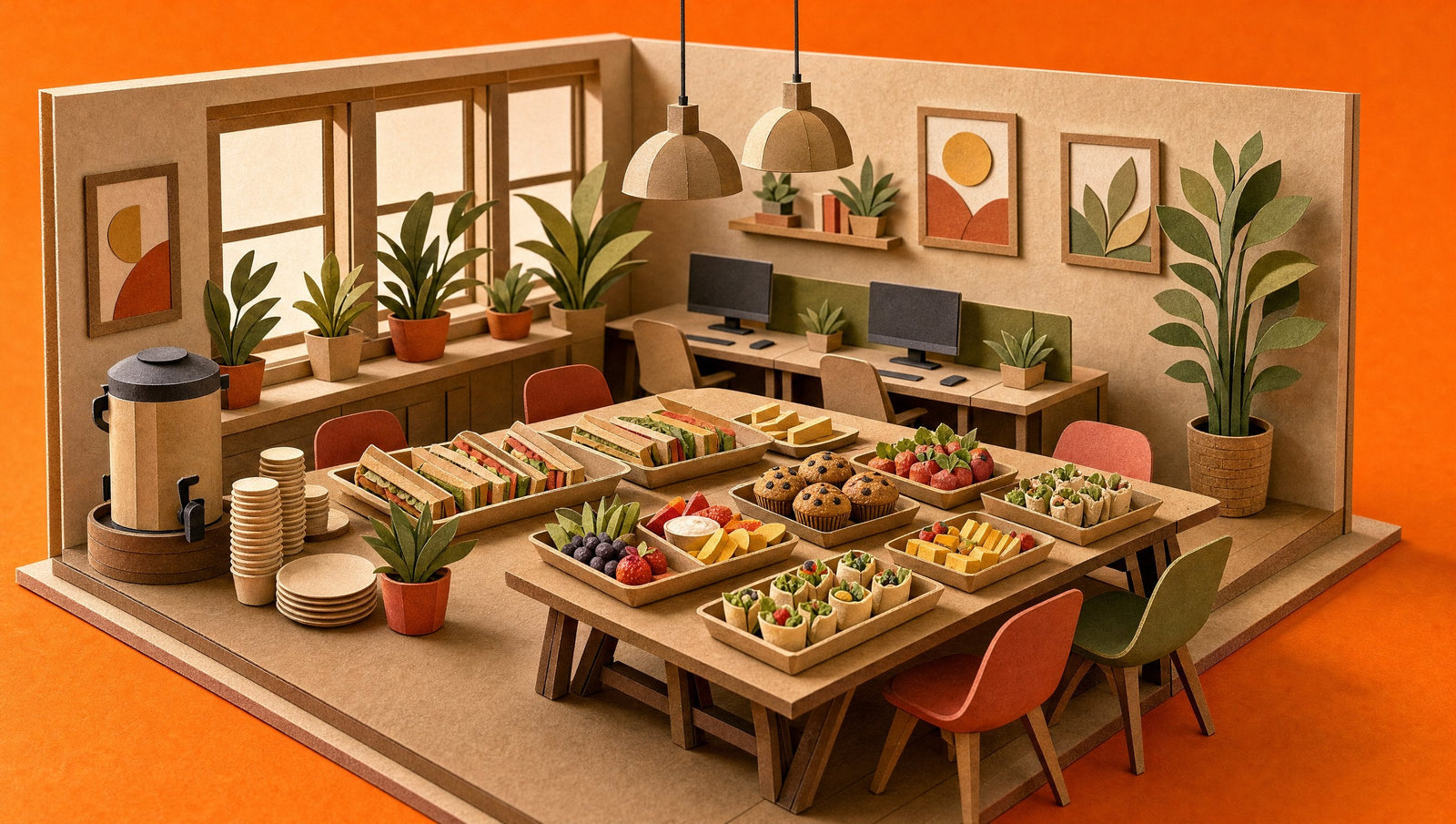
Drop-off catering is the one most offices actually buy. A pre-set menu, food arranged on platters, delivered to a meeting, a training room, a site shed or a staff kitchen, with no staff staying behind. It costs the least of the three because you are paying for food and a delivery run rather than for people standing in a room, and for most working days it is the correct answer rather than the cheap one.
What a platter is for
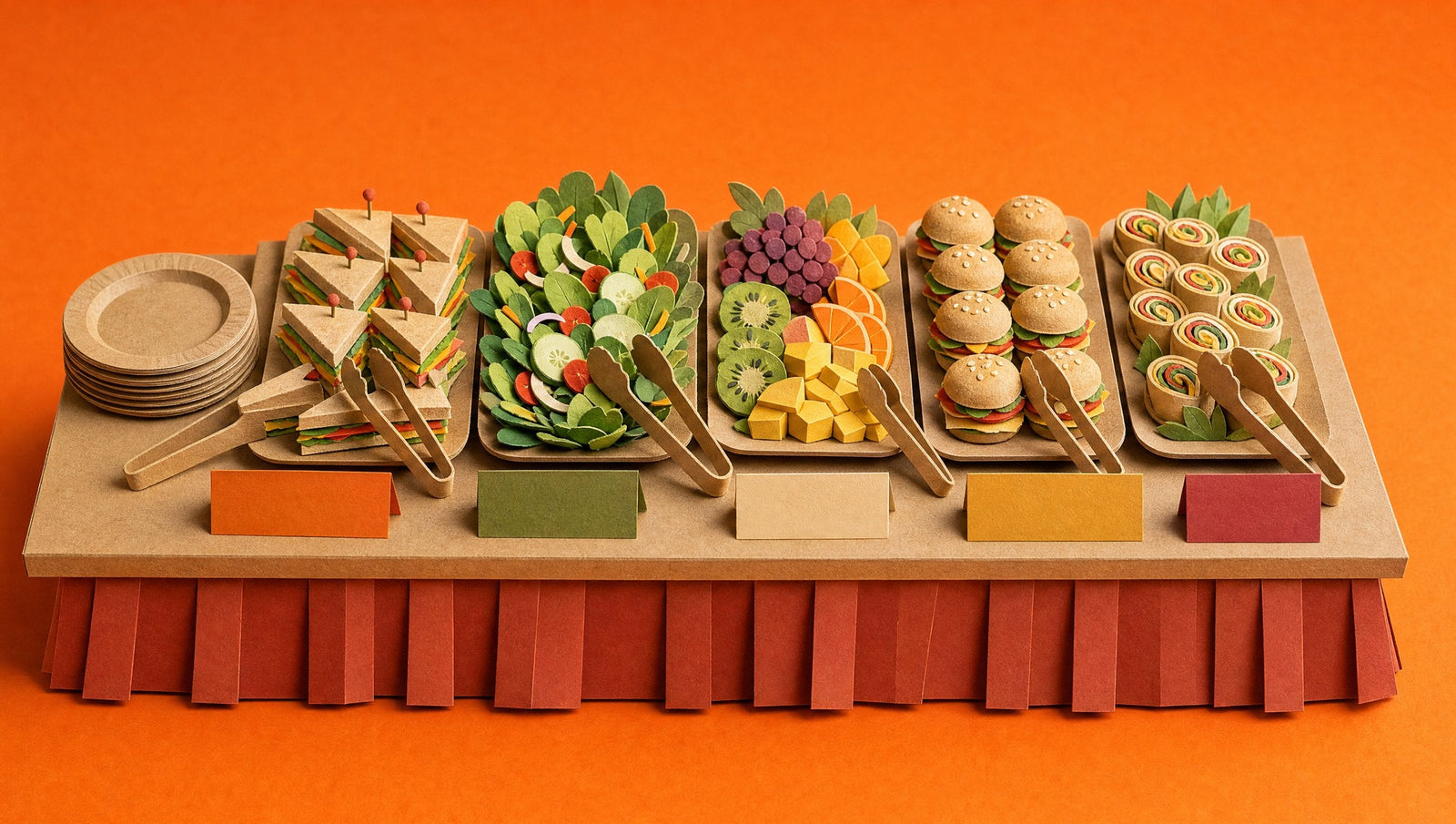
Platters are what drop-off catering is made of. A platter is a menu that does not require a decision from every guest: it goes down on the table, people take what suits them, and nobody has to announce anything about themselves in front of colleagues in order to get lunch. It also works standing up, which matters more than any menu choice. Every platter item is designed for one hand, no plate and no cutlery, so a room that has thirty people and twelve chairs keeps talking instead of queueing.
The other reason to order platters is that variety is cheaper than volume. Four different platters for forty people will be eaten more evenly, and more completely, than two large ones of the same thing. People graze across a spread and stop at a pile. If you are choosing between a bigger meat platter and adding a fruit platter, add the fruit.
Here is what each of the common platters is for, what goes on it, and what it does after two hours on a table, which is the part nobody mentions when you order.
1. Meat platter


The meat platter is the one people photograph, and at an evening function it is the one that empties first. It is also sold as a grazing platter, which is the same idea spread wider: deli meats, cured meats, jerky, ham, sliced chicken and sausage, and then whatever else earns its place beside them. Load it up into a gourmet board and it gains marinated vegetables, leaves, tomatoes, a cheese dip or a mayonnaise spread, and nuts.
Two things about meat platters are worth knowing before you order one. The first is that sliced meat laid out flat dries and curls at the cut edge within about half an hour, while the same slice rolled or folded holds its colour for the length of a party. That is the entire reason a good grazing board still looks alive at nine o'clock, and it is not a garnish trick, it is surface area.
The second is that cured meat is the most forgiving thing you can put in front of a room. Salami, prosciutto and jerky were preserved for a reason and sit happily at room temperature for hours. It is the cooked chicken and anything bound with mayonnaise that sets the clock on the platter, so on our boards those go on last and are the first thing we would take off if the food is going to sit.
Keep anything in brine in its own cup. Olives, cornichons and marinated artichokes wet everything they touch, and twenty minutes of contact is enough to turn a crisp breadstick soft and a cracker bendy. Nuts have the same problem for a different reason: Brisbane air is wet enough that a bowl of nuts loses its crunch across a long afternoon, so they are better added when the platter goes down than when it is packed.
Order a meat platter as a graze rather than as the meal. An antipasto board in front of people for an hour before dinner will empty. The same board asked to be lunch leaves everyone politely still hungry, and that is a quantity mistake rather than a menu one.
2. Dips platter


Platter dips are the cheapest way to make everything else on the table taste of more. A board of cut vegetables with nothing to put them in is a raw vegetable board, and it comes back to us half full. The same vegetables with two good dips come back empty.
Two dips is enough and three is generous. Past that people stop trying them and settle on the one they recognise, so a fourth dip is money spent on decoration. If you want a healthier board, an avocado dip, a tahini and yoghurt dip or something built on beans does the job. If you want the room to eat without thinking about it, a lemon and parmesan dip, a honey mustard or a plain ranch will go faster.
How long the dips hold up
Anything thick skins over. Hummus and beetroot dip dull on the surface within about half an hour uncovered and stop looking like food, which is a presentation problem rather than a safety one; a stir with the back of a spoon brings the whole pot straight back. Avocado is the real deadline. A guacamole or an avocado dip has roughly an hour of looking the way it did in the kitchen, so it goes out last and it goes out from a covered pot.
Never stand the batons in the dip to make it look full. Cut vegetables wick, and a carrot left upright in hummus for twenty minutes goes soft exactly where it sits. Dips beside the vegetables, not underneath them.
There is also a reason a crudites platter is mostly carrot, celery and something crisp rather than a rainbow of everything in the fridge. Carrot and celery survive being cut hours before they are eaten. Cucumber weeps, capsicum sweats, and both leave a wet patch that the drier vegetables sit in. Keep the tray covered until people are actually in the room, because twenty minutes of open air is visible on a cut carrot as a pale chalky edge.
Last thing: check the dips against the room rather than against the menu. A board of dairy-heavy dips is no use to a table that is half dairy free, and the guest who cannot eat it will not say so. Dietary requirements are marked in our product names for that reason, so you can see what a platter is before it arrives rather than after.
3. Cheese and crackers platter


A cheese platter with crackers is the one board that works at both ends of a meal. It opens a casual lunch and it closes a long dinner, sitting between the main course and dessert, and in both positions it does the same job: it gives people a reason to stay at the table. A good one carries a spread of textures rather than a spread of names, so something creamy, something firm, something crumbly, and if the room is adventurous, something blue or smoked.
Cheese needs time out of the fridge
Cheese is stored cold and eaten warm, and the gap between those two facts is where most cheese boards are lost. Straight out of the fridge, the fat is still set and the aroma has not opened, so an expensive cheese tastes of very little. Thirty to forty-five minutes out of the fridge is the difference between a board people talk about and a board they walk past.
Brisbane puts a ceiling on that advice. A soft cheese left out for two hours in an unairconditioned room in February will not sit up on the board, it will spread across it. Hard cheese and soft cheese fail in opposite directions in this climate, which is why a summer board is better weighted towards cheddar, gouda and something aged than towards a big wheel of brie.
Crackers are the part that actually fails. They pull moisture straight out of the air, and a cracker resting against cut fruit or a soft cheese goes bendy in about twenty minutes. They belong beside the board rather than on it, and they are best tipped out when the guests walk in rather than when the platter is set down. If you are collecting a cheese platter and driving it somewhere, keep the crackers in their bag until you arrive.
Cut into it before it goes out. A whole wedge with a knife lying next to it will stall a queue, because nobody wants to be the person who cuts it badly in front of the room. A few slices already off the block and the board disappears. The same is true of grapes: break the bunch into small clusters, or one person takes the lot because there is no polite way to remove three.
Cheese is also the platter people over-order most often. It is rich, and a room eats far less of it per head than it eats of fruit or sandwiches. If the budget is fixed, a smaller cheese board and a second platter of something else will feed more people than a very large cheese board on its own.
4. Fruit platter


Fruits are the easiest thing on any table to put down and the hardest to keep looking the way it left the kitchen. A seasonal platter carries whatever is genuinely in season, which in a Brisbane summer means melon, mango, pineapple, stone fruit, strawberries and grapes, and in the middle of winter means citrus, grapes and melon. Ordering summer berries in July is possible and it is expensive, and they will be a long way from where they grew.
Why melon needs its own side
Melon is the engineering problem. Watermelon and rockmelon keep releasing juice for hours after they are cut, and by the second hour a flat tray has a pool at the low corner that softens the berries and drowns everything sitting in it. On our trays the melon goes on its own side and the berries sit high and dry, which is not styling, it is drainage.
Pineapple is the loudest fruit on a board. Its acid travels into whatever is beside it, so it keeps to its own block rather than being scattered through for colour. Apple, pear and banana are missing from nearly every catering fruit platter and that is not an oversight; they brown within minutes of meeting a knife, and no amount of lemon juice makes them presentable three hours later.
Cut fruit has roughly four hours before it stops looking like it was cut this morning, even while it is still completely fine to eat. That is the window worth planning around. Fruit platters photograph well in the first hour for a reason, and if the food is going to sit through a long conference session, the fruit is the platter to put out for the second break rather than the first.
It is also the platter that behaves differently depending on the room. In a hot room a fruit platter empties before anything else on the table. In a cold room in July it can come back nearly full while the sandwiches are gone, which is worth knowing before you order two of them for a winter morning tea.
The strongest argument for a fruit platter has nothing to do with taste. It is the only board that is automatically vegan, dairy free, gluten free and nut free, so it is the one thing in the room that every single guest can eat without asking a question first. When a function comes with a long list of dietary requirements attached, fruit is the platter we would add before any other.
5. Sandwich platter


The corporate sandwich platters are the least exciting order on any catering menu and the one that never fails. An assortment of breads and fillings will feed a large group with different tastes, some of it meat, some of it vegetarian, most of it both across the platter, and nobody has ever left a meeting complaining that there were sandwiches.
Two numbers do most of the work. Allow one and a half rounds a head for a working lunch, and one a head if the sandwiches sit alongside something else. Then order about a third more of the vegetarian than the room appears to need, because everybody eats the vegetarian, not only the vegetarians, and it is always the first tray to go.
A sandwich platter holds or fails on the build, not on the recipe. Spread to the edges seals the bread against the wet ingredients. Anything juicy sits in the middle away from the crust, and the leaves go in dry. Built that way a platter is as good at two in the afternoon as it was at ten in the morning; built carelessly it is soggy at the corners by eleven.
Keep the cover on until people are in the room. Bread at the outer edge of an open platter dries first, so the untouched corner is the part that looks tired even though nobody has been near it. And do not put a sandwich platter in the fridge unless the fillings force you to, because bread stales fastest at fridge temperature, which is the opposite of what everyone assumes.
If the room is bigger than about twenty people, ask for the dietary halves to be marked. An unlabelled platter means the gluten free guest quietly does not risk any of it, which is the same outcome as not catering for them at all.
Three things to tell the kitchen

Ordering a mixed platter spread is mostly a matter of telling the kitchen three things. Say when the food will be eaten rather than when you would like it delivered, because those are different problems and only one of them is ours to solve. Say what the room is doing, because a seated lunch and a standing function want different platters. And say how many people, honestly, including the ones who always turn up.
The rest is timing. Order by 4pm and it arrives the next day, with no surcharge for leaving it late, because a late order is a normal order here rather than a favour. Delivery starts at $19 on orders over $150 and reaches more than 50 Brisbane suburbs, Saturday at the same rate as any weekday. If it suits you better to collect, pick-up runs from 7am at 159 Knapp St, Fortitude Valley, and a boot full of platters is a perfectly ordinary sight in that car park at half past seven. The one thing that cannot be rushed is a decorated cake or decorated cupcakes, which need two to three business days, so if a cake is part of the event it is the item to book first and the platters second.
Choosing between the platter varieties is easier once you stop thinking about the food and start thinking about the shape of the event. Meat and dips for a room that is standing and talking. Cheese for a table people should stay at. Fruit for a long day, a hot room or a guest list with requirements. Sandwiches whenever the day is not about the food at all. Get that right and the catering is invisible, which is the entire point of it.

Leave a comment
Comments will be approved before showing up.