Yummy Staff Lunch Ideas That Won't Break The bank


A staff lunch is a small logistics problem that turns up every week and never gets a bigger budget. The food has to feed everybody, survive the trip, sit through a meeting that runs fifteen minutes over, and still be worth eating at half past one.
We have been sending working lunch orders out of our Fortitude Valley kitchen since 2005, mostly to the same offices over and over, which means we get to see what comes back on the tray. The pattern barely changes. Food gets left when it was ordered for the wrong number, when it needed to be hot and was not, or when it was the fourth week running of the same thing.

Cost per head is rarely what breaks a staff lunch budget. Waste is. Thirty invited people reliably feed about twenty-five, because someone is out, someone is on a call and someone brought their own. Order for the number who will be in the room rather than the number on the invitation and the same money buys noticeably better food.
The second lever is temperature, and it costs nothing at all. Food built to be eaten at room temperature holds for hours. Food that has to be hot has roughly twenty minutes from the moment it is put down, and an office kitchen with one microwave will not rescue it. If lunch is at half past twelve and the delivery run reaches you at eleven, order the things that do not care.
The third is variety inside one order rather than variety week to week. A single tray of one thing has to please the whole room. Three smaller trays of different things only have to please a third of it each, and the spend goes further because far less comes back.
Below are eight lunches we send out as Brisbane corporate catering most weeks of the year, and what each one is actually good at. None of them is expensive. Two of them cost less a head than the coffee run that follows.
1. A mix of salads

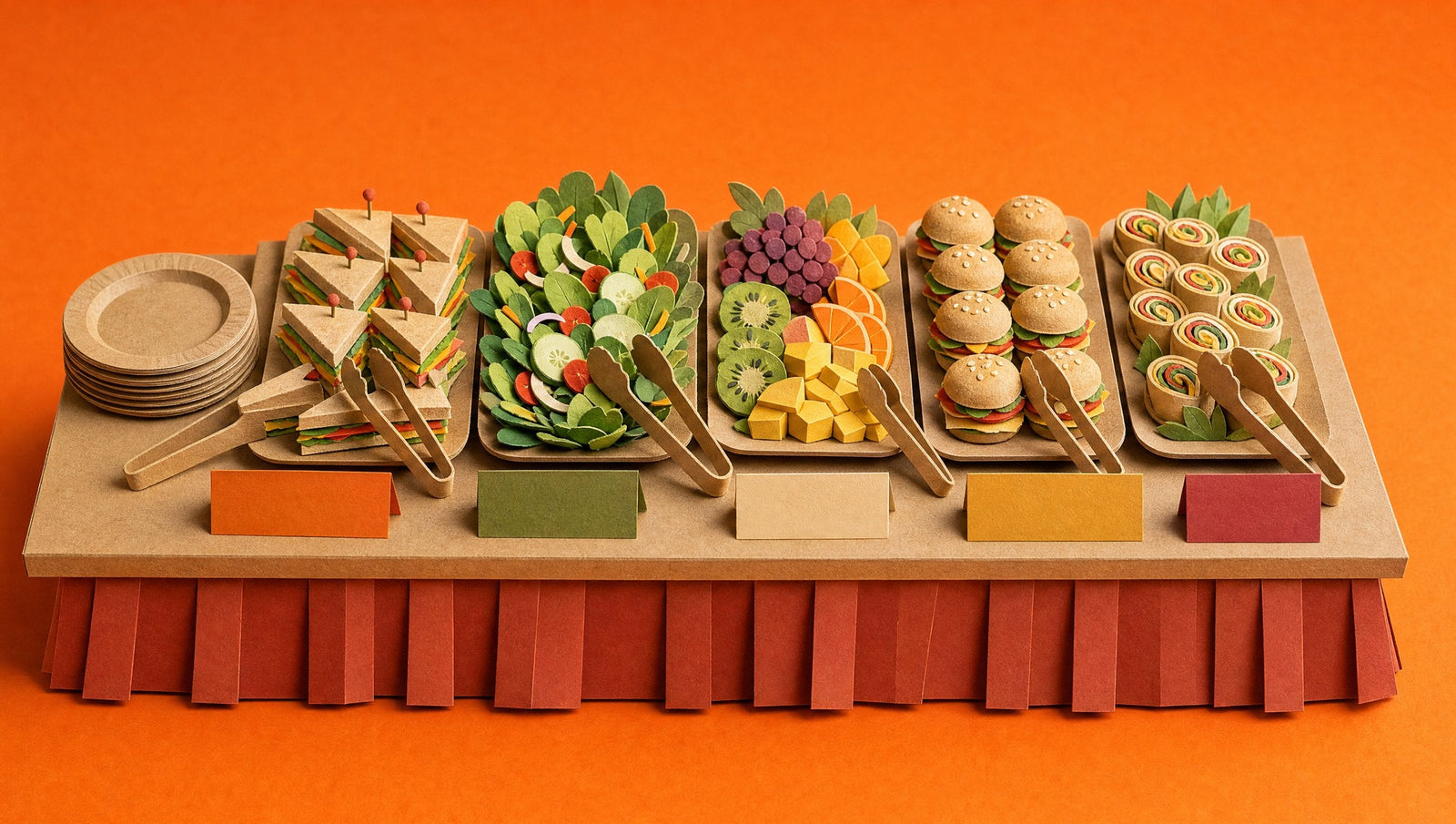
Salad is the cheapest way to make a lunch look generous and the easiest thing on this list to get wrong. The usual mistake is one large leaf salad for the whole room. Leaves are mostly water and they collapse as soon as dressing reaches them. A dressed leaf salad has about thirty minutes before the bottom third of the bowl turns to soup, and it is always the bottom third, which is why the last four people to serve themselves get the worst of it.
Order three smaller salads instead and make only one of them leaves. Roast pumpkin, couscous, pasta and potato salads are built on something structural rather than something that wilts, so they sit happily from ten in the morning until two in the afternoon and taste better at noon than they did when they were made. The leaf salad goes out undressed with the dressing in a separate pot, and whoever sets the table tips it on at the last minute.
A salad is only a lunch if it has protein in it. Without chicken, beef, egg, chickpeas or feta somewhere on the table, the room is hungry again by three and the biscuits come out, which is how a cheap lunch quietly becomes an expensive one. One salad tub feeds about four people as a side and about two as the meal itself.
The last thing, and it sounds too small to mention until it happens to you: ask for serving tongs. Offices have teaspoons and nothing else. We have arrived to find a beautiful spread of salads being served with a stapler-adjacent piece of stationery more than once.
2. Gourmet party pies and sausage rolls

Party pies and sausage rolls are the most reliable thing we send to an office, and they are the item most often ruined between our oven and the table. Everything depends on what happens to the pastry in the hour after it leaves us.
Pastry has two good states and one bad one. Straight from the oven it has about twenty minutes of proper crackle. Fully cool, it is honest and perfectly good cold, which is how half of every tray gets eaten anyway. The bad state is the hour in between, when a hot tray with the lid on steams itself and the underside goes pale and damp. The fix takes two seconds: crack the lid on arrival and let the steam out rather than trapping it.
If you must reheat, use an oven at about 160 degrees for eight to ten minutes. A microwave turns puff pastry chewy and there is no coming back from it. Most offices have no oven at all, which is the real argument for ordering these to land close to the time people eat rather than first thing.
We make ours by hand in the Valley, in beef, lamb, chicken, and cheese and bacon, with spinach and feta and a broccoli and cauliflower one for the vegetarians. Allow two to three pieces a head when pies are part of a spread and four when they are the lunch. They are also the only item here that works equally well at seven in the morning and at four in the afternoon, which makes them the safe order when the meeting time keeps moving.
3. Gourmet sandwiches and wraps


Ordering sandwich trays is the least interesting decision on this page and the one that never fails. Nobody has walked out of a meeting complaining that there were sandwiches. The number to remember is one and a half rounds a head for a working lunch, and one a head when there is something else on the table.
Order about a third more vegetarian than you have vegetarians. Everyone eats the roasted vegetable and the egg, not only the people who need to, and a platter that runs out of them at ten past twelve leaves the two people who were relying on it with nothing. This is the single most common ordering error we see in corporate catering and it costs nothing to avoid.
A sandwich survives the morning because of how it is built, not how it is stored. Butter or spread goes right to the edges, which seals the bread against everything wet inside it. The tomato sits in the middle against the meat rather than against the crust. Beetroot never goes in white bread for catering, because it bleeds a pink line through the slice inside an hour and looks a day old by the time it reaches the table. It goes in a wrap, where it is contained.
Wraps travel better than sliced bread and hold longer, so they are the right call for a lunch that starts late or a delivery that has to sit. Fillings that work at midday are the plain ones: chicken breast, rare roast beef, smoked salmon, ham and cheese, roasted vegetables with hummus. Keep the paper on the tray until people are actually in the room. It is the only thing standing between a fresh platter and a dry one, and it takes a second to remove.
4. Banh mi and rice paper rolls - Vietnamese food

Vietnamese food solves the dietary problem better than anything else on this list, because the vegetarian and gluten free versions are not a compromise made for someone else. They are simply the other half of the menu.
Banh mi has one constraint and it is the bread. The crust cracks properly for about forty minutes after it is filled and then it softens into an ordinary, still very good, soft roll. So banh mi is the order for a lunch that starts on time and close to the delivery. If the meeting drifts, order rice paper rolls instead, because they are unaffected by an hour.
Rice paper rolls have one rule that matters more than every other rule about them. Lay them in a single layer and never stack them. The wrappers stick to each other within minutes and then tear when anybody tries to separate them, and a torn roll is just a pile of noodles. They also dry out and go leathery if they sit uncovered in air conditioning, so leave them covered until the table is ready. The dipping sauce always travels separately, for the same reason the salad dressing does.
Both are naturally light, which matters for a lunch that is followed by an afternoon of work rather than an afternoon off. And the rolls are gluten free by construction, with the only exception being what is in the dipping sauce, so check that before telling anyone they are safe.
5. Sliders Buns
Sliders are miniature burgers, and they are the most requested item on this list and the one that most often arrives disappointing. The reason is steam. A hot patty inside a closed bun in a covered tray cooks the bread from the inside for the whole trip, and what arrives is a damp bun holding a warm patty.
There are two ways around it. The first is to send them cold on purpose, with roast beef, chicken and slaw, or ham and cheese, where nothing is trying to release heat into the bread. The second is to build them so the wet things are kept off the bread: sauce on the top half only, pickles and onion stacked between the patty and the sauce, the cheese acting as a lid over anything juicy. Done that way a slider holds up for an hour on a table.
Two a head is the right number. They read as more substantial than a sandwich half, so people take fewer than you expect, and they photograph well enough that they are worth ordering for the lunches where someone from head office is visiting. They also suit a mixed room. A slider is a familiar thing, which is exactly what you want when the lunch is for a team rather than a client.
6. Sushi

Sushi feeds a crowd well and comes with the one instruction almost every office gets wrong: do not put it in the fridge. Cold hardens the rice and turns it dry and chalky within an hour or two, and it does not recover when it warms back up. Sushi wants a cool room, not a cold one, and it wants to be eaten the day it is made.
That makes it the lunch for a meeting with a firm start time. Sushi delivered at eight for a one o'clock workshop has spent five hours doing nothing good. Sushi delivered at half eleven for a twelve o'clock lunch is exactly what everyone was hoping for.
Count on eight to ten pieces a head if sushi is the meal and four if it sits alongside sandwiches or salad. Say your vegetarian number when you order, because a standard mixed tray runs about two-thirds seafood and the avocado and cucumber pieces disappear in the first minute otherwise. Soy and ginger travel in their own containers, and the tray should be set down whole rather than divided up, since half a sushi tray always looks like leftovers.
7. Mexican food

Mexican is the most comforting thing you can put in front of a room at half past twelve, and the only one on this list that has to be sent in pieces. Corn chips sitting in salsa have about twenty minutes before they give up entirely, and nothing that has been softened by sauce comes back. So the chips travel in one tray, the salsa in a pot, the sour cream in another, and whoever is serving assembles their own plate in ten seconds.
Guacamole browns on the surface within an hour of being made. It is only the top few millimetres and it is harmless, but a bowl that has been sitting open looks tired, so press it flat and cover it, and give it a stir before it goes out. Nobody will notice it happened.
Over-order the rice and the beans and under-order the meat. Both are cheaper, both fill people up, and a Mexican spread that runs out of the base runs out completely. Label the hot salsa, or say which one it is when you put it down. If people cannot tell which of the three red bowls is the dangerous one, most of them will avoid all three, and you will have paid for salsa nobody ate.
8. Poke bowl

A poke bowl is the lunch that leaves people alert instead of heavy, and it is designed to be assembled at the last possible moment. Rice at room temperature, protein cold, dressing on at the end, avocado sliced late because it browns.
For a group, send it as a build-your-own bar rather than as finished bowls: rice in one tray, salmon or tuna or chicken in another, then edamame, cucumber, shredded carrot, pickled ginger, sesame and the dressings alongside. It costs less a head than plating individual bowls, nothing sits in dressing while it waits, and the dietary problem solves itself, because the vegetarian, the gluten free colleague and the person avoiding raw fish all build their own without anybody having to place a second order.
One warning. Raw fish is the one item where the delivery time is not negotiable, so if the day is likely to move, take the cooked chicken or the tofu option and keep everything else the same. The bowl is just as good and the risk disappears.
The thread running through all eight is the same. The lunches that work are the ones that are indifferent to a room running late, and the ones that fail are almost never the wrong food. They are the right food arriving three hours before anybody eats it.
So when you order, give the time the food gets eaten rather than the time you would like it delivered. Those are two different problems and only one of them is ours to solve. Tell us the real head count instead of the invitation list, ask for the dietary items to be marked if the room is bigger than about twenty, and put the salads, sauces and dressings on the table separately from whatever they are meant to end up on.
Our ordering works the way an office needs it to. Order by 4pm for delivery the next day, with no surcharge for leaving it late. Delivery starts at $19 on orders over $150, across more than 50 Brisbane suburbs, and Saturday is the same rate as a weekday. Pick-up is from 7am at 159 Knapp St in Fortitude Valley if you would rather collect on the way in. Dietary requirements are marked in the product names, so a vegetarian or gluten free item can be found without ringing anyone.
Everything above is made by hand in that kitchen, on the morning it goes out. Feeding your team well every week is not a matter of spending more. It is a matter of ordering for the number of people who will be there, choosing food that is not fighting the clock, and letting the room build its own plate.

2 Responses

Leave a comment
Comments will be approved before showing up.



tenzin yangchen tara
March 26, 2025
little budget simple veggies would be nice