Top 10 Catering Trends Shaping Events in 2026


A catering trend list is usually written by someone who has never loaded a van at half past five in the morning. This is the version from the delivery end: which of the 2026 trends actually change what lands on the table, and which ones are only language.
We have been doing catering out of Fortitude Valley since 2005, and the pattern rarely varies. A trend reaches Brisbane a year or two after it reaches a magazine, and it survives here only if it can sit on a boardroom table for three hours in February without going wrong. That is the test we have put all ten through.
Key Takeaways
- Eco-conscious catering has stopped being a talking point and become the packaging. Kraft boxes and moulded sugarcane trays are the default now, and because they breathe rather than seal, they change what can safely be sent and how long it holds.
- Inclusive menus are the biggest real change of the last decade. In a room of forty there are now usually six to eight genuine dietary requirements, so gluten free, dairy free and plant-based have to be part of the main order rather than an afterthought.
- Technology has helped most in the unglamorous places: ordering, allergen labelling, delivery windows. It has changed almost nothing about how the food itself gets made.
Embracing Eco-Conscious Catering
Local sourcing and seasonal menus sound like a philosophy. In a kitchen they are a roster. It means the fruit on a platter changes four times a year, mango turns up for about ten weeks and then stops, and in July the berries are strawberries because Queensland grows them well in winter and everything else has been flown a long way.
Zero waste is the other half, and the largest source of waste at an event is not the kitchen. It is the host who ordered for fifty because fifty said yes. Sixty to seventy per cent of a room eats at a morning tea; nearly all of them eat at a lunch. Order to the meal, not to the invitation list, and you will throw out almost nothing.

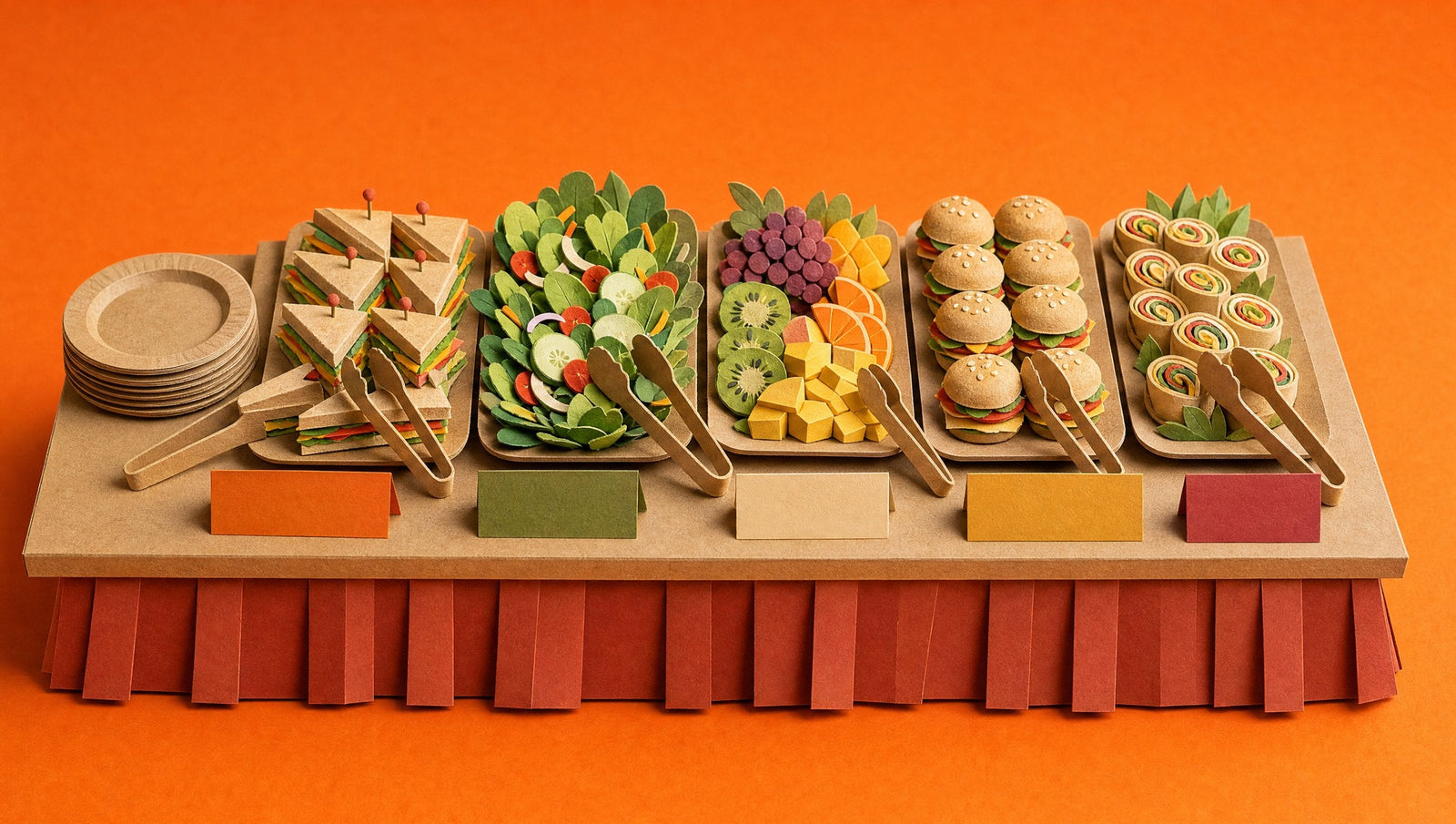
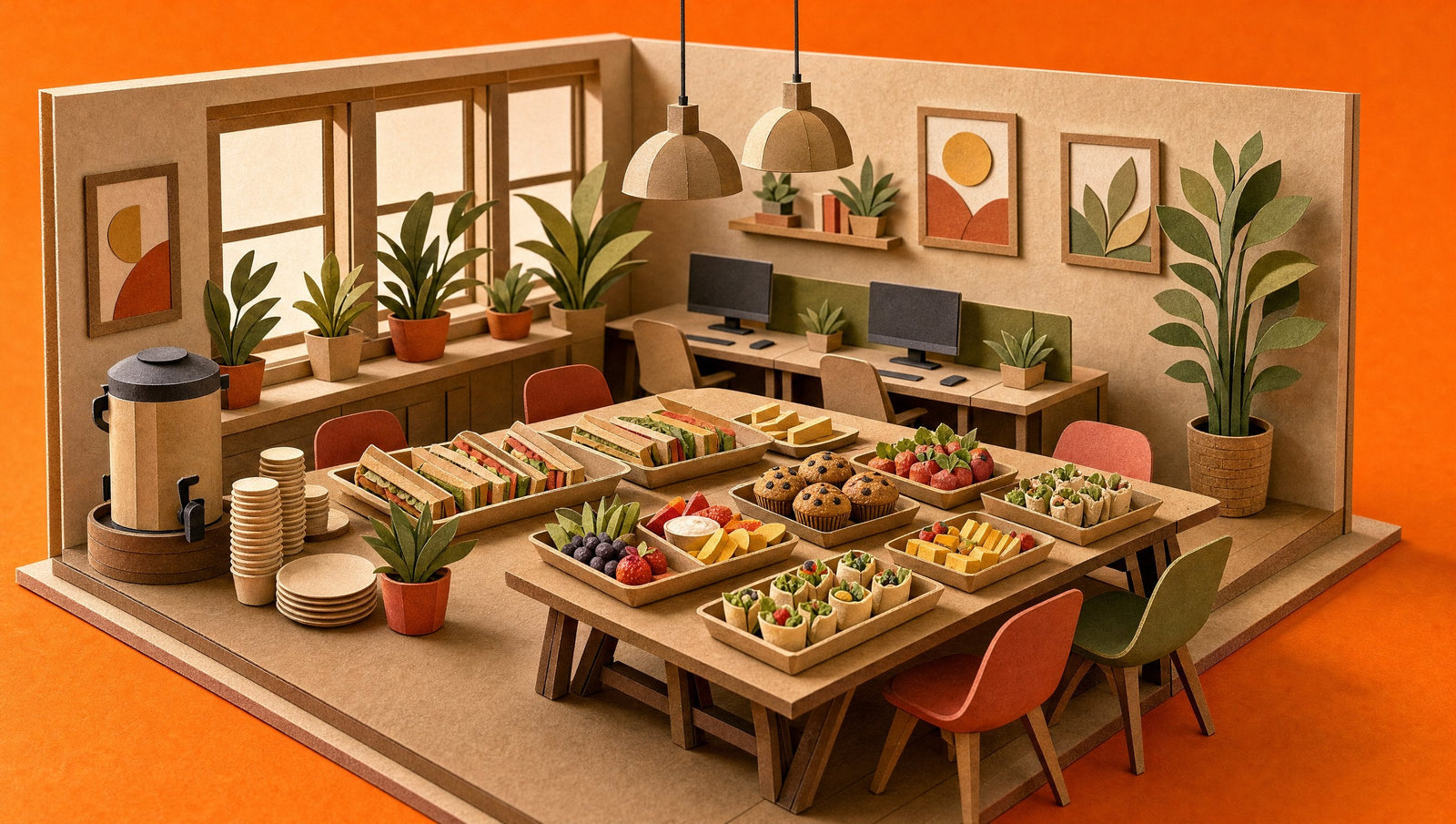
Packaging is where the shift is easiest to see. Brown kraft boxes and sugarcane fibre platters have replaced plastic on drop-off deliveries, and they behave differently. Cardboard breathes. Plastic does not, so anything sealed in it for four hours sweats and the bread goes damp underneath. Kraft costs a little more and delivers food in better condition, which is the rare case of the sustainable choice also being the correct one.
Edible cutlery appears on every trend list and almost never on a table. The version that works is duller and older: order food that does not need cutlery at all.
All-Inclusive Menus for Diverse Diets
Dietary requirements used to arrive as an apology at the end of a phone call. Now they come with the order, and the menu has to be built around them rather than patched afterwards. The four that make up nearly every request we take:
- gluten-free
- dairy-free
- nut-free
- plant-based
The work is less about recipes than about sequence. Gluten free sandwiches are made first, on a cleaned bench, before a single loaf of ordinary bread is opened, because flour travels further around a kitchen than anyone expects.

Labelling matters as much as making. An unmarked platter means the coeliac guest quietly eats nothing and says nothing about it, so our dietary options carry their icons in the product name and go out marked. It costs nothing and it is the difference between a menu that includes people and one that only claims to.
Digital guest management platforms such as RSVPify collect requirements with the invitation rather than the week of the event, which is the whole trick. A requirement known ten days out is a menu decision. The same one mentioned on the morning is a problem, and usually a smaller lunch for somebody.
One practical number: order about a third more of the vegetarian than the count suggests. Everybody eats it, not only the vegetarians.
The Rise of Technology in Catering Services
The useful technology in catering is boring. Online ordering that shows real availability, a delivery system that knows which suburbs the van reaches at which hour, and stock counts that tell a baker on Tuesday afternoon what Wednesday needs. None of it is impressive and all of it is the reason an order placed by 4pm arrives the next day with no last-minute surcharge.

AI and data analysis get the headlines, and in practice they do the forecasting. Knowing which week of November is the heaviest of the year is worth more than a menu written by a machine.
Augmented and virtual reality dining keeps appearing on these lists. We have never once been asked for it.
Virtual catering is the exception, and it is real because hybrid work is real. Individual boxes sent to home addresses so a scattered team eats the same thing at the same time is a genuinely new order type.
Global Cuisines Take Center Stage
Vietnamese banh mi, bao buns, Indian-spiced fillings and Mediterranean platters have moved from the interesting option to the default one on a Brisbane corporate order. The city's makeup did that long before any trend report noticed.
The catering constraint is timing rather than taste. A banh mi has to be built late, because pickled carrot and daikon are wet and a baguette dressed at six in the morning for a midday meeting is a different sandwich by the time it arrives. Rice paper rolls go out in a single layer and never stacked; the wrappers glue themselves to each other within minutes.
The other lesson is that fusion fails when it needs explaining. A platter people can identify at a glance gets eaten; anything a guest has to ask about at a table of colleagues tends to go home again.
Health-Focused Offerings Gain Popularity
Health-focused catering, in an office at ten in the morning, mostly means these:
- Functional fungi
- Fresh ingredients
- More greens on plates
- Fermented foods like kombucha
Two things go wrong with all of it, and both are about water. Dressed leaves collapse in about half an hour, so salad travels dry with the dressing on the side and gets tossed in the room. Cut melon weeps, so it goes on its own tray rather than next to berries, which otherwise arrive sitting in juice.
The rest is information. Dishes labeled with dietary catering details let people choose properly instead of guessing, and a guest who can see what is in something eats more of it than a guest who cannot.
Interactive Dining Experiences Steal the Spotlight
Build-your-own stations and interactive buffets are genuinely popular and genuinely underplanned. The failure is always the queue. One long station holds up a room of forty for the entire break; two shorter identical ones move the same people in half the time, and the food gets eaten while it is still what it was meant to be.

Anything hot on an open station has about twenty minutes before it becomes a lesser version of itself, so it goes out in waves. Cold components hold, which is why the best interactive tables are mostly cold with one hot thing replenished.
Presentation earns its place in the first ninety seconds. That is when the photo is taken and when people decide whether to start, and a tray arranged in rows by filling gets picked over evenly instead of demolished at one end. Tabletop projections and the rest of the theatre suit events where the food is the entertainment. At a working lunch they are furniture.
Customized Catering Solutions for Unique Events
Customisation is where catering has moved furthest, and the useful kind is specific:
- Menus built around the dietary and cultural mix of the actual room, not a standard package
- Traditional dishes checked with the people whose food it is, rather than approximated
- A kitchen you can talk to, so a change to the fruit or the bread reaches the person making it
That last one is the whole advantage of a small kitchen. Everything is made by hand at Knapp Street, so a request reaches a baker rather than a system.
Mobile carts, gelato and baristas are normal at larger events now, and so are novelty desserts such as branded cakes/cupcakes carrying a company mark. They need lead time: decorated cakes and cupcakes take two to three business days, and a logo needs a clean image file rather than one pulled off a website. Order those first and the rest, from corporate meetings to social gatherings, can be settled later in the week.
Farm-to-Table: A Fresh Approach
Farm-to-table means a shorter distance between the grower and the bench, and it shows up in flavour before anything else. It also means accepting that the menu is not identical in January and July.
What it delivers:
- Environmental sustainability: fewer food miles, and produce that has not been held in transit to survive them.
- Economic benefit: money that stays with local growers and suppliers rather than leaving the state.
- Less waste: in-season produce arrives ripe and gets used, instead of half a case going soft in a cool room.
The honest test of a caterer claiming it is simple. Ask what is on the fruit platter this month, and then ask what was on it three months ago. If the answer is the same both times, the produce is coming from a long way away.
Alternative Food and Beverage Options on the Rise
Plant proteins have quietly stopped being alternative. Chickpea, edamame, oats and lentils turn up in ordinary sandwiches and salads now, ordered by people who are not vegetarian and have not thought about it, which is the surest sign a trend has finished being one.
On the drinks side, three things have changed:
- Milk alternatives are no longer a special request. Oat, almond and coconut are expected, and oat is the one that runs out first.
- Alcohol-free cocktails have become a real category rather than juice in a nicer glass.
- Ingredients like aquafaba have moved into everyday use, mostly because they solve a texture problem rather than because anyone asked for them.
One rule covers all of it. The non-alcoholic and dairy-free options have to be served exactly like everything else, in the same cups and on the same table. The moment they are set apart, the people who need them take less than they want.
Forward-Thinking Strategies for Future Catering Success
The forecasts all point at automation, and some of it will arrive. Ordering, routing and forecasting are already partly automated and will get more so, because they are repeatable problems.

The food is not a repeatable problem. Bread is soft, inconsistent and different every day depending on the humidity, which is why sandwiches are still assembled by hand here and will be for a long while yet. Anyone promising a robot line for catering has not tried to get a machine to butter a slice to the edges without tearing it.
The trend worth planning around is duller and much closer. Hybrid work has moved the office week to Tuesday, Wednesday and Thursday, and catering has moved with it. Those three days are heavier than they have ever been, Monday and Friday are quiet, and anything ordered late for a midweek date competes with every other office in the city. Adaptability, in practice, means booking earlier for the middle of the week.
Summary
Strip the language out of the 2026 list and the trends that hold up are the ones that change the food itself. Packaging that breathes. Menus built for everybody in the room from the start. Global flavours, timed properly. Seasonal produce, accepted with its inconvenience. Stations planned around the queue rather than the photograph.
The rest is worth watching and not worth paying for yet. Ordering by 4pm still gets food here the next day, delivery starts at $19 on orders over $150 across more than 50 Brisbane suburbs, Saturday at the same rate, and pick-up runs from 7am at 159 Knapp St. None of that is a trend, which is rather the point of it.
Frequently Asked Questions
What are the food trends for 2026?
Multicultural, and increasingly hand-held. Vietnamese Banh Mi, Korean bulgogi, Italian pizza and Mexican burritos are moving fastest through corporate orders. What they share matters more than where they came from: all four can be eaten standing up, with one hand, without a plate.
What is eco-conscious catering?
Sourcing close to home, cooking to the season, and packaging in materials that break down. In practice it is kraft boxes and sugarcane trays instead of plastic, ordering to the number who will actually eat, and sending components separately so less of the food is beyond saving by the time it is served.
How are catering services accommodating diverse diets?
By building the gluten-free, dairy-free, nut-free and plant-based options into the main menu instead of adding them on request. The other half is process: those items are made first on a clean bench and labelled clearly, because an unmarked platter is the same as no option at all for the guest who needs it.
How is technology revolutionizing catering services?
Mostly around the food rather than in it. Online ordering with real cut-offs, allergen information attached to the product rather than buried in a note, delivery routing, and forecasting that gets the right amount baked. The immersive dining part is still, in Brisbane, mostly a story.
What is the farm-to-table approach in catering?
Buying from local growers and letting the season set the menu. It means better flavour and less waste, and it means the fruit platter in July is not the fruit platter in January. A caterer whose seasonal menu never changes is not running one.

2 Responses

Leave a comment
Comments will be approved before showing up.



sgtamilan
March 26, 2025
You’ve clearly gone the extra mile to ensure that every aspect is top-notch, and it’s truly appreciated. Your dedication to delivering quality work is admirable and inspiring.